Micromegas Returns: What Would He Say Today?
✍️ Author’s Note
Voltaire’s Micromegas remains one of the most delightful works of philosophical satire: giants from Sirius and Saturn who look at humanity and find our quarrels as small as the buzzing of ants. Satire can often teach us more than solemn philosophy. Voltaire’s giant travellers do not despise humanity — they simply see us in proportion. Revisiting the story in 2025, I imagine what Micromegas might think of our world — our pretensions, our endless nationalism, our technological obsessions, our capacity for both cruelty and creativity. This reflection is less about science fiction than about perspective: how to see ourselves as we truly are, without illusions, and perhaps laugh a little at our own pretensions.
“What would Micromegas think if he visited us today?”
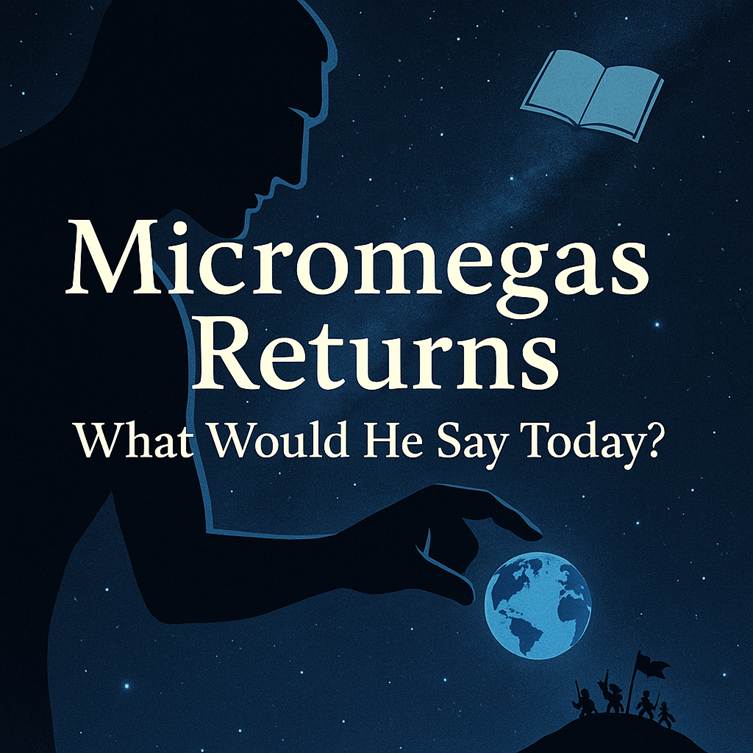
“I assert nothing, I content myself with believing that more is possible than people think.”
― Voltaire, Micromegas
Voltaire’s Micromegas has always delighted me: a cosmic fable in which beings from Sirius and Saturn, miles tall, descend to Earth and observe humanity with a mix of curiosity, amusement, and pity. To them, our quarrels, our dogmas, our sense of grandeur appear as little more than the buzzing of ants in dispute over a mound of dust.
It is, of course, a satire — but also a profound mirror. Voltaire reminds us how small and comic we appear when stripped of our self-importance and viewed from a higher perspective. What to us is history-shaping and world-shaking would, to Micromegas, seem pitifully small.
Now imagine him arriving in 2025. He would find us still arguing over borders, still brandishing weapons of mass destruction, still poisoning the very soil and seas that sustain us. He might chuckle at our belief in “progress,” noting how often it is just folly dressed in new clothes. Our debates about artificial intelligence, our fears of climate anxiety, resurgent nationalism — to him, these would be familiar echoes of the same human condition Voltaire ridiculed in the 18th century.
And yet, perhaps he would not despair. For Micromegas also recognizes that within these small beings lies imagination, art, tenderness, and the search for meaning. If ants can quarrel, they can also build. If humans can destroy, they can also create. Seen from Sirius, both our cruelty and our grace are exaggerated but inseparable parts of the same fragile whole.
The lesson of Micromegas is not to belittle humanity, but to humble it. To remind us that in the vastness of the universe, the only grandeur we can truly claim lies not in dominance, but in cooperation. The giants laugh at us not because we are small, but because we pretend to be so large.
So if you ask what Micromegas might say today, I suspect it would be this: You are not as important as you think, but you are more capable of goodness than you imagine. Choose wisely, for your little planet is all you have.
📝Epilogue: A Glass with Voltaire
Rereading Micromegas in 2025, with a glass of wine in hand, I was reminded how the Sirian spoke kindly to the little ants and promised to make them a beautiful book of philosophy, written in very small print, in which they would see the end of things.
The volume was delivered to Paris, opened by the Academy of Sciences, and found to be entirely blank. “Ah!” said the old secretary, “I suspected as much.”
Satire can often teach us more than solemn philosophy. Voltaire’s giant travellers do not despise humanity — they simply see us in proportion. Our quarrels, our pretensions, our endless search for certainty look small from Sirius, but so too do our moments of grace, tenderness, and imagination shine more brightly for their fragility.
Perhaps the blank book Micromegas leaves us is the truest principle of life: wisdom is not handed down but written by each generation, page by page. What matters is whether we fill those pages with cruelty or with dignity, with folly or with virtue. In the end, our greatness lies not in our size but in how we care for this tiny planet, the only stage on which our brief theatre of life can play.
📝Afterword: The Paradox of Easy Answers
In our age of instant responses, curated snippets, and clever machines, it is tempting to settle for the surface. AI, like satire, can sketch the outline of truth — but the danger lies in mistaking the sketch for the painting. Superficiality flatters us with speed; depth demands patience.
The paradox is that tools meant to enrich thought may also make us lazy, content with fragments where whole works are required. But wisdom never resides in shortcuts. It grows in the slow work of reading, reflection, and the willingness to wrestle with contradictions.
We must resist the comfort of easy answers. For in depth — in turning the page, in questioning, in revisiting old books — lies not only knowledge, but dignity.
“Doubt is not a pleasant condition, but certainty is absurd.”
— Voltaire
William J J Houtzager, Aka WJJH, November 2025
📌Blog Excerpt
Voltaire’s Micromegas reminds us how ridiculous our quarrels look when seen from the stars. To beings of cosmic scale, our wars and dogmas are no more than ants bickering over dust. And yet, within this fragility lies imagination, tenderness, and the search for meaning. The giants laugh not because we are small, but because we pretend to be so large.
“My soul is the mirror of the universe, and my body is its frame.” — Voltaire, Micromegas
 In what kind of world do we wish to live