PAX AMERICANA: Unleashing the Dogs of War
✍️ Author’s Note
This reflection from ‘Old Europe’ in March 2003 is a critique of the unilateral approach of the George W. Bush administration in the aftermath of 9/11 and the build-up to the Iraq War. By going to war in Iraq, the Bush administration opened the Pandora’s box of the Middle East, acting against the will of the majority of the international community. The Bush administration made costly mistakes, straining US–EU relations and causing shifts in US hegemonic power. They also ignored the consequences of climate change and caused foreseeable instability in the Middle East. The erosion of multilateralism shaped the geopolitical challenges of the following decades.
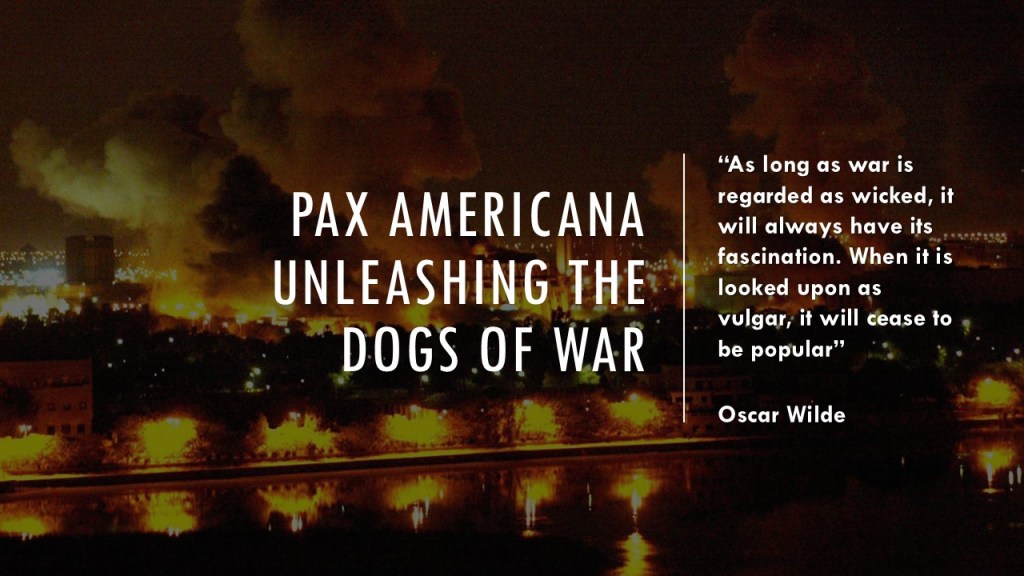
Oscar Wilde thought provoking statement about war, “As long as war is regarded as wicked, it will always have its fascination. When it is looked upon as vulgar, it will cease to be popular”, confirms the complex relationship between human fascination with conflict and our moral judgments.
As someone actively engaged on both sides of the Atlantic, I found myself labelled as part of the “weak-kneed European Elite” by the Bush administration, following the “Axis of evil” speech post the Gulf War. Like many Europeans, I opposed the unilateral approach of the United States towards Iraq, advocating for United Nations’ support and rejecting the Bush administration’s standalone stance.
Allow me to share my reflections on the prevailing situation. I firmly stand against the impending war with Iraq by the US, devoid of UN backing, deeming it unjust and illegal. War should only be considered as a last resort after exhausting all non-violent options. In the case of Iraq, viable alternatives to war exist.
However, Iraq merely represents a symptom. Since George W. Bush assumed the presidency, I have been deeply troubled by the seemingly “absolutist” direction taken by my American friends. George W. Bush, as a candidate, warned against arrogance, acknowledging that an arrogant nation breeds resentment. However, this sentiment seems to have been lost, with the majority of the world now resenting the President.
Under George W. Bush’s leadership, the US has shifted its global and foreign policy towards a strategy of domination as a national security approach. This unilateral approach reserves the right for the US to decide its enemies and dictate how they should be handled, challenging the post-war international framework. The National Security paper underscores America’s global power, emphasizing that no challenge to its primacy will be tolerated.
This shift towards military dominance is evident in the growing reliance on the military to manage world affairs. The administration’s dismissal of the UN as a preferred organization underscores this new system built on American Primacy, which must not be challenged. This departure from the instinctive internationalization of past administrations poses a threat to alliances and global partnerships.
Woodrow Wilson’s call for “force to the utmost, force without stint or limit” during WWI is echoed by the current administration, emphasizing total victory in war for unhindered political objectives. This alarming direction is a grave concern and may lead to the disintegration of alliances and partnerships.
The Bush administration’s argument that the United Nations becomes “irrelevant” without adhering to US demands is perplexing. The fundamental principle of the UN charter, advocating refraining from the threat or use of force, seems to be conveniently ignored.
The primary question for the Bush administration is whether its purpose in Iraq is limited to eliminating potential weapons of mass destruction or involves broader goals like regime change for control over Iraq’s oil and gas reserves. The fear is that this quest for power in the Middle East may extend to other nations in the name of democracy.
While the world agrees on Iraq’s untrustworthiness and Saddam’s tyranny, the preferred approach is for UN weapons inspectors to return and address Iraq’s weapons programs through a two-step approach.
It appears that the desire for war by the Bush administration is politically driven rather than based on logic and evidence. The administration seems set on ousting Saddam Hussein and establishing a new puppet regime, akin to historical precedents in Vietnam, irrespective of consequences, in pursuit of a “Pax Americana” in the region.
As the Bush administration attempts to establish a new democratic order in Iraq, it faces resistance from reluctant allies, notably led by the French Foreign Minister Dominique de Villepin, supported by China, Germany, Russia, and others. These allies represent the majority of the world’s views.
The administration’s attempts to coerce the UN with economic and financial pressure are concerning. Threatening the UN with insignificance if it doesn’t support the war ignores the UN as an expression of international will. Pursuing war with vague arguments may secure victory on the battlefield but jeopardizes America’s standing in the world.
The unilateral action by the Bush administration poses a fundamental problem as international agreements entered into by the US carry the force of law according to the US Constitution. Regime change not only violates international law but is also unconstitutional. This approach risks further destabilizing the already volatile Middle East, fostering terrorism, and undermining the global campaign against terrorism.
The consequences of invading Iraq are uncertain, with potential long-term implications. Ethnic and historical tensions in Iraq is like opening the Pandorra box and may result in prolonged chaos and conflict. President G.W. Bush’s plan to occupy Iraq, placing it under American military command, raises concerns about a post-war scenario similar to General MacArthur’s role in Japan after its surrender in 1945.
President Bush’s language, echoing that of Israel, underscores the perceived necessity of war due to Iraq’s refusal to disarm. This parallels the warnings of Prime Minister Ariel Sharon and sends a clear message to other Arab nations that support for terrorism will not be tolerated.
G.W. Bush asserted, “Rebuilding of Iraq will require a sustained commitment from many nations,” yet, “we will remain in Iraq as long as necessary and not a day more.” Strikingly reminiscent of Israel’s words during the 1982 invasion of Lebanon, where it took 22 years and numerous lives before the occupation ceased.
The U.S. occupation plan deliberately isolates the governing Kurdish people in the north, Shiite groups potentially tied with Iran, Sunni groups with potential ties to Saudi Arabia, and tribal factions. These groups, vital for stitching together a viable Iraq, are being sidelined in favour of establishing a new secular political system—a move contradicting the essence of national unity.
This occupation cannot obliterate religious and ethnic cleavages or eliminate long-standing political organizations. Iraq is not a homogeneous, secular, industrial society where all citizens share a common identity. Rather, it is a society deeply divided along religious, ethnic, and tribal lines.
The future stability of Iraq hinges on whether the U.S.-ignored groups can find a way to coexist within one country, under one political system, without the imposition of a U.S. dictator. As an agent of American power in the Middle East, this occupation poses a threat to its neighbour’s.
Rebuilding a nation while occupying it in the name of liberation is inherently arrogant. No one believes the Bush administration is entering to modernize or democratize Iraq. Ironically, successive U.S. administrations played a significant role in supporting regimes now deemed undemocratic or dictatorial.
Adding to the irony, the U.S., which now aims to eradicate Iraq’s bio-weapons program, supplied Iraq with its bio-weapon program in the 1980s. Congressional records indicate that the Centre’s for Disease Control and Prevention in the U.S. sent samples directly to Iraqi sites identified by UN inspectors as part of Saddam Hussein’s biological program.
But let’s be clear about it; the main objective of the Bush administration is the stability of the Middle East, thereby allowing the U.S. to take control of Iraq’s high-quality and easily extracted oil, thereby ending the Saudi domination of the international oil market. After all, the U.S., with 5% of the world population, is using 42% of the world’s energy sources.
The remarks from the Rand Corporation analyst, while briefing the Defence Policy Board on invading Saudi Arabia and further inflammatory remarks, place everything in perspective. It makes an occupation of Iran and Saudi Arabia most likely, thereby confirming the imperialist direction the U.S. administration is moving.
But what is really at issue is that relations between the allies, U.S. and Europe, have been deteriorating in the last two years in a massive way and are at the lowest since 1945. What is important to realize is that the vision of the U.S. has always been very positive in Europe, but the present change in the overall strategy of the U.S. makes it harder to see the present administration as a reasonable power.
There are constant differences that separate Europe from the U.S., whether in crime, education, welfare, regulation, foreign policy, and world governance. But it should be stressed that there is more that we have in common than divides us, but the approach and priorities of what we see as a civilized society as a whole are different.
It should also be stressed that this present widening of the strategic and conceptual gap between the U.S. and Europe is dangerous and, in the long term, can only be seen as a strategic threat to the U.S. It may even be likely that in the future Europe and Japan, which generally emphasize the international rule of law and multilateralism, will ally themselves with Russia if these differences with the U.S. continue to grow.
Another concern for the U.S. should be its budget dependence on European and Japanese investments. The European Union, with a population of 375 million and a GDP of approximately $10 trillion, has significant economic influence. These destructive “you are either with us, or against us” policies of the Bush administration have already caused and will continue to cause tremendous damage to the U.S. in the long term.
These policies find their origin in the influence of the ideological right in America on the present administration, the same civilian hawks who avoided military service in Vietnam and now call for war from a safe distance in their comfortable homes and blast the generals and anybody else who dares to caution for this kind of approach.
In this desire to go to war, Donald Rumsfeld is seemingly as certain in his misjudgement as was Robert McNamara when the U.S. plunged deep into the mire of Vietnam.
The core issue in American society is not just about Iraq but the debate between the unilateralists (radical and utopian) and the multilaterists (realistic). The unilateralists envision a U.S. imperium, favouring unilateral action based on perceived U.S. moral superiority, being aggressively anti-Europe and pro-Israel. Countries that are not in agreement with these high moral standards of the U.S. or a country that is seen as a danger to the strategic position of the U.S. are in this respect endangered species.
This imperialist approach, fuelled by overwhelming military power, contrasts with the intentions of the founding fathers. A core group of conservatives seems to be realizing long-held ambitions under the cover of the war on terrorism, almost reminiscent of McCarthy-era tactics.
It is almost as if McCarthy is coming out of the shadows; people are branded as unpatriotic when they dare oppose this war effort, individual rights are curtailed, and the harm being done to civil liberties. It is almost perverse; people have been held in jail indefinitely and it is being refused to tell who is held. There are military tribunals, secret arrests, and secret trials. The Bush administration has shown contempt for basic rights.
Benjamin Franklin said in 1755 to the Pennsylvania Convention: “They that can give up essential liberty to obtain a little temporary safety deserve neither liberty nor safety.”
On the other side of this ideological fight for the soul of America, which is fascinating, you have the multilateralists who accept that U.S. power and interests are best served in cooperation with others (State Department versus the Pentagon).
After the events of Sept 11, there was a spontaneous outpouring of support in Europe and everywhere around the world for the U.S. and the Americans; this window of opportunity has not been used by the Bush administration; it is now closed.
Forgotten was the State of the Union, the famous “Axis of Evil“ speech in which GW denounced Iraq, Iran, and North Korea, and the differences in perception of how the U.S. and Europe see the world became very clear. What further became clear was that the once-held common values of freedom and democracy become increasingly frayed.
As Al Gore recently remarked, “After Sept. 11 we had enormous sympathy, goodwill, and support around the world, we have squandered that, and in one year we’ve replaced that with fear, anxiety, and uncertainty, not at what the terrorists are going to do but what we are going to do”.
The serious question which we have to ask ourselves today is, has the once-held belief of a division between the West and the Rest been replaced by a division between the U.S. and the Rest.
These differences in perception between Europe and the United States are a reflection of different views of democracy legitimacy within Western civilization and revolved around American unilateralism and international law. International law which the U.S. has helped structure during the last 50 years and is now engaged in destroying.
A unilateral attack on Iraq will deepen the Anti-Americanism in Europe, Japan, and across the Muslim world, both in Asia and the Middle East, who are very much aware of the rhetoric declaring war on Islam, not just terrorism.
In Europe, the U.S. is getting the image of a rogue state; it is seen as the largest danger to world peace, attempting to destroy the institutions of international law that previous U.S. administrations have carefully built. This sentiment is growing with every assault on the jurisdiction of the International Criminal Court and every rejection of treaty-based responses to climate change or the unconditional U.S. support for Israel, which is seen as one of the largest factors contributing to these feelings.
In this regard, it must be concluded that the first 100 days of the Bush administration were a disaster. The differences appeared in a number of disputes, starting with the withdrawal from the Kyoto agreements, the Rio pact on biodiversity, the U.S. was removed from the Human Rights Commission, poverty and sustainable development, the withdrawal from the ABM treaty, jeopardizing the Korean Détente, the Middle East conflict supporting Sharon, as well as the pursuit of Missile Defence.
On May 9th, 2001, I observed, “after the crisis with China, we saw a President who lives in the past, a President who has no long-term view of the future, behaving like an Elephant in a China cabinet, supported by the old men in the administration, most of them men from the past, old men leftovers from the cold war policies. That it almost seemed that the U.S. needs enemies or a cause to fight. It lacks strategic direction and the world has changed greatly, and we in Europe are not satellite states of the U.S.”
Further intellectual differences between the U.S. and Europe exist in such issues as capital punishment, gun control, the opposition of the U.S. against a ban on landmines, and recently the treatment of prisoners at Guantanamo Bay, as well as the opposition of the U.S. to the ICC (International Criminal Court), leading to the Helms-Miller measure.
It is profoundly disturbing to most Europeans the change in policy as defined in the “National Security Strategy of the United States,” towards preventive war and pre-emptive strikes and its willingness to attack nations unilaterally even in the absence of a provocation. This is unacceptable together with the hostility and limited regard for international law and world opinion.
Now, Congress is authorizing the President of the United States of America without serious deliberation to use the forces of the U.S., whenever, whenever, and however he determines, and for as long as he determines if he can make somehow a connection with Iraq. As Senator Robert C. Byrd observed, “This broad resolution underwrites, promotes, and endorses the Bush doctrine of preventive war and pre-emptive strikes.” The conclusion can only be that this allows the Bush administration to unleash the dogs of war he has so much appetite for.
The clear statement of G.W. Bush at West Point was telling for the strategic change in the thinking of the Bush administration and their belief that U.S. domination of international society is a natural historic conclusion, “America is the only surviving model for human progress.”
The conclusion of some neo-conservative circles is that Europe and Japan are irrelevant and, as Robert Kagan wrote, “The all-important question of power – the efficacy of power, the morality of power, the desirability of power – American and European perspectives are diverging.”
This new strategy is already compared with the pan-German expansionism of Wilhelm II before 1914, unrealistic geopolitical ambitions, and a pre-emptive strategy for dealing with opponents.
He followed the so-called Schlieffen Plan to pre-emptively defeat Russia and attack France and created enemies faster than he could kill them. The same is presently being achieved by the Bush administration in the Muslim world. But like in ancient Rome, China, and the British Empire, military pre-eminence is not a prerequisite for national security.
The principle involved is where the ultimate source of liberal democratic legitimacy lies, whereby Europeans believe that democratic legitimacy flows from the international community and has preference over individual nation-states. In the case of Yugoslavia, this was a multilateral moral expression of the wills and norms of the international community.
In today’s modern diplomatic system, the justification and legitimacy of wars and national self-determination all find their basis in the principle of mutual recognition of national sovereignty, which is the constitutional basis of the
In today’s modern diplomatic system, the justification and legitimacy of wars and national self-determination find their basis in the principle of mutual recognition of national sovereignty, which constitutes the foundational concept of the United Nations.
The rationale behind the last Gulf War was grounded in international norms, specifically the fact that Iraq had invaded and annexed a sovereign state. Iraq played the role of the aggressor, and the subsequent military intervention was deemed an act of sovereign defence. Without such justification, UN backing and the coalition would not have materialized.
It must be asserted that in the absence of clear aggression by Iraq against the territory of another sovereign state, it is the United States that would undermine the entire international system. This system’s underlying consensus rests on mutual recognition of national sovereignty and initiating an attack without a justifiable cause threatens this fundamental principle. Domestic repression, as evident in the case of Iraq, does not provide a valid justification, and neither do the possession of weapons of mass destruction nor support for international terrorism. Directly attacking a sovereign state without a clear and present danger to one’s own sovereignty lacks legitimacy.
However, such concerns seem inconsequential to the present U.S. administration. By opting for a unilateral war against Iraq, the administration is failing in its responsibility to the American people and the global community. It is remarkable that the administration did not capitalize on the post-9/11 momentum when the world came together, missing the opportunity to reach a consensus on crucial matters that impact our long-term existence.
Similarly, the administration’s response to the historic Saudi peace proposal (Beirut Declaration) lacks coherence, demonstrating a lack of strategic planning. There has been a dearth of leadership or a balanced position in the Israeli/Palestinian conflict, with the administration continuing to align with Sharon, dubbing him “that man of peace.” The decision to isolate Arafat, while he might not be the desired moral leader for a new Palestinian state, underscores his status as the only legitimate voice of the Palestinians.
In my view, it is evident that isolating Arafat is not the solution; rather, it is Sharon who is perpetuating the consequences of his policies. The U.S. support for Israel’s offensive makes it morally responsible for the war atrocities occurring in the occupied territories.
The ongoing destabilization could have been averted with leadership from the Bush administration. The 35-year occupation of the Palestinian territories has evidently corrupted Israel, leading to the domination, expulsion, starvation, killing, and humiliation of Palestinians. This situation has invited destructive suicide attacks, resulting in the tragic loss of young lives in Israel. The house-to-house raids, sniper attacks, mass arrests, and executions evoke dark times in European history, constituting war crimes and crimes against humanity that cannot be ignored.
Examining Sharon’s history, especially his involvement in the events at Sabra and Shatila in 1982 reinforces the view that once again appears to be a stampede, leaving a path of destruction without a clear battle plan or exit strategy. It is an illusion to believe that the Israeli army can halt resistance against occupation through massive violence. The slogan “to root out terror” is a futile illusion; true victory can only be achieved through diplomatic negotiations.
The occupation of the West Bank and Gaza is no less a flagrant violation of the Security Council than Iraq’s actions, revealing the double standard of the U.S. administration. However, the momentum for change has dissipated, with NATO involvement in Afghanistan being unwelcome and rejected. We find ourselves in a position reminiscent of the pre-9/11 era, where the so-called war on terrorism dominates the international agenda in a seemingly paradoxical manner.
In Europe, where terrorism has been a part of life for decades—Germany, France, Northern Ireland, Spain—the perspective on 9/11 differs. Many view it as a unique event, and the likelihood of Bin Laden striking similarly is considered small due to preventive measures. I believe the administration is exploiting irrational fear to advance the conservative right agenda—a tactic reminiscent of Thatcher’s use of the Falkland’s War for re-election.
Repeatedly, what we witness boils down to the dichotomy of long-term versus short-term thinking, with the U.S. pursuing power and playing the role of the predator in a contemporary domino theory.
The Bush administration’s neo-conservative agenda focuses on Iraq, aiming to script the latest chapter in its turbulent history with Saddam Hussein. Iran appears to be the next target, and Afghanistan seems forgotten, echoing past patterns in U.S. policy. This lack of a long-term vision results in today’s allies becoming tomorrow’s enemies, as seen with Iran and Iraq, both countries previously supported by U.S. administrations.
The historical precedent of oil playing a decisive role repeats itself, such as in Iran in 1953 when President Mosaddeq’s government was ousted with CIA assistance due to disagreements over oil concessions. This eventually led to the rise and fall of the Shah, ending U.S. influence in Iran. The Reagan administration’s support for Iraq in the 1980s against Iran, along with overlooking the use of chemical weapons, further highlights this pattern.
Qualitatively, the U.S. lacks career diplomats as ambassadors, relying on individuals with ties to the President and business backgrounds. The Gulf War might have been avoidable with a skilled diplomat conveying the unacceptability of invading Kuwait to Saddam Hussein.
Now, we find ourselves on the brink of a new war—the final chapter in Saddam and the U.S.’s relationship. Despite framing it as a war on Iraq for WMDs and U.S. security, it seems more about advancing strategic interests, oil, gas, and securing re-election. The world sees the Bush administration’s stance for what it is—a fraudulent display of power.
Contrary to the notion that American and British soldiers will be greeted as liberators in Iraq, there is scepticism. The U.S. is perceived as a colonial power aiming to dominate the region. After years of economic sanctions and daily bombings, Iraq’s infrastructure is devastated, leading to increased infant mortality. The possibility of the Arab streets igniting, affecting autocratic regimes, is a real concern.
But beyond this, the real power lies in the dark corridors—the CIA, NSA, Carlyle Corporation, Arms-Oil-Gas interests, and re-election motives. The U.S. faces internal problems—poverty, unemployment, economic instability, failing education, and healthcare. The President seems ill-prepared, relying on slogans instead of substantive analysis.
In essence, the Bush administration, through unilateralism and arrogance, is inadvertently fostering terrorism. Its policies are viewed as morally obtuse and naive, damaging the long-term influence of the U.S. Globally, support for U.S. policies is dwindling, leading to isolation. The harm caused will take years to repair.
It’s time to address the root causes of terrorism—radicalism—by fostering change in the upbringing of individuals in Arab states. Dissatisfaction, disillusionment, lack of education, opportunity, and hunger are breeding grounds for terrorism, stemming from despair and loss of hope. The North/South conflict’s underlying reasons must be acknowledged, and sustainable development, often ignored by G.W. Bush, needs consideration.
As Mahatma Gandhi said 60 years ago, “The earth provides enough to satisfy every man’s needs, but not every man’s greed.” It’s a call to action for a world where addressing the deeper dimensions of terrorism and promoting sustainable development are paramount.
Netherlands, William J J Houtzager, Aka – WJJH-10.03.2003
📌 Blog Excerpt
PAX Americana: Unleashing the Dogs of War” Reflection on the unilateral approach of the George W Bush Administration and the Iraq conflict, which strained U.S.-EU relations, shifts in global power, causing instability in the Middle East and erosion of multilateralism shaping international affairs.
Reflection on 16.01.2024
 In what kind of world do we wish to live