Seventy Years Ago in Israel
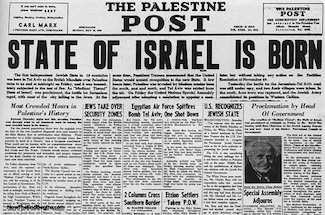
Seventy years ago, the founding of the State of Israel marked a historic event that significantly impacted the Middle East and the world. Reflecting on Israel’s history, one might have hoped that over time, wisdom and moral leadership would have guided both Israelis and Palestinians towards mutual understanding, reconciliation, and respect for international law and human rights. This could have led to greater prosperity for the entire Middle East region.
Today, the question remains how these issues can be resolved, if ever, amid the increasing spiral of violence, polarization, and the absence of moral leadership on both sides. Clearly, expanding settlements with a strategy for a greater biblical Israel is not the solution.
Seventy years ago, on April 9, 1948, events in the village of Deir Yassin profoundly changed Israel’s history. These events, which we would now classify as “war crimes and crimes against humanity,” would demand prosecution at the International Criminal Court in The Hague.
These atrocities occurred shortly after the death of one of the most charismatic Palestinian military commanders, Abd al-Qadir al-Husayni, on April 8, 1948, a day of significant loss for Arab Jerusalem and the Palestinian people. Al-Husayni came from an aristocratic Jerusalem family; his father, Musa Kazim al-Husayni, was the mayor of Jerusalem and a prominent Arab leader in Palestine in the early 20th century. His uncle, Haj Amin al-Husayni, was the mufti of Jerusalem.
Al-Husayni was buried the next day on the Temple Mount, known to Arabs as Haram al-Sharif, in the Khātūniyya near the al-Aqsa Compound, alongside his father and son, with thirty thousand mourners in attendance. That same day, 120 fighters from Irgun and Lehi attacked Deir Yassin, an Arab village west of Jerusalem. Simon Sebag Montefiore, in his book “Jerusalem,” describes this as “the most shameful Jewish atrocity of the war.”
On the morning of April 9, 1948, Irgun and Lehi militias, supported by the Haganah and Palmach, stormed the village of approximately 600 inhabitants. The attack began at 4 a.m. and the massacre lasted until 6 a.m. Several captives were later paraded in Jerusalem before being killed. Nearly 120 men, women, and children were killed that day, marking the beginning of the Nakba in 1948, when villagers around Jerusalem and in Galilee started to flee their homes. More than 700,000 Arabs eventually fled or were expelled during Israel’s War of Independence. Menachem Begin, leader of the Irgun and future Prime Minister of Israel, later wrote that the Palestinians, hearing of the massacre, “were seized with limitless panic and fled for their lives.”
As Simon Sebag Montefiore notes, “while Menachem Begin boasted, ‘The legend [of Deir Yassin] was worth half a dozen battalions to the forces of Israel,’ Ben-Gurion apologized to King Abdullah, who rejected the apology.”
In a July 16, 2017, article by Ofer Aderet in Haaretz, based on archived documents that had been under government embargo for 50 years, Lehi commander Yehoshua Zettler described the events to Ms. Neta Shoshani in 2009, weeks before his death. Zettler denied a massacre but detailed the killings. “I won’t tell you that we were there with kid gloves on. House after house, we placed explosives, and they ran away. An explosion and move on, an explosion and move on, and within a few hours, half the village was gone.”
Arab vengeance was swift. On April 14, 1948, a convoy of ambulances and food trucks was attacked, resulting in the deaths of 77 Jews, mainly doctors and nurses, before the British intervened. The Deir Yassin massacre was amplified in Arab media, triggering an exodus that emptied 80% of the population of the new state of Israel, creating refugee camps.
In 1949, the village of Deir Yassin was resettled by Israelis, becoming part of Givat Shaul. More than 400 villages were destroyed to create the state of Israel. The remains of these villages have been eradicated, leaving no acknowledgment of their existence. Those who fled ended up in refugee camps in the West Bank and Jordan.
Former Prime Minister Ariel Sharon also participated in war crimes. In 1953, as commander of Unit 101, he was responsible for the massacre in Qibya, a Jordanian village, where 75 people, including 50 women and children, were killed. As Defence Minister, Sharon was held responsible by the Kahan Commission for the massacre in Sabra and Shatila, which resulted in the deaths of 800 refugees. Sharon was forced to resign as Defence Minister. As opposition leader, he played a significant role in the second intifada (2001-2006), leading to many civilian casualties.
The prolonged Israeli-Palestinian conflict has morally corrupted Israel, dominating, expelling, starving, killing, and humiliating Palestinians, which has incited destructive suicide attacks and wasted young lives on both sides. The house-to-house raids, snipers, executions, and mass arrests during the second intifada are immoral and reminiscent of dark times in European history.
We have witnessed war crimes and crimes against humanity, resulting in an increasing spiral of violence. Israel must be held accountable for violations of the Geneva Conventions of 1907 and 1949, which obligate the protection of civilians and prohibit changes to occupied territories. The settlements built by Israel are an unnecessary alteration to the permanent status, not in the interest of the Palestinian population. The Fourth Geneva Convention prohibits the occupying force from settling its own population, making a Palestinian state in the West Bank unfeasible.
The vile nature of Hamas does not justify Israel’s disregard for civilian lives. Israel’s treatment of Palestinians has empowered Hamas and lost the moral high ground. Both sides have violated international humanitarian law, with Hamas firing rockets indiscriminately into Israel and Israel responding with disproportionate force.
The belief that massive military violence can end the resistance against occupation is a vain illusion. The disconnection and conflict worsen each year, especially for the children of the region.
In conclusion, Israel has the right to exist within its own borders and defend itself, but the cycle of violence must be broken through negotiation. The Palestinian people have suffered long enough under Israeli occupation and deserve their own state. Only diplomatic negotiations can achieve a two-state solution.
WJJH-5.2.2018
📌Blog Excerpt
Seventy years after the founding of Israel, the Israeli-Palestinian conflict persists, marked by violence and moral failings on both sides. The historical events at Deir Yassin in 1948 and subsequent actions have had far-reaching consequences. Despite the right to self-defence, Israel’s actions must align with international law. The cycle of violence can only be broken through diplomatic negotiations, leading to a two-state solution.
 In what kind of world do we wish to live