Russia: A Great Weak Nation
✍️ Author’s Notes:
This reflection examines the paradox of Russian power—militarily assertive, yet institutionally fragile. It explores the historical, psychological, and geopolitical contradictions that define Russia’s identity in the post-Soviet era.
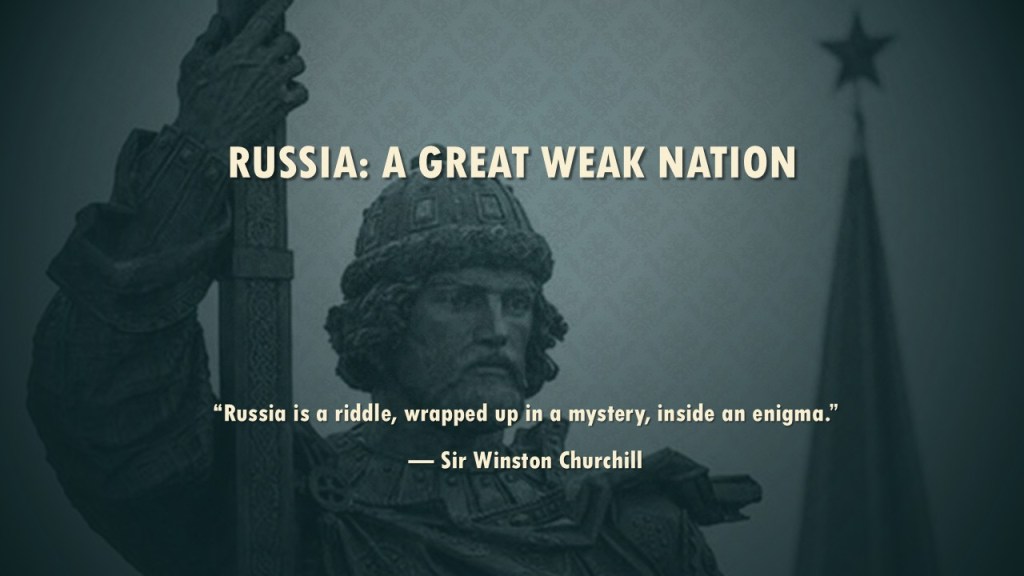
Undoubtedly, Russia stands as a remarkable country with a civilization of profound depth. Shaped by the Romanov dynasty’s 304-year rule, the tumultuous upheaval during the Russian Revolution of October 1917, and a succession of autocratic leaders, its society reflects a complex history.
To understand Russia is to delve into its long and rich cultural tapestry, steeped in literature, ballet, painting, and classical music. As Nikolai Gogol expressed in Dead Souls, Russia’s mournful song echoes across its vast expanse, calling for understanding and exploration of its culture, history, and global position.
With the largest landmass on Earth, spanning eleven time zones, and a population of 144 million, Russia has been centred in Moscow since the 13th century. The nation grapples with internal divisions regarding its origins, history, and the political landscape shaped by its past. The debates about character and destiny are intrinsically tied to historical narratives, with conflicting perspectives on nationalism, identity, and the interpretation of events creating a wide gap between Russia and Ukraine.
The ancient roots of Russia, Ukraine, and Belarus trace back to Kievan Rus in the ninth century, as detailed in Byzantine, Persian, and French sources. The Primary Chronicle, composed in the 1110s, by the monk Nestor and other monks in Kiev recounts the formation of Kievan Rus in 882 under Prince Oleg of Novgorod, emphasizing a loose dynastic federation.
However, the Mongol invasion in 1240, led by Batu Khan, marked the demise of Kievan Rus, destroying Kiev, fragmenting Kievan Rus and turning its princes into vassals of the Golden Horde. Orlando Figes aptly notes in “The Story of Russia” how the southern and western principalities aligned with Poland and Lithuania, while the Russian northeast forged the nucleus of Muscovy, with patrimonial autocracy emerging as a ruling principle.
The decline of the Mongols began after the death of Kublai Khan in 1294, culminating in the Battle of Kulikovo in 1380, a pivotal moment in challenging Tatar and Mongol dominance. Moscow, however, remained a vassal until 1502. In 1547, the grand prince of Moscow was crowned the first Tsar of Russia, marking the beginning of the Romanov dynasty with Ivan the Terrible. Ivan’s reign witnessed transformative reforms and territorial expansion, laying the foundations for an empire.
Ivan the Terrible’s reign saw Russia transform from a medieval state into an empire. Subsequent territorial expansion, bureaucratic development, and strengthened autocratic powers characterized Russia’s trajectory. However, Ivan’s death in 1584 without a clear successor plunged the nation into the Time of Troubles, , a period of political turmoil and civil war that ultimately led to the Romanovs ascending to power once more. ultimately leading to the selection of a Romanov as the next Tsar. The intricate tapestry of Russia’s history, marked by triumphs and challenges, continues to shape its identity and global standing.
The Romanovs ruled from 1613 until 1917, steering policies consistently toward Western Europe. Tsar Peter the Great, in a transformative move, dismantled the church patriarchy, effectively making the Russian Orthodox Church an arm of the state and, in essence, establishing a theocracy. This influence endures, shaping the Orthodox Church’s role in the state today.
Over the past five centuries, Russia and Europe have maintained close political, economic, and cultural ties. From the 18th century onward, this relationship expanded across various domains, characterized by significant cultural interconnections in the 18th and 19th centuries. Russia’s vast territories, a source of national pride akin to Lake Baikal, also evoke vulnerability due to historical invasions, such as the Mongol occupation in 1238.
The geopolitical landscape post-Soviet Empire collapse has led Russia to view neighbouring countries as potential threats rather than partners. Stalin’s perception of independent states as security risks laid the groundwork for defensive aggressiveness, exemplified by recent events in Georgia, Abkhazia, South Ossetia, and Ukraine. The repercussions extend to former Soviet states forming security alliances with the West.
Russia’s history includes victories, such as those against Charles XII and Sweden, as well as in WWII. However, it has also faced significant losses, such as the Crimean War, the Russo-Japanese War, and WWI, with both victories and defeats in wars, shaping its identity. Governance in Russia, as noted by Stefan Hedlund “Russian Path Dependence” faces challenges, with the country collapsing three times in history, in 1610-1613, 1917-1918, and 1991, each time reemerge fundamentally unchanged. Despite transformative leaders’ intentions, Russia retains an unaccountable government, resistance to the rule of law, and a history of repression.
Acknowledging Russia’s history, culture, and current position reveals its struggle to reconcile a sense of exceptionalism with a reduced role in the world. In the contemporary world dominated by economic powerhouses like China, the EU, and the US, Russia finds itself on the economic periphery, not as a superpower but as a great power outside the developed industrialized nations. The delusion of Russian greatness, as observed by Ivan Turgenev in the 19th century, has NOT helped its integration into Europe.
In the 21st century, Russia appears as a “great weak” nation, marked by a decline since Catherine the Great. Despite being the 11th industrial power, Russia’s GDP is comparable to Korea’s, representing 1.8% of the world economy. Although life expectancy has improved, country grapples with issues such as a significant gender-based life expectancy gap and historical disparities in education and industrial development.
The nation’s trajectory has been shaped by autocratic governance, with authoritarianism deeply embedded in its culture persisting through various rulers, including Stalin and Putin. Putinism blends Romanov authoritarianism, Orthodox sanctity, nationalism, crony capitalism, and Soviet and Romanov nostalgia. The absence of strong independent institutions reflects a low level of checks and balances in the system. The country remains organized around a ruler wielding undivided power, linked to opaque cliques, able to amass vast wealth while linked together through hierarchical client – patron relationships which requires the ruler to balance the different vested interests and prioritizing the state as guarantor of the domestic order over individual rights.
The prevailing creedal ideology, rooted in Byzantine visions of grandeur, positions Russia as a regional power at best, despite its nuclear capabilities. With Vladimir Putin leading as a 21st-century czar, ruling through the wealthy elite and opposing democracy, Russia seems to have circled back to its pre-revolutionary origins. Oligarchs wield control over a population of a hundred and forty million, reminiscent of historical aristocratic rule over serfs, with dissent closely monitored by the Federal Security Service (FSB). The situation mirrors a bygone era, where opposition is suppressed, and equal representation and democracy remain distant aspirations.
The prevailing creedal ideology, rooted in Byzantine visions of grandeur, positions Russia as a regional power at best, despite its nuclear capabilities. With Vladimir Putin leading as a 21st-century czar, ruling through the wealthy elite, and opposing democracy, Russia seems to have circled back to its pre-revolutionary origins. Oligarchs wield control over a population of a hundred and forty million, reminiscent of historical aristocratic rule over serfs, with dissent closely monitored by the Federal Security Service (FSB). The situation mirrors a bygone era, where opposition is suppressed, and equal representation and democracy remain distant aspirations.
Netherlands, WJJH, February 2021- Revised November 2023
📌 Blog Excerpt
Russia’s rich history, influenced by the Romanov dynasty and marked by triumphs and challenges, has shaped its cultural tapestry. The nation grapples with internal divisions, historical narratives, and autocratic governance, which persist through rulers like Putin. Despite nuclear capabilities, Russia is seen as a regional power, facing economic and governance challenges.
 In what kind of world do we wish to live
One thought