Ukraine: A Pawn on the Eurasian Chessbord
✍️ Author’s Note
This reflection views Ukraine not as a passive victim, nor a flawless hero, but as a nation caught in the strategic rivalry between East and West. It explores the dangerous simplification of complex realities into binary moral narratives.
Over the past eight decades of my life, as a reflective but obstinate minority of one, I propose that at this pivotal moment, marked by the unanticipated surge of artificial intelligence, we confront a myriad of challenges. These encompass disruptions to our climate and food systems, the emergence of infectious diseases leading to pandemics, issues of poverty and inequality, the loss of nature and biodiversity, and the pervasive problems of pollution and waste.
Addressing these challenges necessitates solutions that extend beyond short-term fixes or convenient soundbites. Moreover, the exclusivity of certain nations from the global equilibrium is not a viable approach. Instead, we require comprehensive, global, and long-term solutions. These issues surpass in importance a potentially devastating and unnecessary regional conflict, such as the one unfolding in Ukraine, as they directly impact the very survival and sustenance of our so-called civilization.
Our world has often been shaped by the tenets of American and Russian exceptionalism, influencing not only each other but also European culture. While the United States has historically been a leading force among free nations, contributing to the establishment of a “free liberal order,” its current state is one of disorder, marked by a divergence from its own ideals. This hegemonic position, with U.S. domination over entities like the U.N., NATO, World Bank, and IMF, as a national security strategy, has bestowed economic advantages and prosperity upon the nation but has also engendered a foreign policy grounded in remorseless self-interest rather than altruism.
In this interconnected world governed by laws, relationships between entities like the EU, Russia, and the U.S. have been shaped by historical agreements such as the 1975 Helsinki Final Act, the post-Cold War settlement and the 1990 Paris Charter for a New Europe. Despite occasional displays of disdain and hypocrisy, adherence to international law is crucial. Fundamental differences exist among major powers, with the European Union and the USA founded on values like human dignity, freedom, democracy, equality, the rule of law, and respect for human rights. In contrast, Russia and, to a lesser extent, China embodies authoritarianism, marked by domination, repression of civil society, corruption, and nationalism.
Contrary to the belief in American exceptionalism, the universality of principles such as freedom, liberty, and democracy is challenged by diverse historical and cultural perspectives. Recognizing and accommodating these differences is imperative, as highlighted by Machiavelli’s insight that the question of how people should live – which human goals should be exalted – lacks a universally satisfying answer.
During President Bill Clinton’s terms, characterized by the 4P principles of peace, prosperity, pluralism, and progress, the push for NATO expansion began, which caused great apprehension in Russia. Under President George W. Bush, influenced by 9/11, the geo-political landscape shifted with the wars in Afghanistan and Iraq, coupled with the misguided encouragement for Georgia and Ukraine to join NATO.
The ongoing crisis in Ukraine signifies a pivotal moment in modern history, reflecting a struggle for global hegemony. It unfolds in a world where the U.S. grapples with economic, political, and moral self-denial, prioritizing its global standing over internal concerns. The era of unipolarity has diminished, with the U.S. relinquishing the positive legacy and reputation built during decades of American global leadership. Both Russia and China aim to curtail America’s sphere of influence, challenging geopolitical advantages and seeking to reshape the international order in their favour.
The ongoing conflict is not a clash of civilizations, as posited by Samuel Huntington, but rather a clash between those who believe in the clash of civilization and those advocating for universal values and international law.
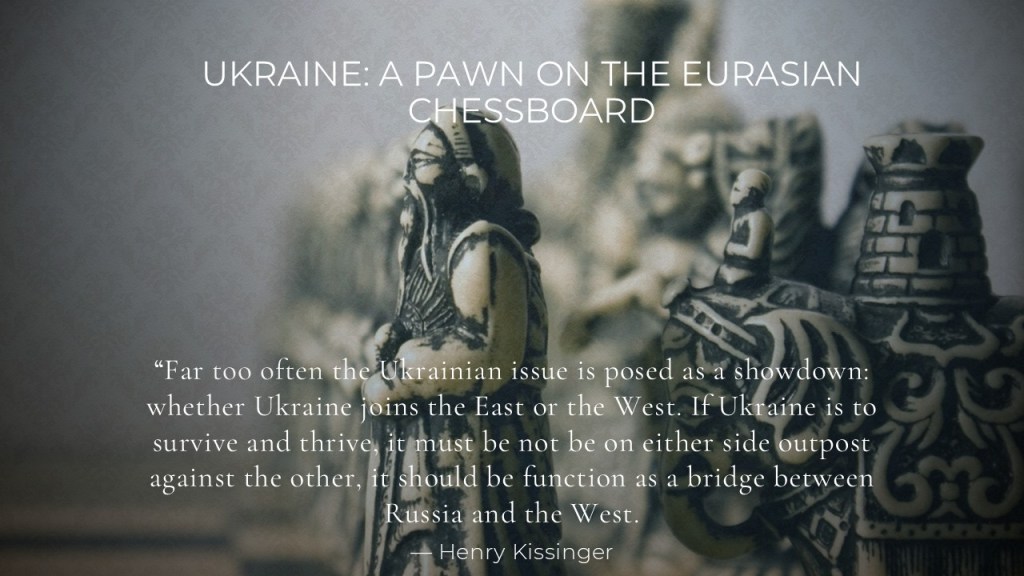
This conflict is not a clash of civilizations, as Samuel Huntington posited, but rather a clash between those advocating the clash of civilizations and those championing universal values and international law. In this context, Zbigniew Brzezinski’s insights in “The Grand Chessboard, American Primacy and its Geostrategic Imperatives” underscore the importance of considering the broader geopolitical landscape.
Brzezinski references Mackinder’s Heartland Theory, which significantly influenced geopolitical thinking and strategy during the Cold War. It emphasizes the strategic importance of Eurasia and was used to justify containment policies against the spread of communism.
The conflict in Ukraine is strategically significant, part of the struggle for global hegemony and the expansion of U.S. sphere of interest. On the global geopolitical chessboard, Ukraine is merely a pawn, serving as a springboard for U.S. influence in the Eurasian Balkans—a critical core of European security within the larger Eurasian landmass. The Eurasian Balkans, comprising former Soviet Union members, hold economic significance with abundant natural resources.
For the U.S., Europe acts as its bridgehead in this strategy, envisioning Ukraine, with a pivot to the west, as part of the expanding critical core of European security. Following the geopolitical pivot of Ukraine, both Kazakhstan and Uzbekistan become potential and crucial pivots to be drawn into the U.S. orbit (U.S., EU, NATO) to counter Russian influence in the Caucasus and control energy resources. In essence, the U.S., Russia, and China vie for control, aiming to weaken rivals and advance their geopolitical objectives.
In the face of a declining U.S. hegemony and an assertive China seeking regional dominance, tensions rise. The war in Ukraine is strategic, although altering the power balance in Europe but contributing to the initiation of a new Cold War. President Joe Biden frames the rivalry with China as a contest between democracy and authoritarianism, emphasizing extreme competition instead of engagement.
For Europe, following the U.S. in its greater power competition with China and a new Cold War is a temptation the European Union must resist. Europe should avoid being drawn into a contest between China and the U.S. for global hegemony. To serve Europe’s interests, a balanced and pragmatic approach is crucial, where Europe cooperates when it can and remains independent when necessary.
Europe needs to discover its strength and prepare for harsher global competition, developing a more compartmentalized China strategy. This involves remaining open to cooperation with China when in Europe’s interest. Triangular relations between the U.S., China, and the EU will contain elements of attraction and hostility. The EU should work with both the U.S. and China to pursue pragmatic policies that maintain stability and result in greater strategic European autonomy.
In conclusion, the current global landscape necessitates a nuanced understanding of historical, cultural, and geopolitical factors. Conflicts extend beyond territorial battles, reflecting broader struggles over values, international law, and the future world order.
Netherlands, WJJH-May 2022, Revised December 2023
📌 Blog Excerpt
About the current crisis, a fateful, epoch-making moment in modern history that reflects the battle over what the world order will look like and Ukraine, the pawn on the Eurasian chessboard.
 In what kind of world do we wish to live
One thought