Scipio Africanus: Build your Opponent a Golden Bridge
✍️ Author’s Note
Inspired by the wisdom of ancient strategy, this post draws on the wisdom of Sun Tzu and on the life of Scipio Africanus to ask whether diplomacy must include a path of retreat for adversaries. Even the defeated must have a way out—or risk total war.
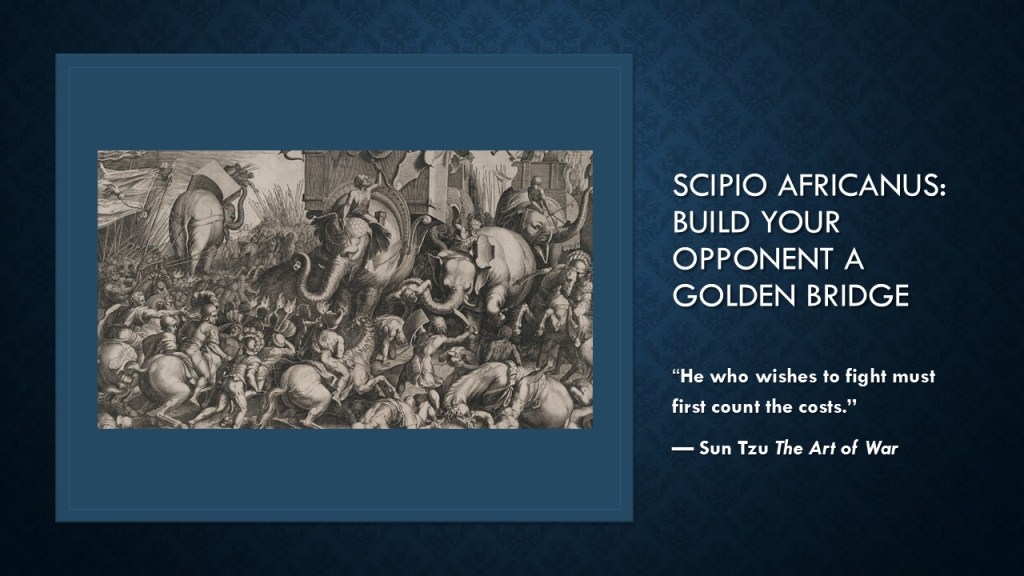
In his monumental work, the 11-volume ‘Story of Civilization,‘ the esteemed American historian and philosopher Will Durant asserted that ‘war is always the result of a longer period in history, and each time the price goes up.’ Echoing this sentiment, Sun Tzu, in the timeless ‘Art of War,’ emphasized that ‘he who wishes to fight must first count the costs.’
Examining the roots of the Ukraine conflict, the notion that it solely arises from neglecting Russian security interests holds undeniable merit but is not the sole catalyst. As highlighted by Zbigniew Brzezinski in 1994 and expounded in his book ‘The Grand Chessboard: American Primacy and its Geostrategic Imperatives,” not all of the Russian security concerns lacked legitimacy or were motivated by malevolent motives.’
This perspective finds support from former U.S. Ambassador John F. Matlock, strategic visionary George F. Kennan, and CIA head William J. Burns, backed by former Defence Secretary William Perry and scholar John Mearsheimer.
The post-Cold War era, starting with the Soviet Union’s collapse in 1991, reveals a failure in learning from history. The West, akin to Count Clemons von Metternich’s approach after the Congress of Vienna in 1815, neglected to establish a new security system for Europe, fostering lasting peace.
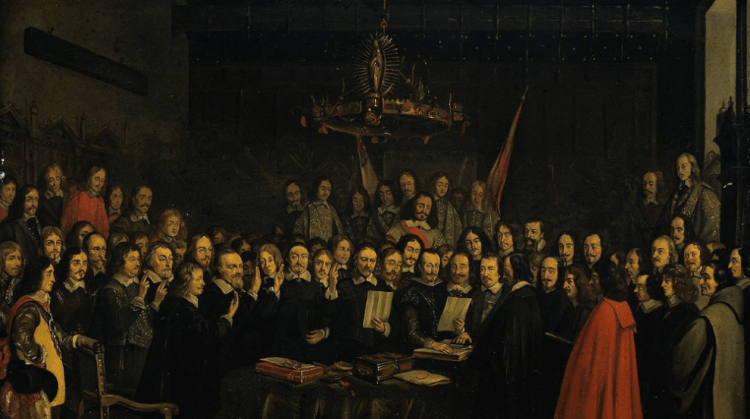
Since the Treaty of Westphalia in 1648, international relations have adhered to the principle of sovereignty, where a country’s internal affairs remain its own unless posing a threat, breaching a treaty, or triggering alliance obligations. However, the world is also marked by cultural differences and values.
In the domain of national states, the pursuit of maximizing control over internal and foreign affairs defines sovereignty. International institutions, while promoting the rule of law and guiding state behaviour, lack enforcement power and rely on mutual interests for effectiveness. In this Hobbesian world, might often dictates right, and realism prevails, leading states to compete for power and harbour mutual distrust.
The ongoing events in Ukraine, marked by atrocities and genocidal intent, constitute a severe violation of international law. Russia’s annexation of Crimea and Eastern Ukraine provinces challenges the sovereignty principle, placing it outside the international rule-based order. This deserves a strategic calculated response, instead of the unlimited moral outrage which can be daily found on the airwaves.
However, history reveals that annexations, as demonstrated by Israel, India, China, Morocco, and others, persist beyond our idealistic aspirations. The tragedy of history is that most of our European borders are the result of annexations. Despite Russia’s deviation from officially recognized borders, economic sanctions primarily divide the world between industrialized nations and neutral counterparts.
Vladimir Putin’s pursuit of 19th-century values in the 21st century, manifested in erasing the Soviet Union’s collapse and expanding Russia’s influence, forms the basis of a dangerous ultimatum delivered in December 2021. This strategic blunder, marked by an invasion of Ukraine, eliminates the grudging acceptance of the Crimean impasse and puts the region back on the negotiation table.
The ultimatum, demanding the cessation of military cooperation, withdrawal of nuclear weapons, and NATO forces’ retreat, underscores Russia’s desire for a bilateral format with the U.S., excluding Europe. This echoes the Ribbentrop-Molotov pact’s influence, signalling a departure into alternative realities fuelled by feelings of debasement, humiliation, and underappreciation of Russia’s global standing.
Despite the rejection of major demands, Putin’s approach limits strategic alternatives for the European Union, necessitating a unified opposition to Russian expansionism. Yet, understanding the motivations and reasons on both sides, acknowledging Russia’s historical invasions and the EU’s expansionary limits, is essential for a comprehensive perspective.”
The historical backdrop of the American–Russian relationship has been consistently influenced by an overwhelming fear of communism. Since 1948, sanctions have been a recurrent tool, yielding minimal results. The current sanctions, enforced since 2014, aim not at engagement but at Russia’s subordination, isolating it globally and fostering regime change in the Kremlin.
The strategy pursued in 2014 under President Barack Obama’s administration demonstrated weakness and exacerbated existing issues. Undoubtedly, the sanctions against Russian interests are a double-edged sword, with Europe bearing the economic brunt through higher energy and food prices, rising inflation, and the spectre of stagflation. The ramifications of this economic war are likely to outlast the conflict itself, echoing the echoes of the 1973 oil crisis.
Amid these challenges, Europe gains some benefits in increased diversification and a shift towards alternative energy sources, mitigating the impact on climate change. However, the reality remains that Russia, under Vladimir Putin’s leadership, is unlikely to undergo significant change. The succession of a leader with similar interests makes a smooth transition improbable, complicating any hopes for regime change.
The imposition of sanctions has inadvertently divided the world, with industrialized nations on one side and neutral and non-aligned countries on the other. Many, including BRIC countries, do not adhere to the sanctions, causing the West to lose influence in Africa and Latin America to China and, to a lesser extent, Russia.
The economic sanctions were a response to Russia’s actions in Crimea and Eastern Ukraine, leading President Vladimir Putin to pursue 19th-century values in the 21st century. His December 2021 ultimatum, followed by the invasion of Ukraine, marked a strategic blunder that reopened discussions on Crimea. The ultimatum, excluding Europe from negotiations and echoing historical pacts, set the stage for a confrontation.
In response, Europe faces a dilemma: strategic autonomy or opposing Russian expansionism. Putin’s actions limit alternatives, pushing Europe towards opposition, but the coin has two sides. As the West imposes sanctions, it inadvertently strengthens non-aligned countries, undermining Western influence globally.
The situation in Ukraine remains complex. The conflict’s continuation, marked by Russian attacks on Ukrainian infrastructure, aims to break the population’s morale. Mobilization on both sides suggests a pause for preparations for a potential spring offensive.
Sanctions alone will not end the conflict, since the longer they taken the less effective they become, and an unconditional surrender is historically rare. Negotiations typically follow a balance of power on the battlefield. This has been the conclusion of war for thousands of years. The psychology of treaties assumes potential deception, emphasizing the need for vigilance. The hope for a change in Russia’s public perception or a coup d’état in the Kremlin is uncertain.
As the war’s economic toll grows, Ukraine next to its corruption issues faces financial challenges, relying on external support for its survival, negotiations must be pragmatic, considering Ukraine’s economic challenges, historical significance, and the limited support from the West. President Zelensky’s demands which focus on justice and retribution for Ukraine as a basis for negotiations, may need adjustment for a realistic settlement.
The global economic fallout is substantial, with the OECD downgrading growth prospects. As Dr. Henry Kissinger noted, Ukraine’s historical lack of compromise complicates the situation. The war’s prolonged duration may depend on the reconsideration of costs by Ukraine’s supporters and financiers in Europe.
While moral and ethical reasons justify support for Ukraine, practical considerations must set limits. In the real world, all wars culminate in negotiations based on battlefield realities. The key questions revolve around the balance of power, the costs of war, likely outcomes, and the best achievable goals for Ukraine.
The historical lesson underscores the finite nature of resources in war. As Thucydides stated, ‘War is a matter not so much of weapons as of money.'”
General Mark Milley, Chairman of the Joint Chiefs of Staff, emphasized in November 2022 the military impracticality of winning the war in Ukraine through force alone, drawing parallels with World War I and the devastating consequences of prolonged conflict. He urged considering peace talks this winter to avoid further human suffering, acknowledging the theoretical nature of negotiations with Russia, a nation not known for its flexibility.
Negotiations, Milley asserted, should be based on strength and a willingness to compromise. A starting point could involve Russian President Vladimir Putin recognizing Ukraine’s sovereignty and the right to exist as a separate state. Former Secretary of State Henry Kissinger suggested a return to the pre-Feb. 24 status quo, with the idea of a neutral Ukraine no longer meaningful. However, caution is advised against Ukraine’s NATO and EU memberships due to concerns about the country’s corruption and faulty institutions.
From a strategic perspective, the balance of power in Europe remains intact, with Russia viewed as a minor power, militarily weak in the global competition. Despite ideological and value differences, Europe, historically and culturally, coexists with Russia under the same roof. A diplomatic solution based on the balance of power in Europe is urged for stability.
The U.S., however, appears to be sleepwalking into a larger conflict, risking military escalation with a nuclear power, a strategy that jeopardizes global security. In contrast, Europe recognizes the need to coexist with Russia and seeks common ground based on equality and understanding of Russia’s geopolitical goals.
As the conflict continues, it becomes crucial to assess the next phase and find a diplomatic solution. While some advocate for regime-change and total defeat of Russia, it contradicts the prediction of a protracted conflict by General Milley. Europe, facing differences in approach between Anglo-Saxons and traditional Maastricht Europeans, needs to weigh the risks of escalation advocated by some Central and Eastern European members.
In conclusion, the war in Ukraine is a tragedy for its citizens, Russia, and Europe. The suffering and economic consequences could have been avoided through acknowledgment and addressing concerns on both sides. Prolonged wars make concessions for an agreement increasingly challenging. In the broader geopolitical context, the war in Ukraine is a side show, with the main event being the struggle for global hegemony. Adapting to the changing world order requires nimbleness, restraint, and pragmatism.
WJJH 23.01.2023 – Updated 21.12. 2023
📌 Blog Excerpt
The complexity of the Ukraine conflict lies in historical neglect and geopolitical power struggles. Russian actions challenge international law, prompting economic sanctions with global repercussions. Amidst conflicting strategies and motivations, a resolution hinges on finding a diplomatic solution, addressing concerns on both sides, while avoiding prolonged suffering and global instability.
 In what kind of world do we wish to live