Ukraine Dilemma: Navigating the Quagmire with Balanced Dissatisfaction
✍️ Author’s Note
This reflection advocates for realism and restraint in a deeply polarized war. It explores the idea that the best outcomes may lie not in victory, but in negotiated compromise based on Henry Kissinger’s formula “The test is not absolute satisfaction but balanced dissatisfaction,”—an uncomfortable middle no one will celebrate, but many may survive.
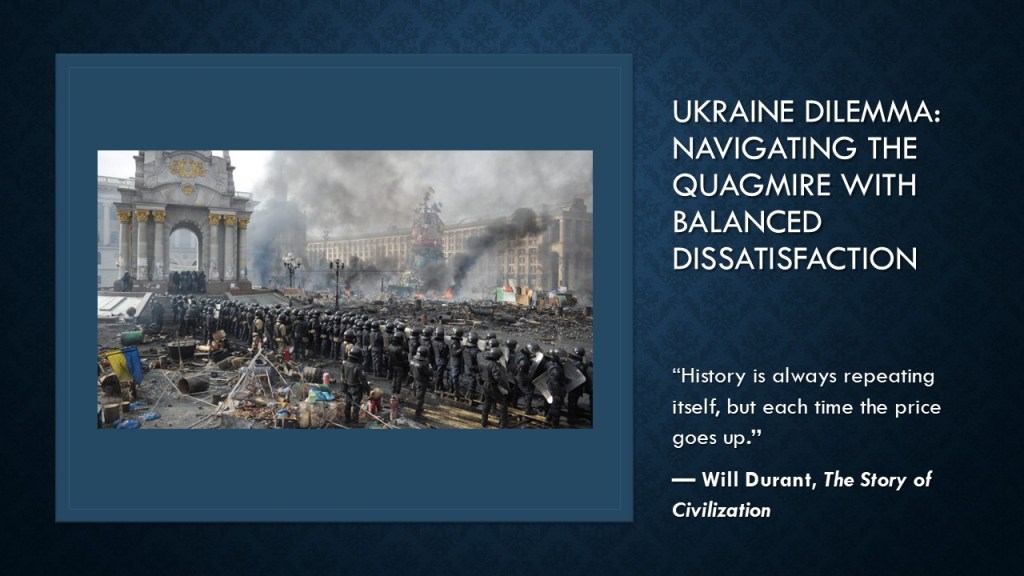
Reflect, if you will, on the fact that even after over 500 years of western dominance, the world remains more of a jungle than a gentlemen’s club. In this chaotic global landscape, the focus is never on avoiding conflicts when national security is perceived to be at risk; rather, humanity has proven adept at initiating wars.
As in the case of the First World War, the escalating tension between Russia and Ukraine needed only a small spark to ignite. Once the flames of war are kindled, extinguishing them becomes a formidable task for the limited minds that created the problem, a predicament with consequences that extend beyond their understanding.
In our contemporary society, driven by a demand for instant gratification, our arguments often derive more from passion than reason and pragmatism. The complex questions surrounding the Ukraine war present a significant challenge. Put simply, addressing this requires nuance—a willingness to objectively examine the reasons, values, and security interests of both sides, along with the geopolitical factors that underpin these events. Once we identify the source, we may find a remedy.
Looking at today’s global landscape, it is not unreasonable to consider the continued relevance of the Kissinger-era paradigm of “spheres of influence” and “balance of powers,” as realpolitik may still hold the key to resolving the Ukraine issue.
The ongoing unjustified events in Ukraine are undeniably devastating—a blatant violation of international law warranting a strategic and calculated response. Russia, by pursuing this aggressive course, has not only forsaken its humanity but also its common sense.
However, history teaches us that the conflict was inevitable when Ukraine chose not to be a bridge between Russia and the West but a Western outpost against Russia. This positioned Ukraine as a pawn on the geopolitical chessboard, caught in the larger power competition between the U.S. and China in the Eurasian Balkans.
The Russian annexations of Crimea, Donetsk, Luhansk, Kherson, and Zaporizhzhia regions violate international law. Yet, annexations are not confined to the past, as demonstrated by Israel, India, Morocco, and China. Today’s pertinent questions include assessing the balance of power, the cost of the war, likely outcomes, and the best achievable goal for Ukraine at a minimum cost. When should diplomacy take serious initiatives for an armistice leading to a negotiated settlement?
Ukraine, having lost territory and engaged in a defensive war, seeks the return of the 2014 borders, including Crimea and the contested regions, even if it means a protracted conflict. In a world saturated with grandiose rhetoric, President Zelensky may overlook Thucydides’ wisdom from the late 430s BC, emphasizing that conflict and war are not merely about soldiers and weapons but fundamentally about money.
According to the Kiel Institute for the World Economy, donors pledged approximately €237.9bn ($256bn) between January 24th, 2022, one month before the war began, and July 31st, 2023. This constitutes a fraction of the financial assistance needed in the next decade.
Amid questions about the war strategy and the slow counter-offensive pace, with the mud and snow season approaching in Ukraine, concluding this war of attrition proves challenging. It becomes an extended struggle with potential success timelines extending into 2024 and possibly beyond—contrary to optimistic military expectations.
Expectations of Ukraine’s military success, as outlined by Lieutenant-General Kyrylo Budanov and Deputy Defence Minister Volodymyr Havrylov, have not aligned with the harsh reality on the ground. The initial anticipation of a swift victory by the end of 2022 contrasts starkly with the enduring and protracted nature of the conflict.
Similarly, the “fairy tale” expectations held by Ukraine’s supporters in various EU member states, the European Parliament, the EU Commission led by President Ursula von der Leyen, and the EU Council have been unrealistically high. With the U.S. often plagued by rhetorical indiscipline, we are moving deeper into a quagmire without much consideration for the broader consequences.
I firmly disagree with those advocating for the total defeat of Russia, as this would likely mean the matter will remain unresolved for an extended period, possibly counted in years. Russian culture and history may offer some much-needed guidance.
There has been a failure to recognize that, in the language of geopolitics, Russia enjoys “escalation dominance” in Ukraine, a fact confirmed by the ratio of people and artillery between the two sides. Under these circumstances, the destruction in Ukraine may persist for an extended period.
It should be apparent to President Zelensky, after nine years of standoff and European “as long as it takes” support, that this backing is neither unlimited nor infinite. With the U.S. seemingly heading towards political anarchy, elections on the horizon, and growing resistance against funding in Congress, it might be useful for us Europeans to consider that change in the U.S. is only one election away.
As European Union President Ursula von der Leyen makes choices seemingly driven by a comfortable relationship with the U.S. rather than pragmatism and the logic of creating a strategically independent Europe, a shift to a more authoritarian “MAGA” government in the U.S. would have consequences for Europe.
Amid international differences and diminishing goodwill and support for Ukraine, it is evident that the conflict will not be solved by force alone. Reconciling what is fair and possible is a challenging task. For European backers of Ukraine, this raises the timely but difficult question of when to let diplomacy take initiatives for an armistice leading to a settlement—unsatisfactory as it may be, but preferable to the continuation of a war with human and economic costs that exceed the benefits.
With the lack of progress in the counter-offensive and the sacrifices Ukraine is making, President Zelensky might reflect on the human, economic costs, and the disagreeable realities of the conflict. A more rational and balanced position, considering the benefits of a peace settlement, may be warranted.
When conducting a thorough “net assessment,” a settlement offers Ukraine the best path forward to begin the lengthy process of rebuilding and state-building. It would enable Ukraine, a poor country with unsound institutions and a society marred by corruption and entirely dependent on outside financial support, to limit the unsustainable daily loss of human life and the downward spiral of its finances.
The tragedy of history is that European history has witnessed enough family disputes, regional conflicts, and world wars, often resolved through painful concessions and land swaps. Unfortunately, the longer a war lasts, the more difficult it becomes to end it. The emotions on each side, coupled with the suffering, make the necessary concessions to an agreement more and more contested.
Negotiations become unavoidable to put an end to this war. Similar to the thousands of years of war, the conclusion has always been that all wars end in negotiations based on the realities on the battlefield.
Any negotiation is conducted based on the balance of power on the battlefield. In a war, belligerents negotiate either when there is a clear winner and loser or when both sides are exhausted. Any treaty is signed under the assumption that the other side may be lying, requiring each signatory to remain on guard and seek security assurances. The psychology is clear: the loser never finds the loss acceptable but has no other choice.
Usually, as soon as the treaty is signed, the loser thinks of rearming and seeking revenge. It is up to the winner to safeguard their security interests and remain vigilant to discourage the other side from relaunching a war. A settlement can only happen once the leadership in the Kremlin and Kyiv become more conscious of the realities and costs of this conflict or when the European financiers, who supply a substantial part of the money to Ukraine, become more pragmatic and return to traditional German realpolitik and balance of power policies. In the words of Henry Kissinger, to reach some kind of solution,
“The test is not absolute satisfaction but balanced dissatisfaction.”
Netherlands, WJJH-September 2023- Revised December 2023
📌 Blog Excerpt
The global dominance by the West has not prevented conflicts, evidenced by the ongoing Russian-Ukrainian war. The resolution requires understanding and addressing the geopolitical factors, security interests, and motivations of both sides. Our society, driven by a demand for instant gratification, our arguments often derive more from passion than reason and pragmatism, requires the return to realpolitik and a focus on achieving “balanced dissatisfaction” in order to find the path towards resolution.
 In what kind of world do we wish to live
One thought