Israel Today: Inheriting the Wind

Looking in a mood of despondency and condemnation at the recent horrific atrocities in Israel, history seems to echo itself, and as the historian Will Durant noted “War is one of the constants of history, and it has not diminished with civilization or democracy.” As war in Israel rages for times immemorial, with violence justified by previous grievances, there is no hope for peace unless both sides of the divide are willing to break the cycle of violence, that is if parties aspire to preserve their humanity.
Allow me to conclude the liberal secular Israel, as envisioned by David Ben-Gurion (3), the founder and first prime minister of Israel has long ceased to exist, wrecked under influence of the seeds of religious-messianic evil. The history is a complex one and has caused deep anger in the Arab world. In 1915, Britain and France, with ambitions for control of the Middle East and in an attempt to resolve the struggle for the Middle East, split the Ottoman’s Middle Eastern empire in the secret Sykes-Picot agreement, dividing it by a diagonal line in the sand from the Mediterranean Sea coast to the mountains of the Persian frontier. They agreed that, failing to find a compromise, the Holy Land should have an international administration (1).
To support their claim to their southern half, the British imperialists supported Zionist aspirations to make Palestine a Jewish state. Under the mandate of the League of Nations, Britain took control of Palestine, Transjordan, and Iraq; France took control of Lebanon and Syria. The rivalry between the British and the French led to large-scale emigration and an escalation in violence between the Arabs and the Jews, resulting in terrorism that led to the creation of the State of Israel.
Now, over seventy-five years later, following the displacement of hundreds of thousands of Arabs from the villages they had inhabited for centuries, those who fled what is now the State of Israel find themselves stateless in refugee camps in the West Bank, Gaza, and Jordan. This occurred during the armed Jewish revolt from 1945 to 1948 against imperial Britain. The period, known as the Palestinian Nakba (“Catastrophe”), witnessed the ethnic cleansing of 700,000 Palestinians and the occurrence of approximately 50 massacres carried out by Jewish militias.
Today, the boundaries of the state of Israel are still not permanent, and the commitment to the Jewish people’s right to settle the entire biblical land of Israel, on both sides of the Jordan river, as the 1917 Balfour Declaration suggested, (2,5) the status quo, also as a result of the Imperial powers’ designs for the greater Middle East region, remains a source of contention, conflict, and war.
In the words of David Ben-Gurion, the Bible is “our deed of ownership,” justifying the wholesale seizure of Arab lands inside and the occupied territories. With almost messianic ideas and myriad fantasies about the “Third Kingdom of Israel” and for a “Greater biblical Israel,” the country has been and is purposely defying international law, and the massive application of violence has structured every aspect of Palestinian existence for 75 years. With this, Israel has failed to fulfil its 3500-year-old promise and is inheriting the wind of its policies.
The case can be made that, with the world’s decades-long overlooking of Israel’s transgressions, including the Israeli occupation of East Jerusalem, the growth of Israeli settlements in the West Bank leading to Israeli settlers’ violence against Palestinian civilians, the siege of Gaza, and provocative incidents at the Al-Aqsa Mosque, this latest Hamas attack did not happen in a vacuum but has culminated to this tragic moment.
The Israeli/Palestine conflict, this festering malignant wound in the Holy Land, evokes the sentiments expressed by Albert Camus in 1956 regarding the “infernal dialectic.” He drew parallels to the conflict between France and Algeria from 1954 to 1962. In the Algerian war for independence from France, numerous villages were razed, extensive damage was inflicted on forests, and around 2,000,000 inhabitants were relocated to new settlements. The human toll of the war remains a subject of dispute, with estimates ranging from hundreds of thousands to as many as 1.5 million.
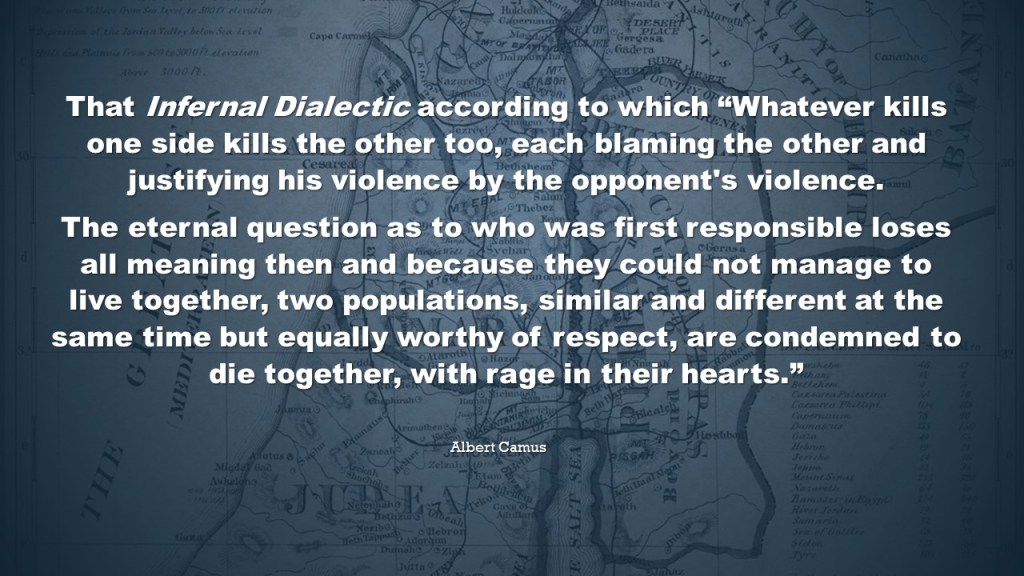
Overlooking the scenery with both Hamas and Israel’s current ultra nationalistic government being more ideologically inclined toward violence than peace, conflict rather than cooperation, it is challenging to envision an end to that “Infernal Dialectic,” is hard to envisage.
The open racism displayed by some members of Netanyahu’s extreme right coalition contributes to the problem. Israeli politicians like the Minister of National Security, Itamar Ben-Gvir, openly stating that Gaza should be “ours” and suggesting Palestinians should go to places like Saudi Arabia, Iraq, or Iran, exemplify this issue. Similarly, Finance Minister Bezalel Smotrich, who is also a minister in the Defence Ministry responsible for policy in the West Bank, has made controversial statements, including referring to Hamas as an “asset” for Israel and denying the existence of a Palestinian people. As delivered in a March 2023 speech in Paris, claiming:
“There is no such thing as a Palestinian nation. There is no Palestinian history. There is no Palestinian language.”
finance minister Bezalel Smotrich
This outrageous claim and other ultra nationalistic asserts are ludicrous, the Palestinian claim to their land is not in question nor is the authenticity of their history.
The terrorist organization Hamas launched a ruthless multipronged assault on southern Israel on October 7, 2023, aiming to undermine the so-called Abraham Accords and normalization with Saudi Arabia. The attack involved killing hundreds of people and taking more than two hundred hostages, with the intent to provoke an Israeli overreaction, making their own Palestinian people sacrificial lambs.
While there is valid criticism of Israel’s unsustainable and oppressive occupation since 1967, the cold-heartedness and ignorance in some circles that justify the killing of innocent Israeli civilians by Hamas is morally corrupt. The targeting of civilians by both Hamas and Israel should be equally condemned. However, there is a perception of self-serving hypocrisy among western leaders and the public when shedding tears for Israeli lives lost while ignoring Palestinian casualties.
Taking a historical perspective, barbarism has been present throughout history, and the Hamas carnage is reminiscent of the 1982 massacre in the Sabra and Shatila refugee camps, for which the Kahan commission after a four-month investigation held defence minister Ariel Sharon indirectly responsible, for failing to prevent the massacre. Without condoning the actions of Hamas, it’s essential to recognize that this attack is no different from the massacres committed by the “Irgun and Lehi” militias during the struggle for Israel’s independence, which would leave a permanent mark on Israeli politics, history, and culture due to their violence (4).
Israel’s response to the attack includes airstrikes that have killed hundreds, a full blockade of the Gaza Strip, and the launch of the operation “Iron Swords.” Given Israel’s advanced military capabilities, this response is expected to lead to a “scorched earth” full-blown ground war in the Gaza Strip, resulting in devastation and suffering for the people of Gaza.
The analysis “Mapping the destruction in Gaza” (12) by The Economist on October 19th, 2023, indicates significant damage to buildings in Gaza, “Overall, our estimates suggest that 11,000 buildings in Gaza are already damaged or destroyed.” The densely populated strip is expected to witness a steep humanitarian toll and a river of blood due to the ongoing fighting.
The number of deaths reported by Israel are 1,300 Israelis; The Ministry of Health in Gaza reports around 7,500 Palestinian lives lost, which number is sure to rise. The reported number of deaths by Israel is 1,300 Israelis, while the Ministry of Health in Gaza reports around 13,000 Palestinian lives lost, a number likely to increase. Israeli Prime Minister Binyamin Netanyahu has vowed to make the enemy pay a severe price, one that will be remembered for decades to come.
Without a doubt, Israel has the right to self-defence, but the response to the latest events must adhere to the obligations that international law imposes on Israel. The collective punishment of Gaza, seemingly intended to force its residents out of Gaza and into the Sinai Desert, demonstrates a pattern of total disregard for Palestinian civilian lives by Israel. Such actions are not only unlawful but also qualify as crimes against humanity, even though, as highlighted by The Economist, International Humanitarian Law grants Israel significant leeway in its actions (“Is Israel acting within the laws of war?”(8)).
Amichai Cohen, a law professor at the Israel Democracy Institute in Jerusalem, emphasizes that while the law is a crucial factor in waging war, there are other considerations. The potential loss of innocent Palestinian lives, especially children in Gaza, even if legally justifiable, poses a significant threat to Israel’s global legitimacy.
Nir Avishai Cohen, a major in the reserves of the Israel Defence Forces, expressed a similar sentiment in a guest essay (“I am Going to War for Israel. Palestinians Are Not My Enemy (9))” in the New York Times, stating, “We cannot allow the massacre of innocent Israelis to result in the massacre of innocent Palestinians. Israel must remember that there are more than two million people living in the Gaza Strip, the vast majority of whom are innocent. Israel must do everything in its power to avoid killing innocent people and to focus on destroying the militant army of Hamas.”
The war aim of “destroying Hamas,” as articulated by Prime Minister Binyamin Netanyahu, after years of leaving Hamas intact as was done at Israel’s own peril, is seen by many, including former Prime Minister and Defence Minister Ehud Barak, as unrealistic. Barak, in The Economist, blames Netanyahu for what he calls “the greatest failure in Israel’s history” and suggests that the objective should be more clearly defined, focusing on degrading Hamas’s military capabilities. The slogans of “total war” and the objective of “destroying Hamas” are deemed illusory” (10), and a lasting resolution can only be achieved through diplomatic negotiations implementing the two-state solution.
The thinking and war aim of “destroying Hamas” as expressed by prime minister Binyamin Netanyahu is based on a mirage, one might experience when one is without water in the Saudi desert for days. Obviously, Hamas is a beast of Israels own making and although leadership can be killed, the entity, the movement, and the ideology will survive, or the beast will be replaced by a more extreme version.
The ongoing occupation of Palestinian territories by Israel for the last 50 years has seen a recurring pattern in multiple wars with Hamas and other Palestinian militants. Observers have witnessed a cycle of systematic land seizures, routine airstrikes, arbitrary detentions, military checkpoints, enforced family separations, and targeted killings by Israel. On the other side, there have been destructive terrorist attacks and wars resulting in the tragic loss of young lives. Throughout this period, the veil has often covered the truth, with Israel avoiding accountability for violations against the “Geneva Convention of 1907” and the “Fourth Convention relative to the Protection of Civilian Persons in Time of War of 1949.”
Today’s reality cannot be ignored—the complete siege of Gaza, a sliver strip of land spanning 42 kilometres (25 miles) with two million Palestinians trapped in the world’s largest open-air prison, already under daily Israeli economic pressure, will not contribute much to finding a mutually satisfactory solution. Israel’s subjugation of Palestinians, allowing this festering malignant wound to persist, and its targeting of civilian infrastructure, cutting off essential resources, should be labelled for what they are: war crimes and crimes against humanity.
With the temporary status of “occupation” of the Palestinian territories evolving into a seemingly permanent condition, the more critical question is how to address these issues amid the decades-long escalating spiral of violence and the absence of moral leadership on both sides of the divide. It is reasonable to conclude that as long as Israel rules over the Palestinian population, these issues will persist, and violence will be of a perpetual nature, marked by periods of escalation and de-escalation.
The solution lies in negotiating and implementing the two-state solution, establishing an independent State of Palestine—a resolution frustrated and delayed for too long. There’s a clear reminder that Israel has been engaged in a war for times immemorial, perpetuating a cycle of violence justified by previous violence. Perhaps, there’s a lesson to be learned from history, such as the Peloponnesian War and Sparta, urging Israel to break this cycle.
The lack of moral leadership is further confirmed by a small extremist majority in the Israeli Government. In the disagreeable words of Israeli Defence Minister Yoav Gallant, reflecting Israel’s view of Palestinians in Gaza and the West Bank: “I ordered a full siege on the Gaza Strip. No power, no food, no gas, everything is closed. We are fighting human animals, and we act accordingly.” Such words, though disagreeable, are characteristic of Israel’s actions, maintaining a blockade on Gaza for over 15 years, impacting the lives of Palestinian civilians significantly.
Under Israel’s control, life for Palestinians is unsustainable, marked by disenfranchisement, limited access to the outside world, and a future without prospects for socioeconomic growth. The growing acceptance of Israel by the Arab world is considered, marking the end of a decades-old belief that Palestinian aspirations for sovereignty could be indefinitely deferred.
The answer doesn’t lie in another “iron fist” occupation or in territorial and settlement expansions for a greater biblical Israel. Neither does it reside in a Jewish state where only Jews enjoy full rights, relegating non-Jews to second- and third-rate citizenship, with no recognition of Palestinian rights or universal human rights.
War is a result of a longer historical period, and there are no easy answers to these complex questions. Since my first visit to Israel in 1982, followed by many trips, I cannot help but conclude that I have become more critical and disturbed by both Israel’s disrespect for international law and the Palestinian leadership’s failure to seize opportunities for a two-state solution.
In the words of PM Golda Meir in 1964, “Peace can prevail—if leaders could focus on the genuine needs of the people of the region.” However, under the influence of leaders like Ariel Sharon and Binyamin Netanyahu, Israel today is fundamentally different from the liberal Zionist state envisioned by the founders. Demographic changes in the 1980s, the arrival of Sephardic Jews, and the expansion of settlements under the Menachem Begin Government have altered the political landscape.
Here, Israel faced a demographic shift with a high fertility rate, averaging 6.5 children per family, heavily reliant on subsidies and not obliged to serve in the armed forces. This unsustainable strategy transformed Israel from a sparsely populated country to one of the most densely populated, with a projected population exceeding 16-18 million by 2050.
The shift towards uncompromising hawkish conservatism under Begin, Shamir, Sharon, and Netanyahu replaced Israel’s moderate and secular direction. This new approach shows little interest in resolving the Israel-Palestinian conflict.
The tragedy lies in the Arab community’s leaders, steeped in nationalism, never accepting the UN’s Resolution 181 in 1947, which called for the partition of Palestine into Arab and Jewish states, with the city of Jerusalem as a corpus separatum, to be governed by a special international regime. Yasser Arafat, the Palestinian leader, never could make the step from revolutionary to leader, failed to rise above emotions and rejected compromise plans for an independent Palestinian state.
Arafat’s failure, coupled with the reprehensible actions of Palestinian groups like Fatah, Hamas, Palestinian Islamic Jihad Movement, and the Popular Front for the Liberation of Palestine, who normalized school bombings and used children as suicide messengers, cannot be justified and displays a chilling disregard for human life. The Palestinians would have needed a leader of the stature of Mahatma Gandi or a Nelson Mandela who said,
“We owe our children, the most vulnerable citizens in our society, a life free of violence and fear.”
Nelson mandela
After three decades of U.S.-brokered peace agreements, Palestinians aiming for a two-state solution face a dead-end due to unwavering U.S. support for Israel, hindering investigations into Israel’s conduct in the occupied territories.
Under the Fourth Geneva Convention, Israel is obligated to protect persons during war and occupation, prohibiting changes to occupied territory. The settlements built by Israel, housing 450,000 settlers, make a Palestinian State on the West Bank unfeasible, violating the convention.
Oslo accords, signed in 1993, were exercises in futility, providing a photo opportunity but failing to usher in a new era of peace or progress toward the “two-state solution.” The Oslo Accords, served Israel’s interests more than the Palestinians. From the outset, negotiations favoured the occupier, leaving core issues such as Jerusalem’s status, Jewish settlements, borders, and the right of return for Palestinian refugees unresolved. The accords merely adorned a dire situation, leaving Israel in full control of most of the West Bank and gave Israeli leaders discretion to interpret their commitments as they wished.
At the signing, 250,000 Jewish settlers resided in the West Bank and East Jerusalem, growing to nearly 700,000 in 300 settlements today, eroding land and impeding a contiguous Palestinian state. Under Prime Minister Binyamin Netanyahu, settlement expansion accelerates, indicating de facto annexation of the West Bank.
The Arab authoritarian order has abandoned Palestinians, with many states normalizing relations through the Abraham Accords, influenced by political dependence on the U.S. Despite international law deeming settlements illegal, U.S. support shields expansionist Israel, using its veto power at the UN to hinder condemnation.
Palestinian disunity plays into Israel’s hands, exploiting flaws in the Palestinian Authority. Over the years, Israeli policies face moral opposition within and outside Israel, despite Netanyahu’s divisive leadership. His rhetoric fosters hate, reminiscent of the atmosphere leading to Yitzhak Rabin’s assassination in 1995 (7).
Netanyahu’s self-serving leadership, initially moderate, has veered into right-wing extremism, attacking democracy by undermining judicial and institutional powers. This has polarized Israeli society and brought it to the brink of civil war. The divide-and-conquer strategy has failed, according to retired brigadier-general Shlomo Brom. (“The crisis shows the failure of Israeli policy towards Palestinians.” (11))
With a unity government emerging against Hamas, an eventual departure of Netanyahu is expected, paving the way for a less divisive climate. While the Palestinian-Israeli conflict is theoretically solvable, it demands a freeze on West Bank settlement activity and articulation of final-status principles for a Palestinian state at the negotiating table.
Ultimately, both Palestinian and Israeli populations desire peace, and Palestinians deserve their own state. Prolonged suffering must end, rejecting the indignity of living in an open prison or under a one-state “Apartheid” regime, not based on race but on ethnicity, nationality, and religion, subjecting Palestinians to second- and third-rate citizenship under Jewish supremacy. (6)
18.10.2023
WJJH
References:
- James Barr – A Line In The Sand – 2012
- Jonathan Schneer The Belfour Declaration – 2010
- Tom Segev A State at Any Cost: The Life of David Ben-Gurion – 2019
- Simon Sebag Montefiore Jerusalem – 2011
- Gudrun Krämer A History of Palestina – 2002
- Jimmy Carter Palestina Peace Not Apartheid – 2006
- The Jerusalem Report Staff/David Horovitz Shalom Friend The Life and Legacy of Yitzhak Rabin– 1996
- Is Israel acting within the laws of war?
- I’m Going to War for Israel. Palestinians Are Not My Enemy
- Ehud Barak blames Binyamin Netanyahu for “the greatest failure in Israel’s history”
- The crisis shows the failure of Israeli policy towards Palestinians
- Mapping the destruction in Gaza
 In what kind of world do we wish to live