Ukraine at the Crossroads: Navigating Realities and Seeking Balanced Solutions
✍️ Author’s Note
With the third winter arriving since the Russian invasion and with the November interview of General Valary Zaluzhny, the commander-in-chief of Ukraine’s armed forces, provided a more realistic assessment of the current situation in the Economist, this post calls for a sober reckoning with the limits of Western ambition in Ukraine. It examines the costs of escalation, the risks of hubris, and the possibility of pragmatic alternatives that acknowledge power and geography.
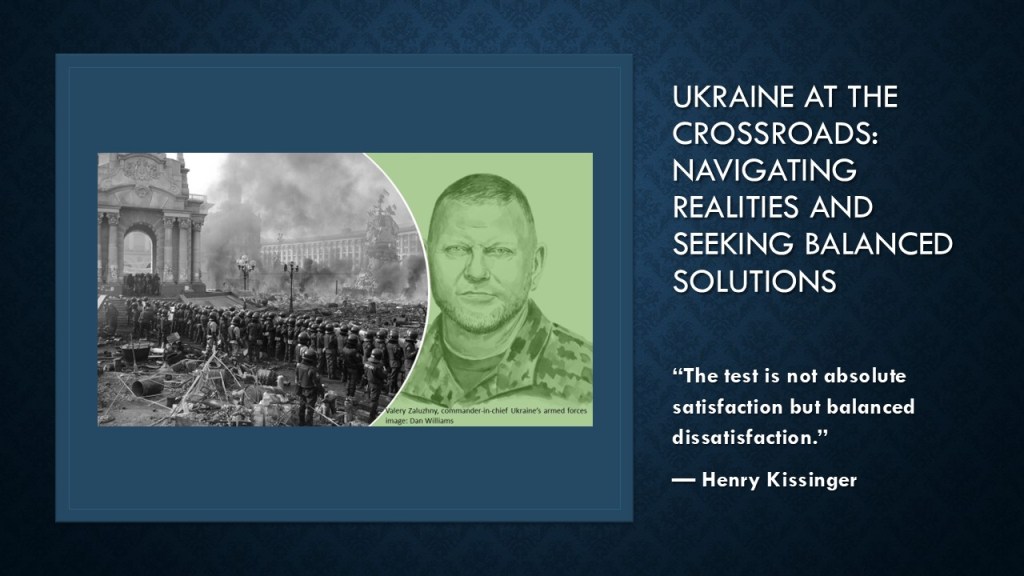
Reflecting on this tragedy, the war in Ukraine appears as an avoidable catastrophe. A failure or unwillingness to consider both sides of the coin is evident. In a recent interview with The Economist on November 1st, 2023, Valery Zaluzhny, the commander-in-chief of Ukraine’s armed forces, provided a more realistic assessment of the current situation.
In an anarchic world where states compete for power based on “balance of power” policies, conflicts are a constant possibility. Nations, when vital security is at stake, act in their self-interest, often disregarding prevailing international rules. The spark that ignited the tension between Russia and Ukraine echoes the First World War scenario, leading to devastating events and a clear violation of international law by Russia.
In a world where arguments are more fuelled by passion than reason, the complexity of the war in Ukraine demands nuance—a rational examination of the reasons, values, and security interests of both sides. The global landscape suggests the relevance of the Kissinger-era paradigm of “spheres of influence” and “balance of powers” in solving the Ukraine issue.
However, historical decisions, such as Ukraine aligning as a Western outpost against Russia, set the stage for the geopolitical chessboard. Russian annexations in violation of international law raise questions about the balance of power, the cost of the war, likely outcomes, and the best achievable goal for Ukraine.
As the conflict enters its third winter since the Russian invasion, with the Rasputitsa, with “General Mud” or “Marshal Mud,” arriving, President Zelensky seeks the return of 2014 borders, even if it means a protracted war. The reality of conflict, as highlighted by Thucydides in ancient times, emphasizes the role of money beyond soldiers and weapons.
General Zaluzhny admits Russia’s superiority in weapons, equipment, missiles, and ammunition, foreseeing an extended period of static and attritional trench warfare. This is benefiting Russia, allowing it to rebuild its military power, eventually threatening Ukraine’s armed forces and the state itself. Increased funding is deemed necessary, demanding advanced weapons, long-range missile systems, and logistic support for Ukraine.
President Zelensky disagrees with his general’s realism, but the geopolitical landscape is changing rapidly. In a race against time, Ukraine faces challenges on the international stage, marked by BRICS expansions and shifting alliances. Sanctions and isolation have not weakened Putin’s rule, and the Israel Palestinian conflict and global geopolitical changes favour Russia.
With the U.S. facing potential political anarchy, European leaders like Ursula von der Leyen must consider the risk of a more authoritarian U.S. government. Von der Leyen’s choices, driven by a cozy relationship with the U.S., may not align with the logic of creating a strategically independent Europe.
The current EU expansion strategy to include Ukraine, Moldova, and Western Balkan countries poses risks of decreasing cohesion and increased internal tensions. As differences persist in the international community, the conflict in Ukraine calls for a diplomatic initiative to achieve an armistice and settlement, avoiding the human and economic costs of continuation.
In a thorough net assessment, a settlement emerges as the best path forward for Ukraine, enabling the rebuilding process. Negotiations become unavoidable, considering historical precedents where wars end through agreements based on battlefield realities. The settlement requires the leadership in the Kremlin and Kyiv to be conscious of the conflict’s realities, and European financiers to return to pragmatic policies.
In the words of Henry Kissinger, the test is not absolute satisfaction but balanced dissatisfaction.
William J J Houtzagerm Aka WJJH, December 2023
📌 Blog Excerpt
The war between Russia and Ukraine underscores the enduring relevance of the Kissinger-era paradigm regarding spheres of influence and balance of powers. Despite international laws, nations act based on self-interest. The conflict proves costly, and a diplomatic armistice and settlement may serve as the best solution, facilitated by pragmatic European policies. However, changes in the geo-political environment may pose challenges.
 In what kind of world do we wish to live