Elegance and Enlightenment:
A Stroll Through the Life of Madame Du Deffand in 18th-Century Paris
✍️Writer’s Note:
This essay recalls an age when thought and beauty were inseparable. In the union of elegance and reason — from Voltaire to Mozart — lies a reminder that refinement of mind and form is not vanity, but civilization’s grace.
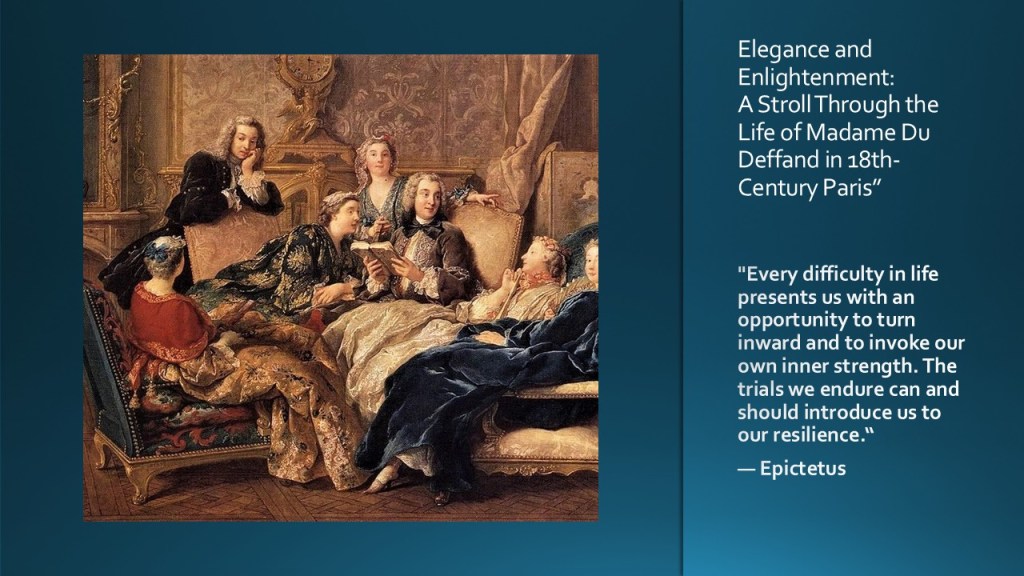
Let’s take a stroll through 18th-century Paris and explore the intriguing life of Madame Du Deffand. In the famous words of Epictetus, “Every difficulty in life presents us with an opportunity to turn inward and to invoke our own inner strength. The trials we endure can and should introduce us to our resilience.”
Life, as Lao Tzu put it, is a journey of a thousand miles that begins with a single step, emphasizing that only the first step is difficult. Paris, often considered the best place in the world to wander or “flâneur,” especially in one’s youth, invites us to flow with its streets and follow in the footsteps of writers, artists, philosophers, and intellectuals, who once called the city, and France, their home, revelling in the unique flavours Paris has to offer.
The streets of Paris conceal their own secrets, and by strolling over bridges, boulevards, and getting lost in backstreets and passages, one can hear the history and stories embedded in the streets and facades. Discovering quiet backstreets and hidden squares with cafes, hidden away from the clamour of Parisian streets is like opening an exquisite old bottle of red Bourgogne wine, particularly delightful with the company of a smart and lovely companion.
Marie-Louise, an elegantly mature lady of noble lineage, was such a companion and dear friend. Together, we roamed the daytime streets of Paris, discovering treasures imbued with traces of rich culture and history. Evenings were spent in salons engaging in stimulating conversations over dinner or supper, and nights in her Place Vendôme boudoir, where the phrase “Il n’y a que le premier pas qui coûte” was mentioned.
To truly grasp the essence of this proverb, we retraced its origin by visiting the dome of Sacre Coeur on the hill of Montmartre, the traditional site of St Denis’s martyrdom, the patron saint of Paris, and the Cathedral Basilica of Saint Denis—a masterpiece of Gothic art and a royal necropolis housing the remains of numerous French monarchs.
Our journey also led us to the headless statue of Saint-Denis, situated on the west façade of the Cathedral Notre Dame, holding his head with the Emperor Constantine, and two angels left from the Portal of the Virgin. Despite the 2019 blaze and ongoing restoration, we hope it will soon regain its former splendour.
A visit to the Panthéon, the national necropolis honouring illustrious members of the nation, revealed the final resting places of luminaries such as Voltaire, Rousseau, and Marie Curie. Leon Bonnat’s 1885 fresco depicting the “Martyre de Saint Denis” captivated our attention, portraying Denis picking up his head, accompanied by an angel offering symbols of martyrdom.
The celebrated French phrase, “Il n’y a que le premier pas qui coûte,” emanates from the Enlightenment, attributed to one of its brilliant ambassadors—Madame du Deffand, a woman of letters and a prominent figure in 18th-century French society.
Madame du Deffand, born Marie de Vichy-Chamrond in 1696, later Marquise du Deffand embodied the salon culture and the art of “le bon ton” conversation during the age of Louis XIV. Describing herself at the age of thirty-two, she proclaimed, “…Madame du Deffand is the enemy of all falseness and affection; her words and her face always interpret faithfully the sentiments of the soul…”
Benedetta Craveri’s 1982 biography, “Madame du Deffand and Her World (1),” provides a brilliant account of this intelligent libertine’s scandalous life, enhancing the essay about the marquise in “Lytton Strachey’s Books and Characters (1922,4).” The narrative unfolds the three stages of her life – debauchery in youth, worldly success in middle age, and religion prudently embraced at the very end– are documented through extensive correspondence, painting a nuanced portrait of Madame du Deffand and her role in 18th-century French social and cultural life, with its infatuations, its rivalries, its intrigues, its sense of civility and its art of conversation.
Madame du Deffand, educated in the elegant convent of the Madeleine du Traisnel in Paris, entered a marriage of convenience in 1718. The differences in temperament and intelligence led to a de facto separation, propelling her, young, pretty, clever, and not extraordinarily rich, into the sophisticated and unscrupulous society of the Regency era. First briefly becoming a mistress of the Regent Philippe II, Duc d’Orléans and part of his circle of favourites and the debauchery what ruled the day.
After a failed marriage and a dubious reputation, Madame du Deffand’s made the pragmatic choice to make order in her life, to forget the past and have the past forgotten, regain social credibility and to insinuate herself into a circle with some prestige. Her pragmatic choices led to a long-term relationship with Charles-Jean-François Hénault, president of the Chambre des Enquêtes. The Court of Sceaux, the private court of the duchess of Maine, with its nights of gambling, concerts, and masked balls, marked a turning point in her life. Here, she established herself as a leader in the society of the Enlightenment.
Madame du Deffand’s salon, located in the Saint-Joseph convent from 1747 onward, hosted luminaries such as Voltaire, Montesquieu, and Fontenelle. Her salon became a prominent gathering place for civil society and the intelligentsia during the classical epoch, characterized by decorum, refined manners, and aristocratic virtues.
Undoubtedly, Madame du Deffand was one of the most intriguing and captivating women of her time—an aristocrat of the Paris salons. Gifted with intelligence, wit, and a rebellious spirit, she navigated a world shaped by women, where some of the most distinguished men and women of Parisian aristocracy frequented her gatherings.
Despite her critical insights, Madame du Deffand, plagued by perpetual boredom and existential angst, found solace in the distractions Paris offered. Her later years were marked by existential pessimism, evident in a 1764 letter to Voltaire, where she mused, “There is rightly speaking, only one misfortune in life, which is to be born, for the very reason you must die, of that we are sure and nature revolts so strongly against this”
Madame du Deffand’s salon remained a cultural epicentre, embodying the spirit of the Enlightenment. Here the marquise gathered them together around the large armchair with a curved back in the shape of a canopy which was nicknamed the “tonneau de la marquise.” A woman devoted to the art of amiable and polite conversation, she presided over a gathering of aristocrats, diplomats, and intellectuals, leaving an indelible mark on the tapestry of 18th-century French society.
Alas, shortly after turning fifty, Madame du Deffand’s eyesight began to wane, gradually descending into total darkness by the age of 57 in 1753. Faced with this unfortunate circumstance, the marquise redirected her focus inward. For the remainder of her life, she grappled with insomnia and internal ennui, bearing it all with dignified stoicism. Though she allowed herself occasional visits to the opera, plays, and suppers, and chariot rides along the boulevard, her presence was mostly confined to the drawing room, swiftly becoming the most celebrated in Europe.
In 1754, she welcomed Mademoiselle Julie de Lespinasse, the illegitimate daughter of her brother, Gaspard-Nicolas de Vichy, Comte de Champrond, into her salon to assist in entertainment. Mademoiselle became a significant figure in the marquise’s life. However, over time, their relationship soured as Mademoiselle Lespinasse’s wit and charm garnered attention, leading to a rift when she received visitors one hour before her benefactor appeared. The discovery in 1764 led to Mademoiselle de Lespinasse’s swift dismissal, causing deep resentment in the marquise, viewing it as a betrayal.
Supported by literary and intellectual followers such as d’Alembert, Mademoiselle Lespinasse established her own salon, drawing some aristocrats away from Madame du Deffand’s circle. Despite this, Madame du Deffand’s salon evolved, taking on a more worldly tone after being purged of Encyclopaedists, with the influence of Horace Walpole becoming paramount..
From 1765, at the age of 67 and undeterred by blindness or age, Madame du Deffand retained her status as one of the wittiest and most intelligent women in Paris. She developed a strong affection for Horace Walpole, an English antiquarian, collector, and writer twenty years her junior. Initially hesitant to acknowledge the intimacy due to the age difference, Walpole the strongest and most durable of all her attachments, maintained a close and voluminous correspondence with Madame du Deffand over fifteen years, making regular visits to Paris.
The twilight years of Madame du Deffand were marked by a warmer and more intimate circle of aristocratic friends. Upon her passing in 1780, she entrusted her dog Topton and her collection of papers to Horace Walpole, a responsibility he had accepted in January 1771, well before his last visit in September 1775.
Their correspondence from 1766 to 1780, consisting of 850 letters on each side, along with manuscripts, assays, and portraits, is housed in the Lewis Walpole Library. This collection offers valuable insights, complemented by Wilmarth S. Lewis’s compilation and a chapter from “Rescuing Horace Walpole” titled “Tonton’s Snuffbox,” describing the friendship between Horace Walpole and Madame du Deffand(3,4).
Among Madame du Deffand’s many witty sayings, her best-known retort is to a conversation, when a garrulous and credulous Melchior Cardinal de Polignac (1661-1742), diplomat, Cardinal, and Neo-Latin poet, recounted to the Duchesse of Maine the martyrdom of Saint Denis in the third century, the first bishop of Paris at Montmartre.
How during the persecution of Christians by the Roman emperor Decius shortly after A.D. 250, the bishop, and his faithful companions the priest Rusticus and deacon Eleutherius were arrested and brought to the highest hill in Paris, now known as Montmartre, where they were beheaded.
That, said the Cardinal was well known; what was not well known was the extraordinary fact that upon execution St Denis took his head up and walked with his head under his arm all the way from Montmartre to the site where he finally collapsed, at the place where he wanted to be buried, and afterwards the cathedral of Saint Denis was dedicated to him and was built – a distance of six miles, delivering a sermon, before finally collapsing and dying.
“Can you imagine, Madame said the Cardinal, that the martyred saint carried his own head in his hands for leagues… Two leagues!”
“Ah, Monseigneur!” retorted Madame du Deffand amusingly, “dans une telle situation, il n’y a que le premier pas qui coûte. Monseigneur, in such matters, it is only the first step that costs.”
On July 7, 1763, Madame du Deffand, known for her prolific letter writing and friendships with prominent Enlightenment figures, coined the phrase “Il n’y a que le premier pas qui coûte” in a letter to the philosopher and scholar d’Alembert. This phrase, also dear to Voltaire, quoting it in the notes of “La Pucelle,” canto 1, and acknowledging its significance in a letter to Madame du Deffand in January 1764.
The enduring friendship between Madame du Deffand and Voltaire spanned over fifty-two years, marked by a shared love for the elegant Regency society, scepticism, and free thought. Their correspondence, reflections on life, death, happiness, and pain provide a precious source of information for posterity.
The friendship between Voltaire and Madame du Deffand, spanning over fifty-two years, is evident in their extensive correspondence about the complexities of life, death, happiness, and pain.
As Louis Tenenbaum observes in “Madame du Deffand’s Correspondence with Voltaire (5),” Madame du Deffand had many correspondents, but Voltaire, while not striking deep sentiments in her heart, presented the worthiest challenge to her mind and epistolary genius. Their letters, rightfully crowned the pinnacle of the genre, offer excellent models of style and expression. Beyond that, they depict the tug-of-war between the philosophes and the respectful sceptics, à la Montaigne, opposing their excesses. Most significantly, these letters offer a glimpse into the tormented soul of the marquise—a self-portrait of a deep-feeling, universally profound personality expressing the agonies of the human intellect and its despair in the paradox of life and death.”
In conclusion, Madame du Deffand’s life, marked by intellectual vigour, social upheavals, and enduring friendships, leaves a legacy reflected in her letters and the cultural milieu she shaped. Her salon, once a hub for Enlightenment thinkers, transformed with time, yet she continued to captivate with her wit and intellect until the end of her days.
WJJH / 27.12.2023
📌 Blog Excerpt
Paris is the best place in the World to Just wander, or to “flâneur” symbolized by Lao Tzu’s saying a journey begins with a single step, and to place the proverb “Il n’y a que le premier pas qui coûte” which adage originates from Madame du Deffand, a prominent figure of the French Enlightenment, in the historical perspective.
Sources:
- Bernedetta Craveri – Madame du Deffand and her World (1982) / The Age of Conversation (2006) / The Last Libertines (2020)
- Lytton Strachey’s Books and Characters – Madame du Deffand
- Lewis Walpole Library – W.S. Lewis collection of Madame du Deffand
- Celebrating Horace Walpole at 300 – Tonton’s-snuff-box
- Louis Tenenbaum – Madame du Deffand’s Correspondence with Voltaire
 In what kind of world do we wish to live