The Historical Dance of Socialism Versus Capitalism
As an unwavering John Locke liberal, I hold the belief that all individuals are inherently free, equal, and independent. Sovereignty should uphold the significance of liberty and the protection of possessions from undue interference by governments or the state. Throughout my high and college school years, engaging in political discussions with my progressive and socialist friends has been a constant, revealing a disconnect in understanding the pursuit of happiness through self-reliance and self-responsibility, without excessive state intervention.
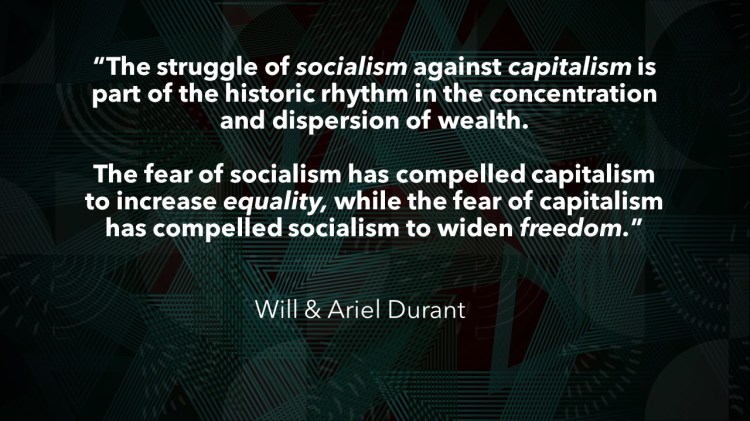
In the historical dance of socialism versus capitalism, as beautifully articulated by Will Durant and Ariel Dunant, there exists a delicate balance. The fear of socialism has prompted capitalism to address inequality, while the fear of capitalism has urged socialism to expand freedom. In present-day Europe, the social democracy movement, active since the late 19th century, has contributed to a more balanced and egalitarian society. However, the gospel of socialism and state control have sometimes been undermined by excessive taxation, leading to bureaucratic challenges and a delicate balance between public welfare and graft.
European economic decisions often prioritize fairness, equity, and reciprocity, guided by the principle of “noblesse oblige.”
“Noblesse oblige,” is a social norm where individuals of higher status, often due to familial wealth passed down through generations, feel a moral obligation to be generous and contribute to the welfare of those of lower status. This obligation is driven by a desire for excellence and selfless service, rather than a sense of superiority.”
This reflects a commitment to making a positive impact and contributing to the improvement of the world, emphasizing a sense of responsibility and stewardship for the well-being of others and the environment. A guiding principle for a life well-lived and a legacy that echoes a desire for positive change.
It’s crucial to acknowledge that Europe embarked on rebuilding after World War II in a different era, marked by a smaller population and a shared understanding of the necessity for sacrifices. Over seven decades, strategic investments were made in social welfare, universal healthcare, infrastructure, environmental sustainability, and education, resulting in a well-maintained societal structure.
In contrast to the United States, Europe has emphasized social coherence and economic investments over high defence spending. This choice has led to higher taxation, but it also corresponds to lower income inequality. European nations with prudent financial policies boast balanced budgets, while others have struggled with excessive national debts.
Today, influenced by neo-liberal policies, corporate taxation in Europe has lowered to a reasonable level. Despite personal taxation still being relatively high compared to the U.S., it reflects a societal choice for a civilized coexistence. European countries with effective governance and austerity measures maintain a favourable national debt-to-GDP ratio, contributing to a society with fewer marginalized individuals, a better quality of life, and higher workforce participation compared to the U.S.
The shift from Keynesian social democratic policies to market-oriented, neoliberal approaches in the 1970s reduced unemployment and increased labour force participation. This transformation, coupled with the demise of the Soviet Union and communism, led to a decline in voter support for traditional social-democratic parties in several European countries.
The emergence of the “Third Way,” an ideological compromise between traditional socialism and capitalism, was articulated in a 1976 article in Le Monde by Bundeskanzler Helmut Schmidt noting “The profits of enterprises today are the investments of tomorrow, and the investments of tomorrow are the employment of the day after.” The third way found success in figures like Helmut Schmidt, Tony Blair, Gerhard Schroder, Wim Kok, Bill Clinton, and Emmanuel Macron. However, this approach faces opposition from the far left, advocating for “democratic socialism” that aims to end capitalism rather than reconcile its contradictions.
As the world grapples with challenges like inflectional diseases like Covid and climate change, there’s a renewed push among democratic socialists to resurrect old social democratic solutions. This involves an expansion of the welfare state, increased social spending, and managed capitalism with progressive income redistribution through higher taxes on wealth, incomes, and investments. However, this approach, laden with increased debt and spending, may lead to socially unjust consequences and fiscal austerity measures in the long run.
In the contemporary global landscape, marked by increased mobility, free flow of capital, and multinational corporations’ dominance, reverting to the original Keynesian framework seems doubtful. Democratic socialists, pushing for a return to the past, might find their proposals incompatible with the realities of a globalized world, where the dynamics of society have changed, and extreme political polarization poses challenges.
In the U.S., advocates of democratic socialism, like Alexandria Ocasio-Cortez and Bernie Sanders, envision a transformative change. However, their approach faces criticism for seeking to destroy capitalism rather than reform it. The tension between private enterprise and progressive ideals underscores the complexity of the debate, as encapsulated in Winston Churchill’s words about private enterprise being a “healthy horse.”
“Some people regard private enterprise as a predatory tiger to be shot. Others look on it as a cow they can milk. Not enough people see it as a healthy horse, pulling a sturdy wagon.”
The world grapples with issues of exploitation, infectious diseases, poverty, and inequality, prompting contemplation on socialistic experiments and revolutions throughout history. While acknowledging the negative side effects of capitalism, a nuanced approach is essential to achieve a more balanced society with less inequality. Simply denouncing capitalism in favour of democratic socialism might oversimplify the intricate challenges that societies face.
William J J Houtzager, Aka WJJH – 6.1.2024
📌Blog Excerpt
Diatribe: on the dance between socialism and capitalism, emphasizing the importance of self-reliance and liberty. Arguing for a nuanced approach to balance capitalism’s negative effects rather than simply denouncing it.
 In what kind of world do we wish to live