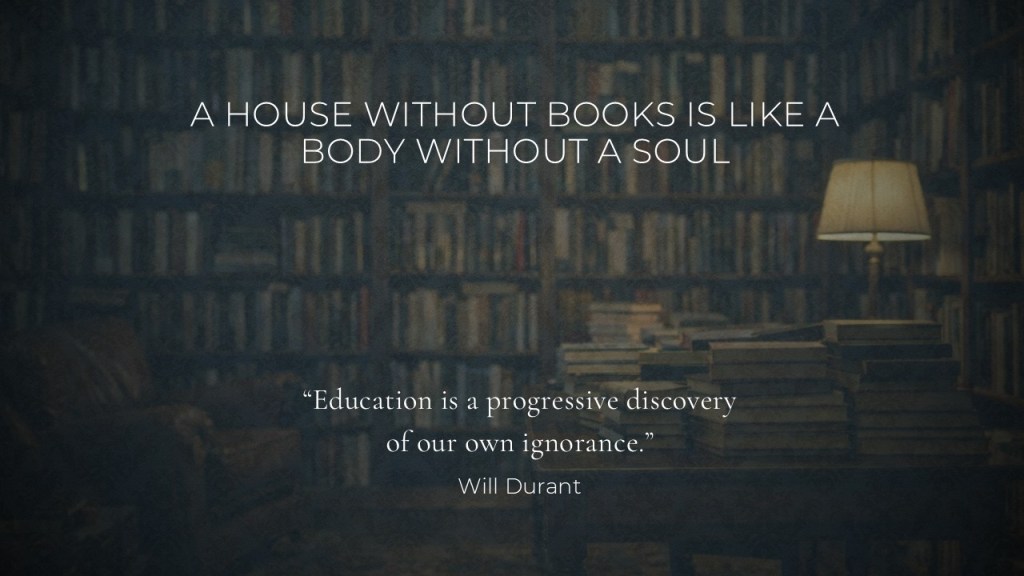
A House without Books is like a Body without a Soul
✍️ Writer’s Note
This post grew out of a deceptively simple writing prompt: “What books do you want to read?”
At first glance, it invites a list. But lists are rarely honest. What we read—and why we read it at a particular moment in life—reveals more than titles ever could. This reflection turns that question into a meditation on books as companions, orientation points, and quiet teachers in an age of distraction.


Letters to the Prompt
Dear Prompt,
You ask which books I want to read.
That question assumes choice in the narrow sense: preference, novelty, intention. For me, reading has never been about keeping up or keeping score. It is about companionship—about which voices I invite into the house, and which conversations I am willing to live with for a while.
A house without books feels unfinished. Over time, books become more than objects; they turn into markers of curiosity, doubt, resistance, and reconciliation. Shelves do not merely store volumes—they hold traces of questions once asked seriously.
At present, four books occupy my reading table. They are not connected by genre, but by concern: power, responsibility, time, and survival.
I am reading Leadership: Six Studies in World Strategy by Henry Kissinger—not as an admirer of power, but as a reader interested in its burdens. Written late in life, the book reflects on leadership stripped of slogans and moral comfort. Kissinger views history as a series of tragic choices, where leaders rarely select between good and evil, but between competing harms. Agreement is not required for engagement; seriousness is.
Alongside it lies The Precipice by Toby Ord, a book that looks not backward but forward. Ord writes calmly about existential risks—technological, environmental, and moral—and asks whether humanity can learn to act responsibly across generations. It is not a book of alarmism, but of stewardship, and it raises a question that lingers long after the page is turned: are we wise enough for the tools we have created?
For balance—and perhaps for consolation—I return to On Old Age, in the translation by Robert Allison. Cicero does not romanticize ageing, nor does he apologize for it. He presents old age as a season of judgment, proportion, and memory. In a culture obsessed with speed and visibility, this small text restores dignity to slowness and reflection.
And then there is Will Durant’s monumental The Story of Civilization, which I am re-reading rather than discovering anew. Durant reads differently later in life. What once felt like grand narrative now feels like perspective: civilizations rising and declining, not as exceptions, but as patterns. His work tempers both optimism and despair, reminding us that history is neither linear progress nor endless collapse—but a long human attempt to make sense of power, meaning, and mortality.
Together, these books form an unplanned dialogue:
between past and future,
between responsibility and restraint,
between urgency and endurance.
They will keep me occupied this year, no doubt. But more importantly, they will keep me oriented. In an age where noise overwhelms thought and immediacy crowds out judgment, books remain among the few places where ideas are allowed to mature in silence.
They do not shout.
They wait.
And perhaps that is why a house without books feels like a body without a soul.
📌 Closing Quote
“Education is a progressive discovery of our own ignorance.”
— Will Durant
William J J Houtzager, Aka WJJH – 27.1.2024
📌Blog Excerpt
The post delves into the profound relationship between reading and self-reflection, proposing that books can be companions, teachers and markers of our experiences. It emphasises the importance of engaging with diverse perspectives, particularly in an increasingly noisy world. Ultimately, as Cicero argued, a home without books is incomplete — it is like a body without a soul.
 In what kind of world do we wish to live