Navalny’s Lagacy: Challenging Putin’s Russia
✍️ Author’s Note
This post reflects on the life and death of Alexei Navalny—a symbol of resistance, sacrifice, and the enduring possibility of dissent in authoritarian systems. It questions what his legacy means for Russia, and for us.
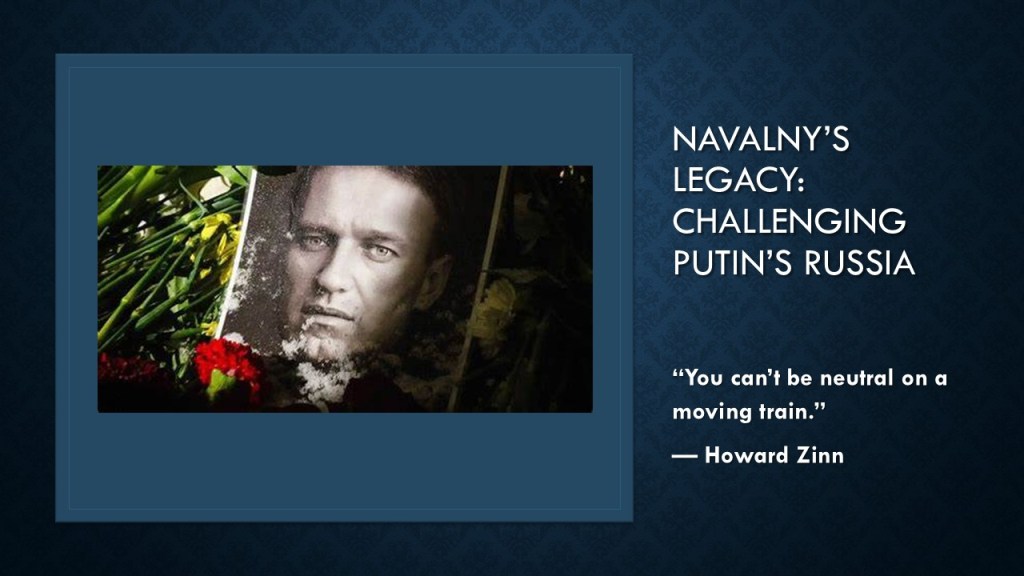
The demise of Alexey Navalny at the age of forty-seven, a prominent nationalist and the undisputed leader of anti-Kremlin political forces, as well as a figure opposed to Russian President Vladimir Putin, is indeed tragic. It marks a pivotal moment for Russia’s fractured pro-democracy movement, although not entirely unexpected given the repressive nature of the regime. Navalny’s passing adds his name to a list of critics, including Boris Nemtsov, Boris Berezovsky, Alexander Perepilichnyy, Sergei Magnitsky, Alexander Litvinenko, and Anna Politkovskaya, who paid the ultimate price for their opposition and persistence.
The response from the West was swift and expected, with both the US and Europe accusing the Kremlin of culpability in Navalny’s demise. US Secretary of State Antony Blinken remarked, “His death in a Russian prison and the fixation and fear of one man only underscores the weakness and rot at the heart of the system that Putin has built. Russia is responsible for this.”
Western perspectives often harbour a somewhat romanticized view of the harsh realities within Russia. Throughout its history, Russia has been governed by autocrats, with authoritarianism deeply ingrained in the culture, organized around a ruler exercising absolute power. Opaque cliques amass vast wealth, connected through hierarchical client-patron relationships, all subject to the ruler’s whims.
Russia, with a median age of 39.2, tends to harbour conservative sentiments. Many of these opinions are entrenched in traditional worldviews and show little inclination to return to pre-Putin chaos. Despite Navalny’s popularity among young urbanites, he failed to garner widespread support among average Russians to incite the desired change akin to a Russian Spring or colour revolution.
The notion that Russia will transform post-Putin remains highly questionable. While Navalny gained prominence as a leading opposition figure, unlike the charismatic Boris Nemtsov, he never held public office. Born in 1976 in Butyn, a Moscow suburb, Navalny began his political journey with Yabloko, Russia’s oldest liberal democratic party, but was expelled in 2007 due to his “ethno-nationalist views”, denunciations of “ethnic criminality,” asserting that the future in Russia belonged only to the nationalist Russian political process.
Navalny’s political evolution over the past decade witnessed shifts from Russian nationalism, marked by his involvement in far-right movements and nationalist groups like the Movement Against Illegal Immigration and Great Russia and in involvement in the “Russian Marches,” a gathering with ultranationalists, monarchists, and white supremacists. Navalny even advocated for gun rights and expressed xenophobic views, calling for the deportation of migrants from Russia.
In Navalny’s 2013 bid to become mayor of Moscow, his central theme was also illegal immigration from Central Asia, a subject dear to his heart. In 2014, after Russia occupied Crimea, he said that, while he opposed the invasion, he did not think that Crimea could be just “handed back” by a post-Putin Russian government.
Navalny’s nationalist rhetoric persisted until he shifted focus to anti-corruption campaigns and left-leaning economic positions, even advocating for same-sex marriage rights. He followed a strategy of adopting new positions—without ever explicitly denouncing old ones.
Despite his changing stance, doubts lingered regarding Navalny’s sincerity in moving away from his nationalistic past. He mobilized diverse protesters across Russia, yet his ultimate leadership style remains unknown.
Navalny’s activism culminated in mass protests against government corruption, notably the 2017 demonstrations triggered by the Anti-Corruption Foundation’s investigations into Dmitry Medvedev’s assets. In 2018, he became the leader of the opposition party Russia of the Future, opposing Putin’s brand of nationalism based on Soviet empire nostalgia.
However, his efforts were consistently met with repression, culminating in his poisoning with a Novichok nerve agent in 2020, an incident reminiscent of the Skripal poisoning in Britain.
Despite facing adversity, Navalny remained resolute in his convictions, urging Russians not to succumb to fear and demonstrating unwavering resolve even in the face of imminent danger. His sentencing to 19 years in prison for “extremism,” further underscores the challenges posed to dissent in contemporary Russia.
By returning to Russia, Alexey Navalny committed the supreme act of opposition and defiance against Vladimir Vladimirovich Putin, and passed away on February 16, 2024, in a remote penal colony in the Arctic Circle. His is legacy serves as a reminder of the enduring struggle for freedom in Russia, a battle far from over even in his absence.
Netherlands, WJJH – 18 February 2024
📌 Blog Excerpt
Alexey Navalny, a key figure in Russia’s anti-Kremlin movement, has died at 47. His passing underscored the challenges of dissent in Russia. Navalny’s evolution from nationalist to anti-corruption activist remains contentious, leaving a complex legacy in the country’s ongoing struggle for freedom.
 In what kind of world do we wish to live