Opinion: Vladimir Putin’s Useful Idiots
✍️ Author’s Note
This opinion refers to the critique in some circles, among them The Economist using the over-simplistic terms as “Vladimir Putin Useful Idiots.” This post explores how Western voices, intentionally or not, echo Kremlin narratives under the guise of realism or anti-imperialism. It asks when critique becomes complicity—and who benefits from moral confusion
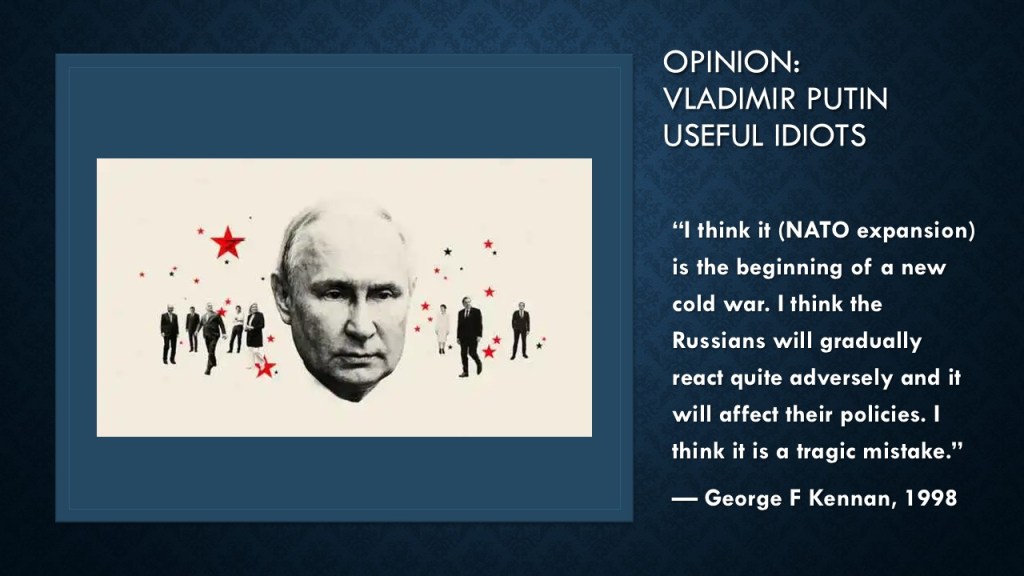
George F. Kennan (1904-2005), the eminent American diplomat, articulated the “containment and encircling” doctrine that has defined American policy toward the former Soviet Union since its inception, displaying remarkable foresight in anticipating the demise of the Soviet Union. Kennan also cautioned in 1948 that no Russian government would ever willingly accept Ukrainian independence and observed the absence of a clear dividing line between Russia and Ukraine. However, Kennan’s influence waned after his opposition in 1949 to the growing militarisation of U.S. foreign policy. Despite his stance against the Vietnam War, the nuclear arms race, and the Iraq War, American administrations sought his counsel until the late 1990s.
In 1998, Kennan cautioned against NATO’s initial expansion, foreseeing it as the most pivotal error of American policy in the post-Cold War era, suggesting that Russian reactions would gradually turn adverse and influence their policies. Ultimately, Kennan concluded that a separate and independent Ukraine could only be sustained through force.
Considering today’s landscape through Kennan’s wisdom, one is inclined to reflect on the prevalence of passion over reason and pragmatism in contemporary discourse, particularly amid the complexities of the Ukraine conflict and the pursuit of liberal hegemony. Addressing these demands nuanced analysis—an impartial examination of the motivations, values, and security concerns of all parties involved, alongside the geopolitical dynamics shaping these events.
While acknowledging the legitimacy of Russian security concerns articulated by Zbigniew Brzezinski and others, it’s crucial to recognise that the roots of the Ukraine conflict stem from multifaceted origins, not solely neglecting Russian security interests. The ongoing events in Ukraine, marked by atrocities and genocidal intent, constitute a blatant violation of international law, with Russia’s annexation of Crimea and Eastern Ukrainian provinces undermining the principle of sovereignty and challenging the international rules-based order.
Some realists, the undersigned included, reflecting on historical arguments, contend the conflict in Ukraine, dating back to the late 1990s, could have been avoided, much as it was created. Citing Henry Kissinger “Far too often the Ukrainian issue is posed as a showdown: whether Ukraine joins the East or the West. But If Ukraine is set to survive and thrive, it must be neither outpost against either side outpost against the other-it should function as a bridge between them.”
Ukraine decided otherwise, and made the choice not to be a neutral state in world affairs, but to be bridgehead for the West against Russia. This choice can be seen as the catalyst to the conflict and with this decision the fuse of the conflict was lighted and started to burn. George F. Kennan’s relevance endures today, echoing Cicero’s timeless query: “Is an unjust peace better than a just war?”
However, the term “Putin’s useful idiots,” despite containing elements of truth, risks oversimplifying complex geopolitical realities and may alienate those realists who hold legitimate concerns about the state of democracy or who advocate for alternative approaches to foreign policy. While acknowledging Russia’s interference in Western democracies, it’s imperative to recognise the broader erosion of democracy globally, evident well before Moscow’s interventions. The term also encompasses national populists and conservative politicians who have aligned with Russian interests, fostering nationalism and undermining European unity.
It is the paradox of our times, that despite the reverence for democracy, in many countries’ democracy is regressing giving the betrayal to its own principles. In this context, the European Commission, under Jean-Claude Juncker and Ursula von der Leyen, faces criticism for failing to uphold its standards and pursuing a risky enlargement strategy, empowering Eurosceptic leaders to weaken the EU from within.
Reflecting on the balance of power and spheres of interest, blame for the Ukraine crisis cannot be solely attributed to the overreaching U.S. and its European allies who made Ukraine a pawn on the geo-political chessboard. Russia and Ukraine are also implicated, with the conflict arising from geopolitical competition and power dynamics in the Eurasian region.
In conclusion, while acknowledging the complexities of the Ukraine crisis, and the diverse range of opinions and motivations that shape them, the use of the term “Putin’s useful idiots” is futile, potentially dismissing legitimate criticisms or differing perspectives on Western policies and strategies. However, the imperative remains to navigate these intricate issues with sobriety and discernment, seeking balanced solutions that prioritise peace, stability, and respect for international law.
Netherlands, WJJH – February 2024
📌 Blog Excerpt
George F. Kennan, the influential American diplomat, shaped U.S. policy towards the Soviet Union and warned of the challenges in Russian-Ukrainian relations. His insights still offer valuable perspective on current global affairs, urging a nuanced analysis of motivations and geopolitical dynamics. The Ukraine crisis does not need oversimplistic terms like “Putin’s useful idiots” but warrants serious and careful consideration to prioritize peace, stability, and international law.
 In what kind of world do we wish to live