Echoes of History: From Weimar to Washington
✍️Author’s Note
History never repeats, yet it rhymes. This essay traces how democratic decay often begins not with violence, but with indifference. From Weimar’s collapse to today’s America, the echoes are uneasy and urgent. Memory is our only antidote to forgetfulness.
Voltaire famously observed, “Those who can make you believe absurdities can make you commit atrocities.” Donald J. Trump exemplifies such a figure, as evidenced during his first term—a presidency marred by frequent clashes with truth and the utilization of “fake reality” or “Lügenpresse” to undermine the media and sway public opinion.
The tool of fake reality is favoured by autocrats to discredit media outlets, sow confusion among the populace, and divert attention from substantive issues. President Trump’s assault on democratic foundations found support within the Republican Party, which now grapples with moral decay.
Trump’s initial tenure was marked by heightened nationalism, increased military spending, a burgeoning and unsustainable budget, and the forcible separation of parents and children. Minorities and religious groups faced degradation, while democratic and moral values came under attack, stoking racism and resentment through fear and anger—hallmarks of fascism—to obfuscate genuine concerns.
By disregarding Russian interference in the 2016 elections, Trump imperilled American security and posed an existential threat to global peace, stability, and prosperity. The tactics of employing “fake reality” or “Lügenpresse,” reminiscent of Germany in the 1930s, seek to distort truth, foster multiple versions of reality, and erode accountability, effectively nullifying the concept of objective truth.
The term “Lügenpresse” was first used by German author Reinhold Anton in 1914 during World War I, later weaponized by Adolf Hitler to vilify opposition and sow distrust in intellectuals, Jews, communists, and foreign press. Contemporary Russia, following suit, modernized this disinformation campaign to blur the lines between analysis and propaganda, truth and falsehood, undermining trust in institutions and the rule of law to consolidate autocratic power.
The resurgence of “Lügenpresse” by European far-right parties and Trump’s propagation of “fake news” bolster extreme right movements globally, echoing Putin’s efforts to destabilize the European Union. While parallels with the 1930s exist, Trump’s presidency heralds fascism in America, akin to Hitler’s rise in Germany.
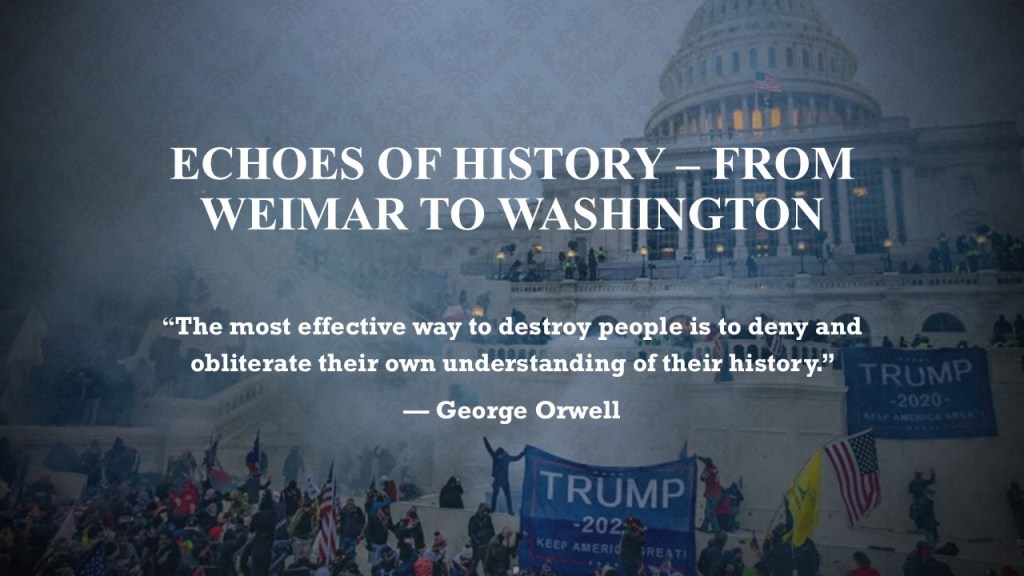
Hitler’s 1923 Beer Hall Putsch, aimed at seizing autocratic control in Bavaria, mirrors Trump’s failed insurrection on January 6, 2021, both fuelled by conspiracy theories, fake news, lies, and nationalism. While Hitler preyed on post-World War I humiliation, Trump capitalized on baseless claims of election fraud, attempting to subvert democracy and cling to power—an endeavour that, like Hitler’s, met legal consequences for treason.
In 1932, Hitler embarked on his path to power, securing 30.1% of votes in the first round and 36.8% in the second round of elections, while Paul von Hindenburg, in declining health, claimed 53% of the votes. Hitler’s appointment as chancellor on January 30, 1933, paved the way for Nazi ascendancy.
Similar to today’s GOP, the conservatives led by former Chancellor Franz von Papen believed they could control Hitler, only to rue their miscalculation. Allowing him to form a minority government, they inadvertently enabled Hitler’s assault on democracy, its institutions, and the Weimar Republic.
Hitler, like Trump, vilified the press as “Lügenpresse,” using his propaganda apparatus to delegitimize the free press, demonize opponents, and exploit racism against minorities. He purged dissenting voices from the government, empowered security services to target political adversaries, and incarcerated opponents.
In 1932, complicity with the supreme leader was rife, with some privately regretting Hitler’s brutality yet acquiescing to his agenda of nationalism. They normalized his actions, echoing the sentiment, “It’s better to serve the devil you know than the devil you don’t.”
Echoing Hitler’s ascent, Trump’s first term rallied behind the slogan “Make America Great Again” (MAGA), undermining democratic institutions and the rule of law. Like Hitler, who withdrew of the League of Nations, Trump withdrew from international commitments, and eroded the foundations of democracy.
By 1933, legislation enabled Hitler’s minority government to:
- Undermine the judiciary and appoint sympathetic judges.
- Curtail freedom of speech and the free press.
- Prohibit public gatherings.
- Suspend civil liberties.
- Prosecute political adversaries.
By 1934, democracy lay in ruins as Hitler consolidated control over institutions.
Today, Trump’s actions echo the 1930s playbook, imperilling America’s security alliances and global stability. The transatlantic relationship, pivotal since WWII, faces unprecedented strain, and American exceptionalism teeters under the weight of internal turmoil.
A second Trump term, fuelled by narcissistic rage, would extend repercussions beyond U.S. borders, posing a threat akin to history’s darkest chapters. As history unfolds, the spectre of the past reemerges, a sobering reminder of the dangers of complacency.
William J J Houtzager, Aka WJJH, March 2024
📌Blog Excerpt
Donald Trump’s presidency, marked by attacks on truth, the media, and democratic norms, recalls the early warnings of Weimar Germany. Like Hitler’s 1923 Beer Hall Putsch, the January 6 insurrection was fuelled by conspiracy and nationalist fervour. These parallels warn of the fragility of democracy when populism feeds on fear and lies.
 In what kind of world do we wish to live
One thought