The Economist: “What if Ukraine Loses?”
✍️ Author’s Note
This post is a response to The Economist’s provocative question, examining the deeper implications of a Ukrainian defeat—not only for Ukraine, but for Europe, NATO, and the credibility of liberal democracies in an era of rising authoritarianism.
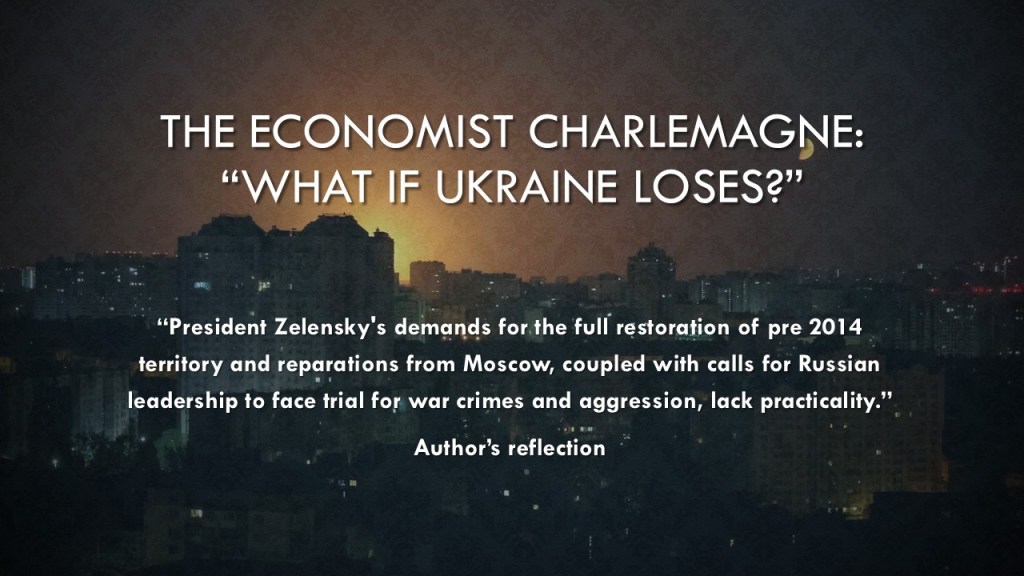
“What if Ukraine were to Lose?” Charlemagne posed this question in The Economist, prompting a sombre reflection on the tragedy unfolding in Ukraine. It’s evident that the war in Ukraine represents a catastrophic outcome that could have been avoided with a more balanced approach.
Over the past decade, since 2014, eastern Ukraine has been locked in a stalemate, with the spectre of a Russian summer offensive looming. Ukraine’s once-high hopes of victory now seem unrealistic, given dwindling support and the looming threat of total destruction. President Zelensky’s demands for the full restoration of territory and reparations from Moscow, coupled with calls for Russian leadership to face trial for war crimes and aggression, lack practicality.
Ukraine stands at a critical juncture, as the era of illusion draws to a close. There’s a serious risk that Ukraine may not emerge victorious from this conflict. While uncomfortable to contemplate, the world may simply shift its focus from this regional conflict to other pressing issues if Ukraine were to lose.
In a world where emotion often overrides reason, the complexities of the Ukrainian conflict demand a more nuanced examination—a rational exploration of the motivations, values, and security interests of all parties involved. The geopolitical landscape suggests that the Kissinger-era principles of “spheres of influence” and “balance of powers” hold relevance in resolving the Ukraine crisis.
However, historical decisions, such as George W. Bush’s rejection of traditional geopolitical concepts and the harmony of “spheres of interests” in favour of American hegemony, have contributed to the current proxy battlefield in Ukraine. By aligning itself as a Western outpost against Russia, Ukraine made itself a pawn on the larger geopolitical chessboard.
Russian annexations, in violation of international law, underscore the need to reassess the balance of power, the costs of war, likely outcomes, and achievable goals for Ukraine. A settlement emerges as the most viable path forward, enabling the rebuilding process to begin. Negotiations are inevitable, drawing on historical precedents where conflicts ended through agreements grounded in battlefield realities.
As Henry Kissinger aptly stated, “the test is not absolute satisfaction but balanced dissatisfaction.” Finding this balance will require conscious efforts from leaders in both the Kremlin and Kyiv, as well as a return to more pragmatic policies by European financiers, which have allowed themselves to be dragged into this quagmire.
Netherlands, WJJH-April 2024
📌 Blog Excerpt
The Economist Charlemagne’s “What if Ukraine were to Lose?” prompts reflection on the war as Ukraine faces dwindling support and a looming Russian offensive. President Zelensky’s demands seem impractical, and Ukraine’s victory is uncertain. The conflict underscores the complexity of geopolitical interests, and a balanced settlement is necessary. Leaders must strive for balanced dissatisfaction and pragmatic policies.
 In what kind of world do we wish to live