Margraten: A Legacy of Sacrifice
✍️Author’s Note
Written in remembrance of those who crossed oceans to liberate a continent not their own. Margraten is more than a cemetery — it is a landscape of gratitude, where history breathes through the silence of aligned white crosses. Memory demands not sentiment, but vigilance.
Freedom is never more than one generation away from extinction.”
— Ronald Reagan
On May 4th, the Netherlands observes “Dodenherdenking” Remembrance Day, while on May 5th, we celebrate “Bevrijdingsdag,” marking the liberation by Allied forces and the end of the Nazi occupation during the Second World War. This day symbolizes the freedom we enjoy, a freedom that encompasses the ability for individuals to act, think, and express themselves as they choose. However, in an era marked by populism, nationalism, and the rise of national populism, the cherished freedom from tyranny and the liberty from fear come at a cost.
The remembrance of the dead, a solemn occasion dedicated to honouring the soldiers and civilians who have perished in conflicts since World War II. At 20:00 hours, a nationwide moment of silence lasting two minutes is observed, with the central ceremonies taking place in Amsterdam at the National Monument on Dam Square. These ceremonies are attended by members of the cabinet, the royal family, and other dignitaries.
This day serves as a time for deep reflection, prompting us to acknowledge the debt of gratitude owed by Europeans to the United States and its allies for their crucial role in World War II and their efforts in defeating the atrocities of fascism. This debt, born out of sacrifices that can never be forgotten, remains immeasurable and unrepayable. However, it has been expressed through the enduring friendship between nations, which has been nurtured and strengthened over time by historical, cultural, and economic bonds, as well as a shared commitment to individual freedoms, democratic values, and human rights, principles that have been upheld since the early days of American independence.
This shared commitment has fostered a resilient alliance between the United States and Europe, echoing the visionary ideals outlined by Walter Isaacson and Ivan Thomas in “The Wise Men: Six Friends and the World They Made,” ideals that encapsulated the post-war era.
As we pay tribute to the victims of World War II, confronting the evils of anti-Semitism, fascism, racism, extremism, and political violence, we cannot ignore the troubling parallels with the resurgence of neo-fascist and far-right ideologies in contemporary times. Fascism, like a pernicious weed in a garden, threatens to poison the entirety of society if left unchecked. It is evident that since the end of World War II, we have not done enough to uproot these dangerous ideologies.
In the establishment of the United Nations, President Truman aptly reminded us that eradicating tyrants and dismantling concentration camps is simpler than dispelling the ideas that spawned and fortified them. This underscores the enduring challenge of combating ideological extremism.
This leads to the sombre realization that the true test of whether we have gleaned lessons from history and truly internalized the mantra of “never again” will come when the last survivors of World War II, my generation, have passed on.
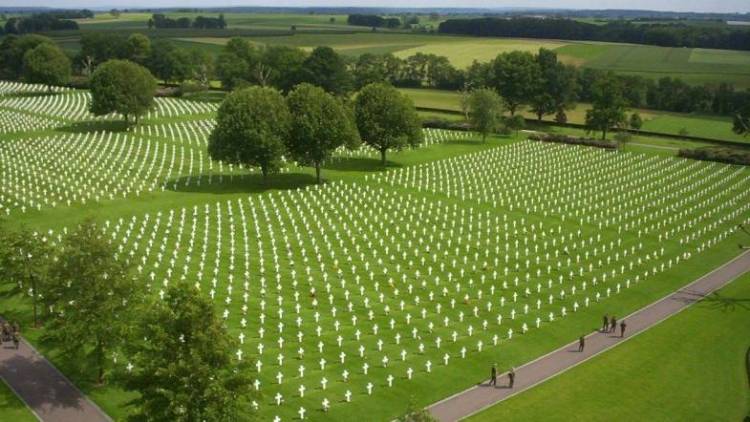
The Netherlands American Cemetery and Memorial in Margraten stands as a poignant testament to the sacrifices made during World War II. Situated on sixty-five acres of gently sloping landscape, it serves as the final resting place for 8,301 American liberators. The solemnity of the site is palpable, with rows of white marble crosses and Stars of David serving as reminders of the youthful lives laid down in the pursuit of freedom.
Upon entering the Court of Honor, visitors are greeted by a reflective pool and a towering statue representing the women who endured profound loss. Flanking the court are the Tablets of the Missing, bearing the names of 1,722 individuals whose remains were never found.
Since 1945, local communities, families, and individuals have adopted each grave and memorial, with many adorned with flowers as a gesture of gratitude towards the fallen liberators and their families. This tradition serves as a poignant reminder of the enduring impact of their sacrifice.
William J J Houtzager, Aka WJJH, May 2024
📌Blog Excerpt
On May 4, the Netherlands observes Remembrance Day, followed by Liberation Day on May 5 — a moment to reflect on World War II sacrifices and the debt owed to the United States and its allies. The Netherlands American Cemetery at Margraten stands as a poignant testament to courage and compassion, its adopted graves symbolizing a living bond between liberators and the liberated.
 In what kind of world do we wish to live