Looking in the Mirror: Angela Merkel, Our Humanity, and the Refugees
The Rise of Populism and Nationalism
In recent years, political movements that exploit people’s emotions, insecurities, and fears have gained momentum. This surge is fuelled by crises, conflicts, and wars, and by a pervasive sense that globalization has negatively impacted many people’s lives with no apparent way to mitigate these effects. As a result, populism and nationalism are on the rise across Europe.
The Refugees Crisis and Europe’s Response
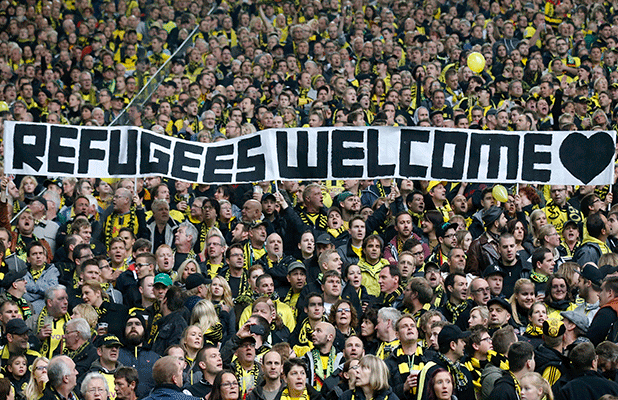
Recent elections have shown increased support for extreme right-wing national populist forces in the European Union, which have leveraged refugees and immigration as central themes to their advantage. How Europe treats refugees is a reflection of how it treats human beings, a measure of its dignity and humanity. However, there is a glaring disparity in Europe’s treatment of different refugee populations. Ukrainians, who often share the same religion and skin colour as many Europeans, are prioritized over others, making some refugees seem less deserving. This preferential treatment violates Article 3 of the 1951 Refugee Convention and the unwritten laws of basic human decency.
The Refugees in the Netherlands
The treatment of refugees in my home country the Netherlands, given our history as a refuge for the persecuted, is a source of great embarrassment. According to justice ministry inspectors last December “the most basic demands in terms of bed and board” are not being met. The appointment as Minister of Refugees and Immigration of Marjolein Faber, a former senator for the extreme right-right PVV, who has referred to Islam as a hateful ideology in parliament, used the term “Umvolkung,” a term rooted in Nazi ideology and known for her repopulation theories, cannot be seen as an improvement. Faber has been given a significant platform to implement stricter migration policies, with domestic ambitions conflicting with European law, the treatment of refugees can be expected to get more inhumane.
Angela Merkel’s Legacy
Reflecting on Angela Merkel’s tenure as Chancellor of Germany, she stands out as a skilled problem-solver and global leader. In August 2015, Merkel welcomed Syrian refugees with open arms, showcasing her courage and commitment to human rights. Her leadership navigated multiple crises, including the Eurozone debt crisis, the refugee crisis, the COVID-19 pandemic, and Brexit. Her pragmatic and compromising approach helped keep Europe united and focused on human rights, environmental protection, citizen well-being, and economic development.
Divergences Within the European Union
The European Union has always faced internal divergences, such as those between East and West or North and South. Issues like migration, the eurozone, national identity, EU values, expansion, and sanctions against Russia have all highlighted these divides. For instance, Northern members like Germany and the Netherlands advocate for fiscal discipline, low debt-to-GDP ratios and if need be austerity measures, while Southern members like France, Italy, Greece, and Spain, with higher debt-to-GDP ratios feel in the European Union the more prosperous nations not subject to the constraints of the financial markets should share more in the burden.
Merkel’s Pragmatism and European Unity
Merkel’s pragmatic and fact-based approach to politics led to significant decisions, such as rejecting Ukraine’s NATO membership in 2008 and supporting Nord Stream 2 for Europe’s energy needs. Despite criticisms, her policies aimed at maintaining Europe’s stability and economic growth. However, during her term, the EU struggled to uphold its founding principles of human rights and the rule of law, as seen in the issues of corruption and judicial independence in Eastern European members.
The Need for Principled Leadership
Merkel’s principled stance on the migration crisis, exemplified by her “Wir schaffen das” (“We can do it”) statement, contrasted with calls to close borders. Closing Germany’s borders would have violated European law and left neighbouring countries, which were more vulnerable to stress, to handle the refugee influx alone.
Europe’s Relationship with the United States
The Trump administration’s foreign policy strained the traditionally close relationship between the EU and the US, leading Europe to reconsider its reliance on the US. This shift underscores the need for European leaders who prioritize European interests and uphold a firm moral compass, resisting the rise of nationalism and populism.
Global Interdependence and Universal Values
In our interconnected world, international institutions and laws have fostered cooperation on issues affecting peace, stability, and human well-being. Despite the benefits of globalization, there is growing disillusionment due to rising inequality and immigration challenges. Technological advancements have made us more interconnected, but they also exacerbate divisions and distrust, leading to renewed nationalism.
Selective Humanity and Refugee Treatment
The differing reactions to refugees from Ukraine compared to those from Afghanistan, Iraq, or Syria reveal a selective humanity based on race and religion. Historical examples, such as the welcome of Hungarian refugees in 1956, contrast sharply with current attitudes and actions.
Addressing Authoritarianism and Divergent Values
The EU’s financial investments in Eastern Europe have not always been tied to commitments to the rule of law and democratic values. As some Eastern European countries slide towards authoritarianism, the EU must address these divergent values and question their membership suitability.
The Need for Integration and a Moral Compass
As Merkel emphasized, “freedom of movement is one of the main principles of our European house.” Europe needs more integration, not less. Her convictions and moral principles are to be admired, but the rest of Europe must share the burden of refugee care. Our interconnected world demands universal values and a commitment to human dignity.
Welcoming Refugees for a Better Future
For those living in wealthy European countries, welcoming refugees is a moral obligation and a demographic necessity, given the aging population and changing demographic pyramid. Refugees, often well-educated, can positively contribute to society. We must reject nationalism and embrace a future of inclusion and cooperation.
WJJH – 6.7.2024
📌Blog Excerpt
The rise of populism and nationalism in Europe is fuelled by crises and globalization’s negative impact. Merkel’s legacy reflects her commitment to human rights and pragmatic leadership. The EU faces internal divergences on migration, fiscal policies, and values. The treatment of refugees and the need for principled leadership are crucial in addressing global interdependence and universal values.
 In what kind of world do we wish to live