The Dilemma of Resistance:
Moral Integrity, Political Oppression, and the Limits of Nonviolence
✍️ Author’s Note — The Dilemma of Resistance
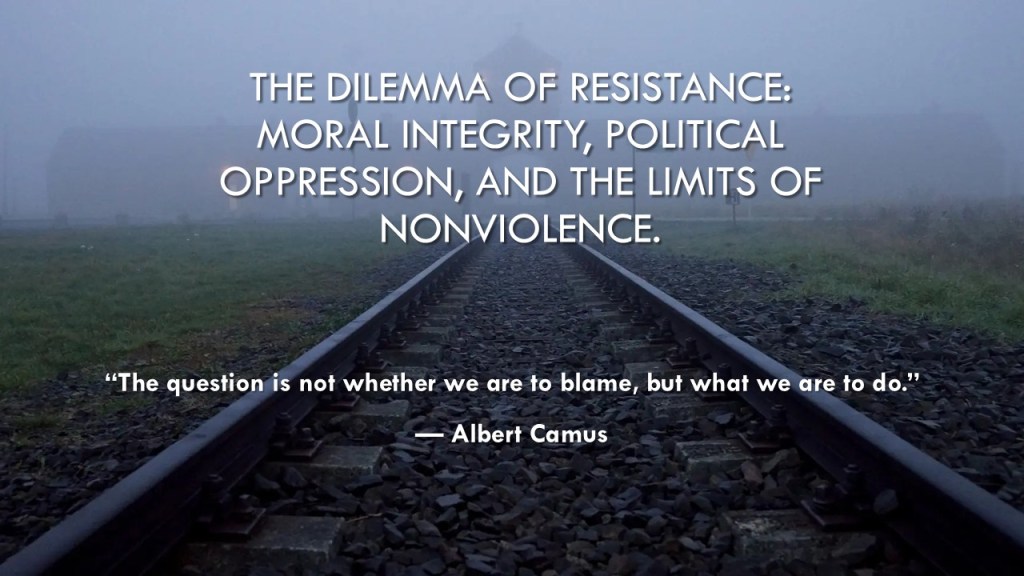
This reflection considers the moral tensions faced by those who choose to resist tyranny. Drawing from history, philosophy, and personal legacy, it explores the question of when violence becomes justified—and whether non-action is itself a form of complicity. Albert Camus captured this dilemma best: “The question is not whether we are to blame, but what we are to do.”
The question, “Would liberals genuinely consider violent opposition against an oppressive regime?” presents an intricate and thought-provoking dilemma. Liberalism traditionally emphasizes individual freedoms, human rights, and democratic principles, often championing peaceful and institutional avenues of resistance. However, when these very values are severely threatened—when oppression becomes intolerable—history has shown that liberals have, at times, resorted to violence, especially when all other avenues of resistance appeared exhausted. This decision is often justified through the framework of a “just war” or self-defence against extreme tyranny.
Philosophers like Albert Camus, alongside thinkers such as Hannah Arendt and George Orwell, identified the human desire for unity, and the impulse to escape the absurdity of life, as underlying drivers of totalitarian rule. Camus, in particular, experienced the horrors of World War II firsthand. He was an active participant in the French Resistance against the German occupation and from 1943 to 1947, served as editor of the movement’s newspaper Combat in Paris. His activism extended beyond France, as he later opposed General Franco’s dictatorship in Spain and, during the Algerian War, became a voice for peace. Camus called for an end to the violence perpetrated by both France and the Algerian National Liberation Front (FLN), advocating for a postcolonial, multicultural, and democratic Algeria. His evolving thoughts on these issues are captured in his later works, including his posthumous novel, The First Man.
Camus grappled with the moral complexities of violent resistance, particularly in his 1951 philosophical work, The Rebel, a critique of totalitarianism from a humanist perspective. Reflecting on his experiences during the French Resistance, Camus rejected nihilistic violence while recognizing the necessity of decisive action when fundamental human values were at risk. The core dilemma lies in determining when violence is a necessary form of resistance rather than a path to further harm and dehumanization.
In a world marked by injustice, acceptance or normalization of oppression is untenable. Yet, as Camus cautioned, all-encompassing explanations or hegemonic narratives should be approached with suspicion. He reminds us that the temptation to believe in a singular political ideology as a solution to humanity’s deepest needs leads to dead ends, often with tragic consequences.
Civilization progresses unevenly, and there is no universal culture that binds all of humanity. Ideological differences and cultural distinctions are real, and they persist. To insist on a universal truth or ideological conformity within the framework of liberal democracy is, ultimately, an illusion.
The belief in the universality of liberal democracy’s ideals often clashes with the reality of diverse societies, each with distinct moral, political, and ethical values. The notion of a singular solution for global peace and harmony is at odds with the complex, multifaceted reality of today’s world.
On an individual level, the moral question of resisting oppression is a profound exercise in empathy and self-awareness. It forces us to confront our values, our boundaries, and the extent of our courage. While it’s impossible to predict with certainty how any of us would act in such circumstances, understanding historical contexts and the experiences of those who lived through them can offer valuable insights.
The final answer to whether one would resist depends greatly on the complexities of the situation: the psychological effects of living under authoritarian regimes, the feasibility of political resistance, and the availability of an alternative vision—a vision of equality, liberty, and justice that feels worth defending, no matter the consequences.
This complex question demands an honest answer to deeply personal inquiries: What would I have felt? What would I have done? How would I have responded? The answer depends not only on one’s political leanings—whether conservative, liberal, or socialist—but also on how much one prioritizes self-preservation in an autocracy, dictatorship, or theocracy. It depends on the individual’s willingness to compromise on their values and how they can mentally, morally, and spiritually survive under such a regime.
Margaret Atwood’s The Handmaid’s Tale captures the horror of an authoritarian theocracy in which self-preservation becomes the highest hope, as the people feel powerless against the system. However, in her sequel, The Testaments, Atwood raises the possibility that individuals—given the right combination of luck, bravery, and cleverness—can fight back.
In reality, though, the answer is far more complex. History shows that there are always individuals, endowed with enough courage, intelligence, and moral fortitude, who find ways to resist once they reach a breaking point. This often becomes an uneven struggle—on one side, a powerful, ruthless state, and on the other, seemingly insignificant private individuals or groups determined to preserve their integrity, their private lives, and their personal honour.
Throughout history, there have been notable examples of individuals who, despite overwhelming odds, chose to stand against oppressive systems to preserve their integrity. These cases demonstrate how resistance can dramatically reshape the political landscape of a nation, often at significant human and social costs:
The French Revolution (1789–1799): A period of radical social and political upheaval, which led to the fall of the monarchy and the rise of the French Republic. This revolution was marked by violent events such as the Reign of Terror, during which thousands were executed.
The Russian Revolution (1917): The overthrow of Tsarist autocracy and the rise of the Soviet Union. The Bolsheviks, led by Vladimir Lenin, used armed insurrection to seize power from the Provisional Government.
The Cuban Revolution (1953–1959): Fidel Castro and his guerrilla forces overthrew the Batista regime through a series of armed conflicts and guerrilla warfare.
The Iranian Revolution (1979): Following the 1953 CIA-backed coup, the Pahlavi dynasty was eventually overthrown, and the Islamic Republic was established under Ayatollah Khomeini. This revolution involved significant violence, with clashes between revolutionaries and the Shah’s forces.
The Libyan Civil War (2011): A conflict that led to the overthrow and death of Muammar Gaddafi, involving extensive violence, including NATO intervention and widespread fighting between Gaddafi’s forces and various rebel groups.
These examples reflect how resistance, though costly, has the potential to change the course of history, often driven by individuals who refuse to yield to oppressive forces.
The Third Reich:
Resistance, Compliance, and the Moral Dilemmas of Conscience
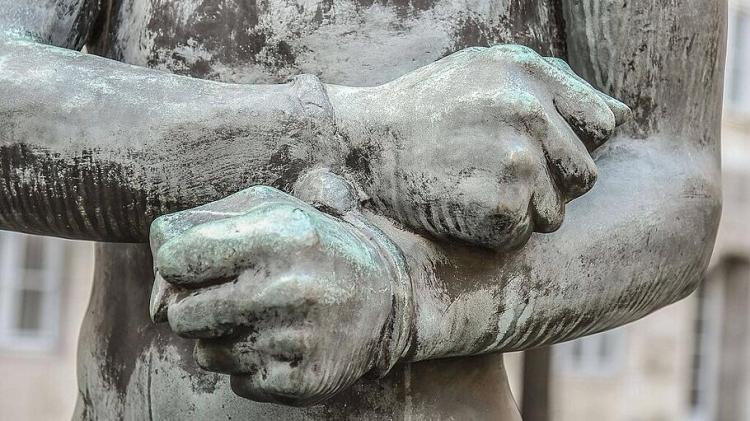
Bronze figure, young man with tied hands, statue in the inner courtyard of the so-called Bendler Block, at the historical site of the attempted coup dtat of 20 July 1944 on resistance against the Nazis, against National Socialism The statue stands at the site of the shooting of Claus Schenk Count von Stauffenberg and his co-conspirators on the night of 20 July after the unsuccessful assassination of Hitler
In the Third Reich, many individuals sought to defend their integrity and personal honour against a formidably hostile state. Often, these were ordinary people whose resistance did not take the form of overt violence but who nonetheless refused to submit to the all-powerful Nazi regime.
Professor Wolfgang Benz, an anti-Semitism researcher, has addressed the German myth of guiltlessness—the belief that, as individuals, there was nothing one could do against the Nazis. In his 2019 book Im Widerstand (In Resistance), he explores the many different ways it was possible to oppose the Nazi regime and how diverse the groups engaged in resistance were, far beyond the canonized heroes like Stauffenberg or the White Rose.
His other book, Protest und Menschlichkeit (Protest and Humanity), tells the story of the Berlin group Onkel Emil, which was formed around the journalist Ruth Andreas-Friedrich. Initially an apolitical circle, they were galvanized into action by the burning of synagogues during the November Pogrom (Kristallnacht) in 1938. As Andreas-Friedrich explained to her thirteen-year-old daughter, “We can’t stand Hitler. He’s mean to our friends. But keep that to yourself.”
Andreas-Friedrich, a woman known for her independent lifestyle and open relationship with conductor Leo Borchard, hosted many of the group’s activities in their flat in Berlin-Steglitz. The core members included figures like Dr. Walter Seitz, who would later marry Andreas-Friedrich, and the poet Fred Denger. Together, they sheltered persecuted individuals, including Jews and deserters, helped them escape from Germany, forged identification papers, and organized food supplies.
One of those they saved, Hanna Angel, a Jewish woman who later emigrated to America, wrote: “All she had to do was turn up, and everything would change. The hungry would have food, the homeless a bed, and the hopeless hope again.” The group’s name, Uncle Emil, was based on a code word they used as a warning signal. Remarkably, the group remained undetected by the Nazis until the war ended.
What made Uncle Emil special, Benz notes, was the “equal coexistence of Jews and non-Jews.” Unlike other rescuers, they did not expect gratitude or compensation. Nor were they motivated by high political ideals. Their actions were driven purely by humanity, by a personal sense of responsibility for the suffering they witnessed.
Remembering these “silent heroes” serves as a powerful counter-narrative to those who argue that resistance against the Nazi regime was impossible or futile.
Authoritarianism, repression, and nationalism dull the moral senses over time, as Nazi Germany demonstrated, where obedience gradually became habitual, and cautious abstinence morphed into enthusiastic support. The tragic result was complicity in war and genocide on an unprecedented scale.
As philosopher Hannah Arendt famously argued, the atrocities of the Holocaust were made possible by ordinary people, manipulated into conforming to a grotesque set of behavioural norms under the Nazi regime. In her exploration of the banality of evil, she showed how evil deeds often arise not from fanatics, but from unthinking individuals who simply follow orders.
Sebastian Haffner’s memoir Defying Hitler offers a powerful personal account of life in Nazi Germany, documenting his internal struggle against the regime. Haffner, who left Germany for Britain in 1938, captures the moral dilemmas faced by those living under such oppression. His other work, The Meaning of Hitler, gives a brilliant evocation of the collapse of civilization in Germany under Hitler’s rule.
The path that led to Nazi Germany was not sudden, but gradual, beginning with the aftermath of World War I and the Treaty of Versailles in the 1920s. One early indication was the 1922 assassination of Walther Rathenau, a Jewish industrialist and Foreign Minister, by a right-wing death squad that viewed his attempts to fulfil the Versailles Treaty as treasonous.
Hitler’s 1923 Beer Hall Putsch was driven by conspiracy theories, fake news, lies, and rampant nationalism. He capitalized on the postwar humiliation of Germany, and by 1932, he had begun his rise to power. The political elite, including figures like Franz von Papen, mistakenly believed they could control Hitler, but his appointment as Chancellor in January 1933 allowed him to dismantle democracy and consolidate totalitarian control.
By vilifying the press as “Lügenpresse” (lying press), exploiting racism against minorities, and purging dissent from government, Hitler reshaped Germany into a dictatorship. By 1934, with civil liberties suspended, political opponents persecuted, and democratic institutions undermined, Hitler’s grip on power was complete. Even those who privately opposed his brutality often acquiesced, rationalizing that “it’s better to serve the devil you know.”
It’s easy to judge those who supported or followed such regimes as evil or morally inferior. However, the psychological toll of living under such conditions often produces a sliding scale of complicity, from passive acceptance to active support. Repression erodes people’s sense of power, fostering negative emotions and leading many to compliance.
Christopher Browning’s Ordinary Men provides chilling insights into how ordinary people, under pressure from group dynamics and authority, became complicit in unimaginable atrocities, while Arendt’s concept of the banality of evil emphasizes the ordinariness of those who carry out horrific acts.
When political resistance is criminalized, deemed unpatriotic, or when dissenters are persecuted, violent opposition becomes a consideration. These are deeply personal, complex questions, involving the balance between self-preservation and moral integrity.
Resistance within Nazi Germany, though often overshadowed by the scale of the regime’s oppression, took many forms. Throughout the 12-year Nazi reign from 1933 to 1945, numerous Germans resisted—far from passive or paralyzed by fear or propaganda.
In The White Rose: Munich, 1942–1943, Inge Scholl recounts the story of Hans and Sophie Scholl, who led a small group of students and professors in opposing the atrocities of the Nazi regime. Their underground leaflets denouncing Nazi crimes eventually led to their arrest and execution.
Opposing the Nazi state was a serious matter, often treated as treason. Even suspicion of opposition could lead to arrest. The Gestapo could detain anyone and place them in so-called “protective custody,” resulting in imprisonment or internment in concentration camps without legal recourse. These detentions were arbitrary, subject to the whims of Gestapo leaders. Furthermore, resisters faced the arrest of family members, or Sippenhaft, where children would be placed in homes and re-educated according to Nazi ideology. Resisters were publicly reviled as criminals and traitors, a perception that persisted long after the war.
In 1934, Hans Paul Oster played a pivotal role in military conspiracies to overthrow Hitler. Together with General Ludwig Beck, Oster opposed Hitler’s plans for war, though their efforts were thwarted.
The failed July 20 plot of 1944, also known as Operation Valkyrie, remains one of the most notable attempts to assassinate Hitler, though it too resulted in brutal reprisals. The aim was not only the physical elimination of Hitler but also of key figures like Himmler and Göring, to prevent civil war and initiate a coup d’état.
Most of the conspirators came from conservative, nationalist, aristocratic, and military backgrounds. They were not champions of democracy, and several were later implicated in war crimes. Yet the decision to resist was deeply personal, a solitary act in defiance of both the regime and a largely supportive public. For many, resistance was driven by a desire to avoid military defeat, salvage Germany’s moral standing, or simply as a matter of personal honor.
Henning von Tresckow, a key resistance leader, disavowed the Nazi regime as early as 1935, after the passage of the Nuremberg Race Laws. From 1941, having learned of the mass killing of Jews, he committed himself to freeing Germany from Hitler, seeing it as a matter of honour. Tresckow initiated several assassination attempts, culminating in Operation Valkyrie in 1943, with Friedrich von Olbricht.
Germany’s wartime morale between 1944 and 1945 was complex. Even under the heaviest Allied bombings, there was no widespread organized dissent, resistance movement, or strike action in war industries. The lack of public rebellion, unlike in 1918, was largely due to the Gestapo’s effectiveness and the regime’s propaganda. Research suggests that the Allied bombing campaign, while damaging, failed to incite widespread panic or rebellion. However, from 1943 onwards, as the war seemed increasingly lost, domestic resistance acts grew, though the Nazi regime countered all forms of opposition through the People’s Court, staffed with loyal Nazi judges.
After the defeat at Stalingrad, Tresckow sought to involve high-ranking officers like Erich von Manstein in the resistance, but these officers avoided active participation, fearing the risks and the potential dissolution of the armed forces. The failure to engage commanders like von Manstein and von Rundstedt contributed to the coup’s failure.
Military officers faced difficult decisions due to their oath, sworn not to the country, but to the Führer. As von Stauffenberg famously remarked: “It is time that something needs to be done. However, whoever dares to do something must be aware that he will enter German history as a traitor. But if he does not act, he will be a traitor to his own conscience.” General Beck and Carl Goerdeler, in planning the 20 July plot, had similarly reconciled themselves with their consciences.
Field Marshal Erwin von Witzleben, in notes prepared for an address to the army, argued that because Hitler had broken his oath to uphold Germany’s values, soldiers were no longer bound by their oath to him.
A central question remains: why did prominent and popular commanders like Erwin Rommel, Gerd von Rundstedt, Günther von Kluge, and Erich von Manstein not lead the revolt? All had been approached, and the military catastrophe was clear long before. These field marshals had serious disagreements with Hitler, yet von Rundstedt and von Manstein hesitated, leaving the decision to mostly unknown officers from Army Group Centre, a hesitation that contributed to the coup’s failure.
An exception was Field Marshal Erwin von Witzleben, who joined the resistance early in 1942 but was retired. Stauffenberg himself joined the resistance relatively late, after witnessing the Nazi war machine’s initial successes.
After the Allied landing in Normandy on June 6, 1944, Stauffenberg questioned whether resistance still made sense. Tresckow replied: “The assassination of Hitler must take place, at any price. Now it is no longer the object of the assassination that matters but rather to show the whole world and history that the German resistance movement dared to gamble everything, even at the risk of its own life. All the rest, in the end, is merely secondary.”
The coup was about German identity, national interests, and an obligation to the Fatherland, aiming to end the war. Oster, Beck, the Boeselager brothers, and Tresckow exemplified internal dissent within the German military, demonstrating moral conviction despite their failure. After the failed coup, Hitler’s vengeance was swift and brutal. Nearly 200 conspirators were executed, and thousands of alleged dissidents were purged. Rommel, though only tangentially connected, was forced to commit suicide.
Public contempt for the July 20 resisters continued long after the war. Many were seen as traitors who had broken their oaths. Even after the (West) German government officially recognized the resistance, civil society debated whether the coup participants were heroes, traitors, or martyrs. Former officers passionately debated the moral justification for breaking their military oath.
Perceptions of the Widerstand (resistance) evolved, but even into the 1950s, many did not view the resisters as courageous examples.

This began to change with President Theodor Heuss’s speech on July 20, 1954, which marked a turning point. Heuss declared that the shame Hitler had brought upon Germany on July 19, 1944, was washed away by the blood of the men of July 20. By rehabilitating the conspirators, he reshaped national memory, casting Stauffenberg and his companions as symbols of resistance against the Nazi regime. Today, military officers in Germany cite Stauffenberg when referring to their oath, recognizing the moral courage of those who defied Hitler.
Today, German leaders like Angela Merkel unequivocally see the resistance figures as moral exemplars who stood against intolerance, racism, and totalitarianism. During the 75th-anniversary commemoration of the July 20 plot in 2019, both Chancellor Merkel and President Frank-Walter Steinmeier highlighted the Widerstand figures as models for democratic engagement and defenders of democracy.
In today’s precarious global environment, the questions raised by these historical events remain highly relevant. Amid rising intolerance, racism, and authoritarianism, the tension between pragmatism and morality, the role of civil disobedience, and the justification for resistance—violent or otherwise—continue to be debated. In extreme situations, the decision to act often stems from a profound sense of injustice and a desire to reclaim one’s humanity and dignity.
WJJH – 20.10.2024
Diatribe: The dilemma of resistance is a complex and thought-provoking issue, as demonstrated by historical and philosophical perspectives. From understanding the human impulse towards unity in totalitarian rule to examples of resistance in history, the moral complexities of violent resistance are examined. The balance between self-preservation and moral integrity is at the heart of this analysis, as well as the potential for resistance to change the course of history.
Below some resources which provide a deeper understanding of the complexities of resistance and the psychological effects of living under authoritarian regimes
Books on Resistance:
“The Rebel” by Albert Camus – This assay on revolution treats both the metaphysical and the historical development of rebellion and revolution in societies, especially Western Europe.
“The First Man” by Albert Camus – Is the most autobiographical of Camus’s novels, it gives profound insights into his life, and the powerful themes underlying his work. The ‘first man’ is Jacques Cormery, whose poverty-stricken childhood in Algiers is made bearable by his love for his silent and illiterate mother, and by the teacher who transforms his view of the world.
“Defying Hitler: A Memoir” by Sebastian Haffner – This memoir provides a personal account of life in Nazi Germany and the author’s internal struggle against the regime.
“The Meaning of Hitler” by Sebastian Haffner – The book explores a different aspect of Hitler’s life, personality and actions, which Haffner analyses.
“Im Widerstand” (In Resistance), by Professor Wolfgang Benz– The book explores the many different ways it was possible to oppose the Nazi regime and how diverse the groups engaged in resistance were.
“Protest und Menschlichkeit” (Protest and Humanity), by Professor Wolfgang Benz – The book tells the story of the Berlin group Onkel Emil, which was formed around the journalist Ruth Andreas-Friedrich.
“The White Rose: Munich, 1942-1943” by Inge Scholl – This book tells the story of the White Rose, a non-violent resistance group in Nazi Germany led by students.
“Resistance: The Underground War in Europe, 1939-1945” by Halik Kochanski – This comprehensive history covers various resistance movements across Europe during World War II.
Books on the Psychology of Authoritarianism:
“Ordinary Men: Reserve Police Battalion 101 and the Final Solution in Poland” by Christopher R. Browning – This book examines how ordinary individuals can commit atrocities under certain conditions.
“The Authoritarian Personality” by Theodor W. Adorno et al. – A seminal work that explores the personality traits associated with authoritarianism.
“The Lucifer Effect: Understanding How Good People Turn Evil” by Philip Zimbardo – This book delves into the psychological mechanisms that can lead ordinary people to commit evil acts.
Articles and Papers:
“The Banality of Evil” by Hannah Arendt – This essay explores the concept of ordinary individuals committing heinous acts under totalitarian regimes.
“The Psychology of Tyranny: Fascism and Totalitarianism” by Ian Kershaw – This paper examines the psychological underpinnings of fascist and totalitarian regimes.
Documentaries and Films:
“The Pianist” (2002) – A film based on the autobiography of Władysław Szpilman, a Polish-Jewish pianist who survived the Holocaust.
“Sophie Scholl: The Final Days” (2005) – A film that portrays the last days of Sophie Scholl, a member of the White Rose resistance group.
“The Act of Killing” (2012) – A documentary that explores the psychological impact of mass killings in Indonesia.
 In what kind of world do we wish to live