Under the Surface: Football Violence and Rising Antisemitism in Amsterdam
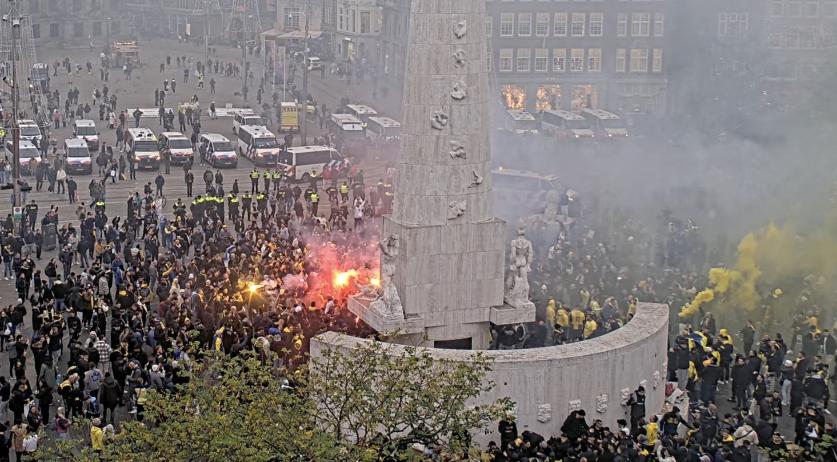
The first lesson of philosophy—and indeed of life—is the recognition that we may all be mistaken. This applies to the recent disturbing events in Amsterdam, where much remains unknown about both the causes and the likely outcomes.
Observing these events, one might conclude that we are living in unprecedented times, in a world steeped in grievances. The liberal world seems to be undergoing a kind of implosion, with echoes of the 1930s surfacing in the resurgence of authoritarianism and xenophobia. The erosion of trust in democratic institutions, combined with rising grievances, has fostered an environment where fears and prejudices flourish. Islamophobia, particularly in Europe, increasingly mirrors the scapegoating of the Jewish community before World War II, a troubling reminder of how old biases persist and adapt to modern contexts.
Roland Benedikter, an academic who has analyzed the social dimensions of European football, notes a resurgence of violence in the sport. Football hooliganism, traditionally dismissed as a “fringe issue,” has begun intersecting with broader societal unrest, transforming arenas into battlegrounds. This trend has especially affected vulnerable groups within the middle and working classes, whose economic and educational inequities often contribute to anger that spills into stadiums and beyond.
In the Netherlands, rivalries among teams like Ajax and Feyenoord have created a “tribalism” that is hard to contain. Ajax, sometimes referred to as the “Jewish club” due to Amsterdam’s Jewish history, has become a frequent target for antisemitic chants, a problem that reflects a wider trend in European football. This escalating hostility came to a head recently in a match between Ajax and Israel’s Maccabi Tel Aviv, where the behaviour of fans on both sides underscored the polarized climate.
Maccabi supporters, including some affiliated with far-right Israeli ultra-groups, reportedly engaged in inflammatory acts the night before the game, vandalizing property and chanting racist slogans in central Amsterdam. Videos from the day of the match depict Israeli fans chanting anti-Arab sentiments like “Let the IDF win,” “Fuck Palestine” and “Why is there no school in Gaza? There are no children left there”. Dutch police later confirmed that the violence was not one-sided, and both sides bear responsibility. Sixty-two people were arrested, some facing further investigation for offenses such as vandalism.
Given the date of the match, November 9—a significant anniversary due to the 1938 Kristallnacht pogroms—the incident carries added symbolic weight. Leaders across Europe have condemned the violence, with Dutch Prime Minister Dick Schoof calling it an alarming sign of “rising antisemitism” in the Netherlands. Political figures, including Germany’s Chancellor Olaf Scholz and France’s President Emmanuel Macron, emphasized the importance of protecting Jewish communities and condemning antisemitism in all forms.
Dutch far-right leader Geert Wilders vocal support for Israel, particularly within far-right circles in the U.S. and Israel is well known and quickly leveraged the incident, using it to promote his longstanding anti-Muslim agenda. Known for inflammatory rhetoric, Wilders claimed that “95 percent” of the attackers were Moroccan, Meeting with Israeli Foreign Minister Gideon Sa’ar, Wilders highlighted the incident as further evidence of a “radical Islam problem,” an assertion unsupported by evidence and inflammatory in nature.
PM Schoof’s decision to forego the upcoming UN Climate Conference in Azerbaijan underscores his government’s prioritization of domestic issues around antisemitism. In addressing the Amsterdam incident, Schoof framed it as part of a broader “integration problem,” presenting himself as a protector of the Jewish community, which he said “feels let down.” However, Schoof has minimized the actions of Maccabi supporters, focusing instead on the actions of Dutch citizens.
After four months in office, Schoof has begun to show his true face, that of the former director-general of the General Intelligence and Security Service, known for his willingness to seek and overstep the boundaries of the law. A face long hidden beneath the surface, and his pledge at his inauguration to be a prime minister for all citizens has proved worthless. His rhetoric signals that the government may pursue more divisive and extreme policies, with the House of Representatives expected to debate the incident soon and likely reaffirming traditional Dutch support for Israel.
Meanwhile, Israel’s military actions in Gaza have drawn intense international scrutiny. Since October 9, 2023, Israel’s blockade has devastated Gaza’s infrastructure, displacing large portions of its population and obstructing access to basic resources, resulting in a deepening humanitarian crisis. Health officials estimate that over 42,000 Gazans, many of them women and children, have died, raising concerns over potential genocide. ICC Chief Prosecutor Karim Khan is reportedly seeking warrants for Israeli leaders on charges of alleged war crimes.
As emotions stabilize, perhaps the House of Representatives might consider addressing alleged crimes against humanity in Gaza and the resulting humanitarian crisis in a balanced manner. Beyond routine expressions of “concern,” a re-evaluation of the Netherlands’ long-standing support for Israel might be warranted, considering the global emphasis on accountability and human rights.
WJJH-12.11.2024
📌Blog Excerpt
Commentary: The recent surge in football violence in Europe, particularly surrounding Ajax and Maccabi Tel Aviv matches, reflects broader social unrest and rising antisemitism. Incidents in Amsterdam have led to multiple arrests and significant political outcry, highlighting the intertwining of sports with societal issues, including economic inequities and escalating tensions amid ongoing crises in Gaza.
 In what kind of world do we wish to live