Lord Byron: Poet of Passion and Paradox
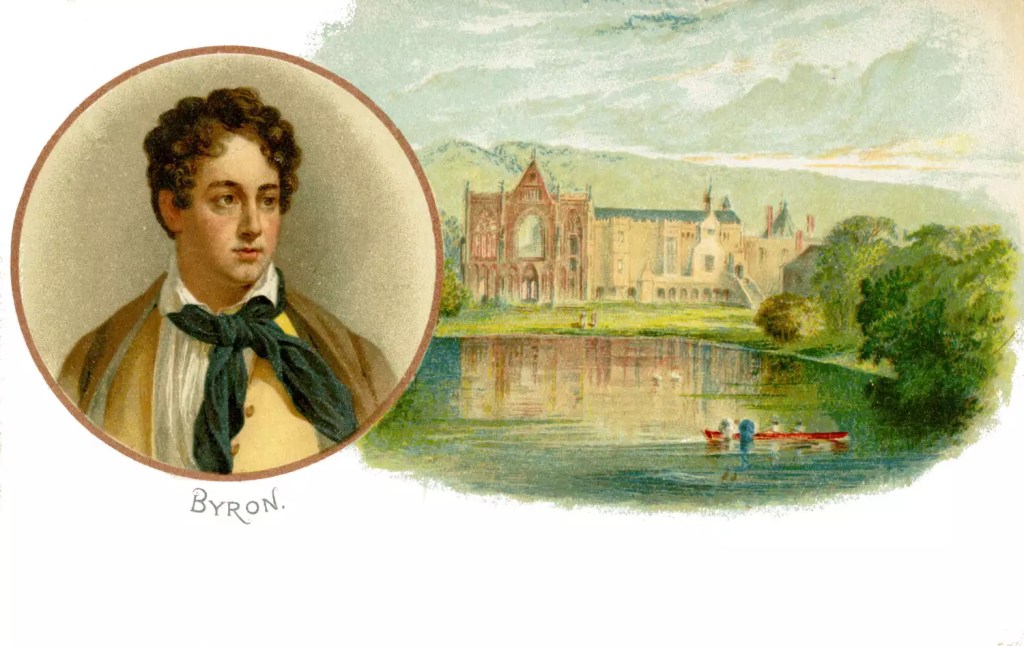
George Gordon Byron, later Noel, 6th Baron Byron of Rochdale, FRS—universally known as Lord Byron—was a leading British poet of the Romantic era, alongside contemporaries like William Wordsworth, Samuel Taylor Coleridge, and William Blake. Byron inherited his title and estates from his great-uncle, the 5th Baron Byron, in 1798, at the age of ten. Upon reaching adulthood in 1809, he took his seat in the House of Lords and embarked on a grand tour with his friend John Cam Hobhouse, visiting Spain, Gibraltar, Malta, Greece, and Turkey. During his time in Greece, he began writing Childe Harold’s Pilgrimage, a work that would become one of his most celebrated. The tolerance and open-mindedness he observed among the Greeks broadened his views on society and human nature.
Upon returning to England, Byron made his first speech in the House of Lords in February 1812. This moment marked his entry into public life in a Regency Era characterized by elegance, refinement, and cultural innovation. As Byron famously expressed, “The great object of life is sensation—to feel that we exist, even though in pain.” This period was ruled by the Prince Regent, later King George IV, who acted on behalf of his father, the ailing King George III. Under his patronage, Britain flourished in the arts and saw advancements in literature, fashion, and social customs, despite the social and economic tensions arising from the Napoleonic Wars and rapid industrialization.
The Regency was a time of intense political, social, and economic upheaval, exemplified by events like the Peterloo Massacre and the notorious liaisons of figures like Lord Nelson and Lady Hamilton. Although the upper classes enjoyed the opulence and indulgences set by the Prince Regent, the lower classes faced harsh working conditions, child labour, and limited rights. Yet, it was also a time of burgeoning social reform movements, including efforts toward the abolition of the slave trade.
The Romantic period was deeply influenced by the social and political changes of the time, from the depopulation of rural areas to the growth of crowded industrial cities. Romanticism arose, in part, as a reaction to the Industrial Revolution and the aristocratic norms of the Enlightenment. Particularly impactful was the French Revolution, which shaped the political thinking of many Romantic poets and inspired their critique of British society’s cultural and literary decline.
Byron’s literary success exploded with the publication of the first two cantos of Childe Harold’s Pilgrimage in 1812, establishing him as a sensation at just twenty-four. Childe Harold reflects the disillusionment of a young man weary of a life of pleasure and troubled by the Napoleonic wars, seeking solace abroad. The poem served as both a critique of British society and a self-reflection for Byron.
Elizabeth Foster, Duchess of Devonshire, recounted Byron’s sudden social success in a letter to her son, Augustus Foster. Of Childe Harold, she wrote, “It is on every table, and [Byron] himself is courted, visited, flattered, and praised whenever he appears … he is truly the only topic of conversation—the men are jealous of him, the women of each other.” Byron’s fame only grew with subsequent works like The Giaour (1813), The Corsair (1814), and his magnum opus, Don Juan (1819–1824).
Byron’s life was as captivating as his poetry, earning him a reputation for both genius and scandal. Lady Caroline Lamb, one of his lovers, famously described him as “mad, bad, and dangerous to know.” Their affair, like many of his relationships, was passionate and fraught, with Lamb herself becoming a dramatic and persistent figure in his life. Another notable affair was his rumoured relationship with his half-sister, Augusta Leigh, which sent shockwaves through society. Seeking an escape from scandal, Byron married Anne Isabella (Annabella) Milbanke in 1815, but their union quickly deteriorated due to Byron’s unpredictable nature and Annabella’s strict disposition. The couple’s separation and Byron’s accumulating debts led him to leave England in 1816, never to return.
Byron found a new chapter in Italy, living in Venice and later beginning a lasting affair with Teresa Guiccioli, an Italian noblewoman. During this period, he wrote some of his greatest works, including Don Juan, a satirical poem that reveals Byron’s wit and humour, veering from the melancholic tone of Childe Harold.
In 1823, Byron left Italy to join the Greek insurgents in their fight for independence against the Ottoman Empire. His commitment to the Greek cause cemented his legacy as a hero in Greece, where he died of fever on April 19, 1824, in Missolonghi. Though mourned across Britain, he was denied burial in Westminster Abbey and instead laid to rest at his ancestral estate in Nottinghamshire. Over a century later, in 1969, a memorial was finally placed in the Abbey, acknowledging his lasting impact.
One of Byron’s most beloved poems, She Walks in Beauty, Like the Night, was inspired by his encounter with Mrs. Anne Beatrix Wilmot in 1814. Captivated by her elegance as she appeared in mourning attire, Byron penned the verses the next morning. Today, some might view the poem as sentimental or objectifying, reflecting a time when women’s roles were limited. Yet others see it as a celebration of the harmony between inner grace and outward beauty. Using contrasting imagery of light and dark, Byron compares Mrs. Wilmot’s beauty to the night, underscoring how her inner goodness enhances her outward appearance in a subtle dance of complementary forces.
WJJH – 17.11.2024
📌Blog Excerpt
George Gordon Byron, known as Lord Byron, was a prominent Romantic poet who gained fame with works like Childe Harold’s Pilgrimage. His life was marked by passion, scandal, and political engagement, notably supporting Greece’s fight for independence. Despite his literary acclaim, he faced personal turmoil, ultimately dying in 1824, remembered as a cultural icon.
 In what kind of world do we wish to live