An Octogenarian’s Farewell to a Lost Friend: Reflections on the International Herald Tribune
✍️Authors Note:
This piece is part of Reflections from the Eighth Decade, where I take stock of the world we are leaving behind — and the strange new one emerging before our eyes. In an age of instant communication, superficial news, and restless scrolling, I still long for a time when reflection, nuance, and a cup of coffee with a real newspaper were part of everyday life. Perhaps it is just nostalgia. Or perhaps, something important really has been lost.
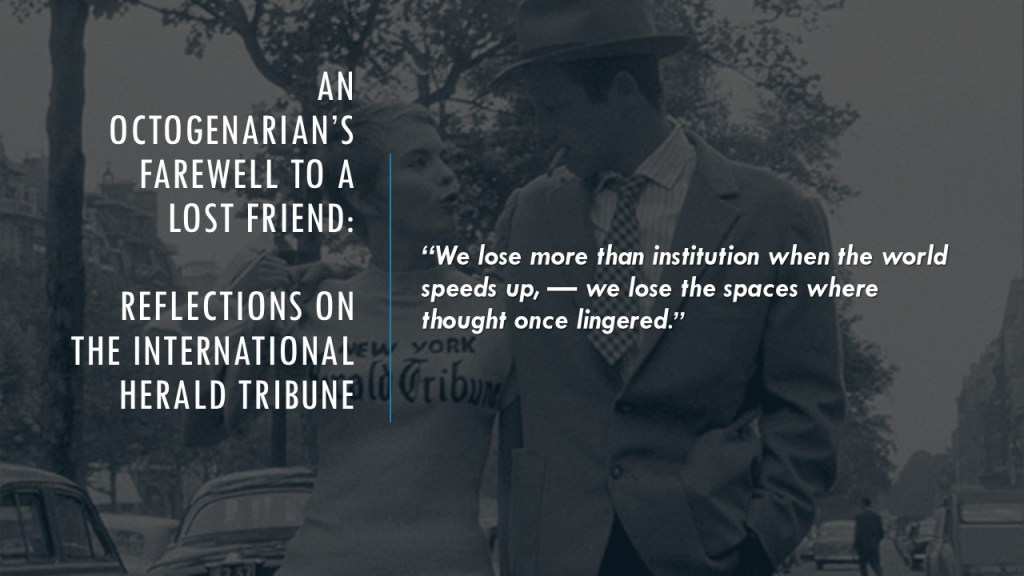
The International Herald Tribune (IHT), a Paris-based newspaper with roots dating back to 1887, was once a daily beacon for English-speaking readers worldwide — offering a uniquely international perspective. Fondly known simply as “the Herald,” it grew into a superb global newspaper. But nothing, not even great institutions, lasts forever. Just like people, companies and publishing houses are not immune to mortality. The day its owners finally ran it aground was a sad one indeed — though, in a way, its soul lives on.
“We lose more than institutions when the world speeds up — we lose the spaces where thought once lingered.”
Personally, I have fond memories of the IHT. Since the early 1970s, when I lived in Zurich, it was my favourite travel companion — a trusted, high-quality friend who kept me informed about a fast-changing world. It offered insights into international affairs, business, stock prices, fashion, theatre, sports — and not to forget, the indispensable comics and puzzles.
But it was the two Opinion pages that captured my heart and mind.
For my generation, the IHT was immortalized in Jean-Luc Godard’s 1960 classic À bout de souffle (Breathless), where a radiant Jean Seberg, in her tight yellow T-shirt, called out “New York Herald Tribune!” on the Champs-Élysées, alongside the effortlessly charismatic Jean-Paul Belmondo — an actor who embodied the rebellious, stylish spirit of the 1960s.
I first encountered the paper in the late 1960s at the home of childhood friends — an American family living near us in the Netherlands. Slowly, it grew on me, revealing its relevance with every edition.
Later, I devoured it everywhere: on airplanes, on trains, and in the back of taxis whisking me off to business centers. It was a less impatient age, when we still had the luxury to sit on a café terrace in Amsterdam, Frankfurt, London, Paris, or Zurich, a cup of coffee at hand, taking it all in — and pondering the meaning of it all.
Some called the paper globalist and elitist — vague criticisms at best. The fact remains: from the 1970s onward, thanks to shared ownership between the Washington Post and the New York Times, the IHT combined the best of American journalism with an unmistakable Parisian sophistication.
Its balanced, thought-provoking perspectives, especially during the destructive years of G.W. Bush’s foreign misadventures, stand out in my memory. The diverse voices of Francis Fukuyama, David Ignatius, Flora Lewis, Henry Kissinger, William Pfaff, and Mort Rosenblum brought clarity to the complexities of a shifting world.
Suzy Menkes brought fashion to life, Mike Zwerin illuminated the world of jazz, and Art Buchwald added his irresistible touch of humour.
Sadly, the IHT’s fate was sealed in 2003 when the Washington Post — after 32 years of partnership — sold its shares to the New York Times, making it the sole owner.
From there, the decline was predictable. Our beloved Herald was gradually subsumed into the business operations of the New York Times — “The Gray Lady” — and became little more than a rebranded edition.
The death blow came in 2013, when the paper was renamed The International New York Times.
By 2016, the Paris office closed its doors.
The National Book Review aptly called it “the end of a romantic era in international journalism.”
Times have changed — and with it, the media landscape.
Today’s world is driven by speed, momentum, and the insatiable hunger for immediacy: news delivered at warp speed via laptops and smartphones, aided by AI algorithms, all at a fraction of the cost I once paid for the IHT.
Travelers, expatriates, and business communities have the world at their fingertips — but the price has been a loss of nuance, depth, and reflection.
Life, like the news cycle, has become more uniform, more superficial.
Perhaps the IHT, like this octogenarian, belongs to a bygone era — when readers were more cosmopolitan, more willing to pay a premium for quality and analysis.
This musing, then, is a small expression of sentimental attachment to a paper long dead and buried.
Yet, despite all the marvels of modern technology, I still find myself — iPhone and laptop always within reach — oscillating between superficiality and restlessness.
Old habits die hard.
I still cherish the luxury of buying a weekend stack of real newspapers — the Financial Times, the Frankfurter Allgemeine Zeitung, Die Zeit — and reading them at my leisure in a quiet Amsterdam café with a strong coffee.
There, sometimes, I reflect:
With our growing transatlantic differences, yet with the understanding that America and Europe remain indispensable to one another, we desperately need strong political and military frameworks to protect our shared values.
But for that, we also need political renewal in Washington.
It’s a grim irony that even once-proud newspapers like the Washington Post and New York Times seem ever more willing to bow to King Donald Trump and the noisy circus of today’s media economy — all in the name of clicks, subscriptions, and quarterly profits.
One wonders: had the old IHT Paris office — known for its independent spirit and its worldly, slightly mischievous Parisian humor — been alive today, how would they have covered it all?
Probably with a touch more irony, a touch more scepticism — and a great deal more perspective — than their American peers allow themselves.
With all that is going on in this mad, dizzying world, this octogenarian misses his good but extinct friend — the International Herald Tribune.
Netherlands, WJJH- 2.5, 2025
📌 Blog Preview
Reflection: Albeit nostalgic, on the International Herald Tribune (IHT), a once-revered newspaper, emphasizing its role in providing depth and insight in journalism. With its decline post-2003, and the loss of nuanced discourse in today’s fast-paced news environment, there is a yearning for a time of thoughtful reflection over superficiality.
 In what kind of world do we wish to live