The Drums of War
✍️ Author’s Note
This reflection explores how war gains momentum long before the first shot is fired. Through propaganda, fear, and false necessity, societies march toward conflict with disturbing regularity. The piece is a meditation on the seductive rhythm of militarism and the ease with which history is forgotten. As Pindar warned centuries ago: “War is sweet to those who have never experienced it.”
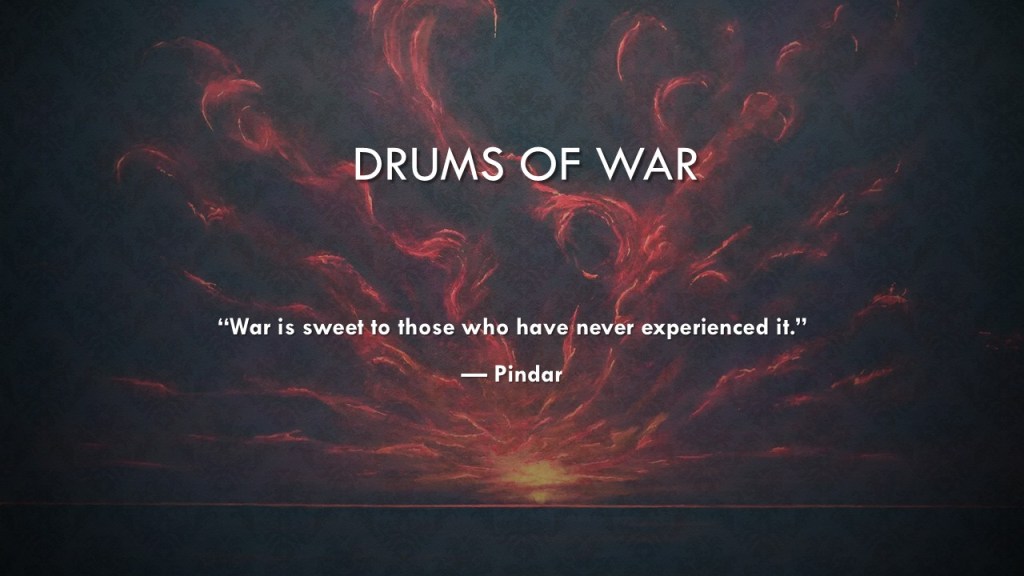
In an age defined by global interdependence and digital interconnectedness, the world is witnessing the return of an age-old spectre: the drums of war. The global landscape is increasingly characterized by geopolitical tensions, nationalist fervour, and a resurgence of militaristic rhetoric. As we navigate this precarious era, the challenge lies not only in understanding the origins of these tensions but also in charting a path toward sustainable peace and coexistence.
Geopolitical Tensions and the Fault Lines of Power
The 21st century has unveiled new and renewed fault lines in the global order. The rise of China, the reassertion of Russia, and the persistence of Western hegemony have created a multipolar world fraught with competition and mistrust. NATO’s eastward expansion, justified by some as a means of ensuring stability, has been perceived by others as a provocation, particularly by Russia. This dynamic has culminated in conflicts such as the war in Ukraine, which serves as a microcosm of larger global power struggles.
Meanwhile, China’s Belt and Road Initiative and its assertive actions in the South China Sea signal its ambitions to reshape the international order. The United States, previously often seen as the architect and enforcer of the post-World War II liberal order, faces the dual challenge of maintaining its global primacy while addressing domestic divisions and economic inequalities. The tensions between these major powers have created an environment where smaller nations are increasingly caught in the crossfire, forced to navigate a delicate balance between competing spheres of influence.
The Resurgence of Nationalism and Militarism
Nationalism, once a unifying force during struggles for independence, has reemerged in a more insidious form. Across the globe, leaders have harnessed nationalist rhetoric to consolidate power and justify aggressive policies. From the United States to Europe, and from Asia to the Middle East, militarism is increasingly seen as a legitimate tool for addressing grievances and asserting dominance.
In Europe, the rise of far-right movements has challenged the principles of liberal democracy, leading to policies that undermine solidarity and promote exclusion. In Asia, historical animosities between nations such as Japan, South Korea, and China continue to fester, often stoked by political leaders for domestic gain. The Middle East remains a cauldron of instability, where external interventions and internal divisions perpetuate cycles of violence.
The Economic Dimensions of Conflict
Economic interests often underlie geopolitical tensions, as nations vie for control over resources, markets, and strategic trade routes. Sanctions, while framed as non-violent tools of diplomacy, have become instruments of economic warfare, with devastating effects on civilian populations. The competition for technological supremacy, particularly in areas such as artificial intelligence and energy, further exacerbates global rivalries.
The Path Forward: Toward a New Paradigm
Amidst these challenges, the need for a new paradigm of international relations has never been more urgent. This paradigm must prioritize dialogue over confrontation, cooperation over competition, and mutual respect over dominance. Multilateral institutions, though often criticized for inefficiency, remain vital platforms for addressing global issues such as climate change, pandemics, and economic inequality.
The lessons of history remind us that wars often stem from miscalculations and misunderstandings. To avoid repeating these mistakes, nations must invest in diplomacy, education, and cultural exchange. The drums of war may never be fully silenced, but through collective effort, their beat can be softened, allowing the symphony of peace to resonate once more.
Netherlands, William J J Houtzager, Aka WJJH – 16.12.2024
📌 Blog Excerpt
The resurgence of geopolitical tensions and nationalism in the 21st century, is marked by competition among major powers like the US, China, and Russia. It highlights the impacts of militarism, economic interests, and the need for a new international relations paradigm focusing on dialogue and cooperation to foster sustainable peace.
 In what kind of world do we wish to live