Morning in The Netherlands — and Not a Moment too Soon
-or How Not to Govern a Country
✍️Author’s Note:
I write this not just as a Dutch citizen, but as someone who watched with dismay as Dutch political pragmatism gave way to opportunism. The last eleven months showed what happens when the far right is treated as a legitimate partner in government. This collapse should be seen not only as a welcome end—but as a warning.
Reflections from the eighth decade — on life, culture, the human condition, Dutch and European politics, international relations, and the state of the world. I offer quiet observations, drawn from a lifetime of watching, questioning, and remembering. The sun lowers, but still gives light.
It is, at last, a good morning in the Netherlands. And not just for the Dutch—Europe, too, can exhale.
After eleven months of spectacle, stagnation, and sheer political amateurism, the “Netherlands First” experiment has collapsed under the weight of its own contradictions. It began in chaos, governed in chaos, and fittingly, ends in chaos. The relief is palpable. The curtain has fallen—and let’s hope it stays down this time.
Let us not forget how we got here. Dilan Yeşilgöz, leader of the VVD and would-be heir to Mark Rutte, decided it was time to normalize the abnormal. In a bold leap over decades of political prudence, she opened the door to the far-right PVV, led by that master of populist grievance, Geert Wilders. By doing so, she dismantled the cordon sanitaire that had—wisely—kept the xenophobic PVV out of power.
Wilders is not just a domestic demagogue. For over two decades, he has built his career on anti-Muslim rhetoric, calls to ban the Quran, and proposals to shut down mosques and Islamic schools. He was once convicted (but not punished) for inciting discrimination. He has positioned himself as the Dutch figurehead of a broader European far-right movement, maintaining ties—ideological and symbolic—with leaders like Marine Le Pen in France and Viktor Orbán in Hungary. His vision is one of cultural homogeneity, national closure, and hostility toward liberal institutions.
In breaking the barrier to power, Yeşilgöz didn’t just change Dutch politics; she gave encouragement to every nationalist demagogue across Europe. Judicial independence? Press freedom? Academic autonomy? All suddenly negotiable, if it meant keeping the coalition intact. The VVD, once a liberal-conservative party with European aspirations, became an enabler of extremism in exchange for power.
The government was nominally led by Dick Schoof—a competent, even well-meaning technocrat. But one cannot pilot a burning ship when the crew is setting new fires below deck. His ministers from the PVV proved unfit for public office, and their leader—Geert Wilders, or “Geert Milders” during the brief phase he pretended to be statesmanlike—was never going to govern seriously. He simply doesn’t know how.
Take, for example, PVV Minister Marjolein Faber, responsible for asylum and migration. Faber promised “the harshest immigration policy ever”—and then proceeded to accomplish almost nothing. Her proposals were so legally ill-conceived that even the Dutch Council of State barely kept a straight face. Most of her initiatives were dead on arrival. This was not a government. It was a pantomime.
Then came the inevitable implosion. Last week, Wilders demanded ten new measures so extreme—like halting all asylum procedures, deporting Syrian refugees, and scrapping family reunification—that even his coalition partners blinked. These weren’t policies; they were slogans stapled to legal impossibilities. When met with resistance, Wilders did what he always does: he stormed out.
It’s a familiar scene. Wilders did the same in 2012, bringing down the Rutte I cabinet, and earning his now-permanent nickname from Mark Rutte: “the runaway.” And once again, he’s proven that he cannot be trusted, cannot govern, and cannot cope with the responsibilities that come with power. He thrives only in opposition, where criticism is easy and accountability is nonexistent.
And yet, this man was brought into the heart of government by Yeşilgöz. Rutte had sworn never to repeat the mistake of trusting Wilders. His successor did exactly that—and here we are.
The cost has been immense. In a world spinning faster than ever, where Europe faces serious challenges—from climate to security, from economic resilience to digital transformation—the Netherlands came to a grinding halt. For nearly two years, the country was frozen first by endless coalition talks, then by the dysfunctional marriage of liberalism and far-right populism.
Europe cannot meet its moment with leaders like Wilders, Orbán, or Le Pen—figures more interested in dismantling the EU than solving its problems. Nor can it rely on parties like the VVD if they continue mistaking pragmatism for capitulation.
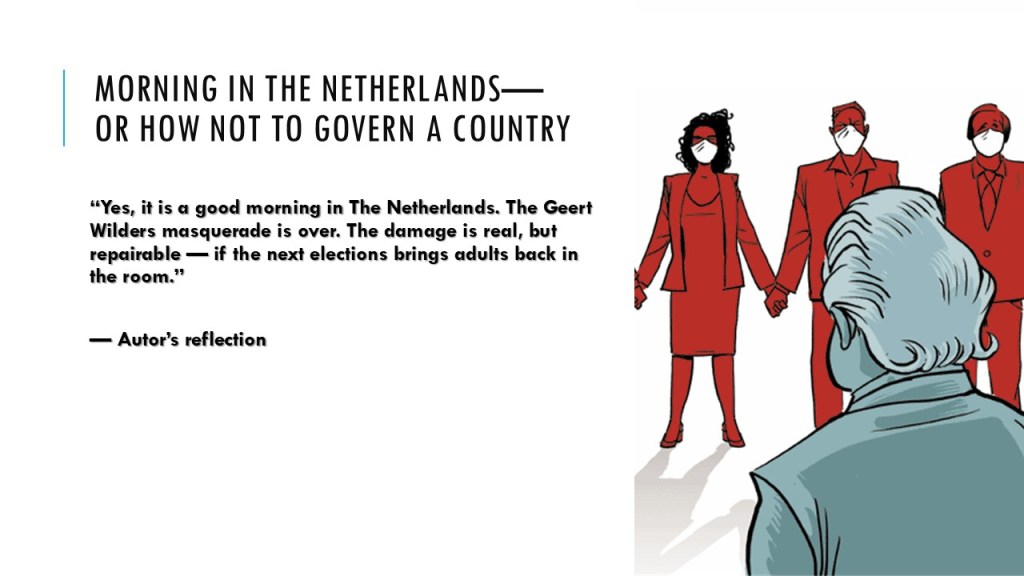
So yes, it is a good morning. The masquerade is over. The damage is real, but repairable—if the next election brings adults back into the room.
Let us hope this time, the Dutch electorate will reject the fantasy of governing with wrecking balls. The country deserves a government that doesn’t treat democracy like a game show.
Netherlands, WJJH, June, 2025
📌 Blog Excerpt
I write this not just as a Dutch citizen, but as someone who watched with dismay as Dutch political pragmatism gave way to opportunism. The last eleven months showed what happens when the far-right wrecking ball of Democracy is treated as a legitimate partner in government. This collapse should be seen not only as a welcome end—but as a warning.
 In what kind of world do we wish to live