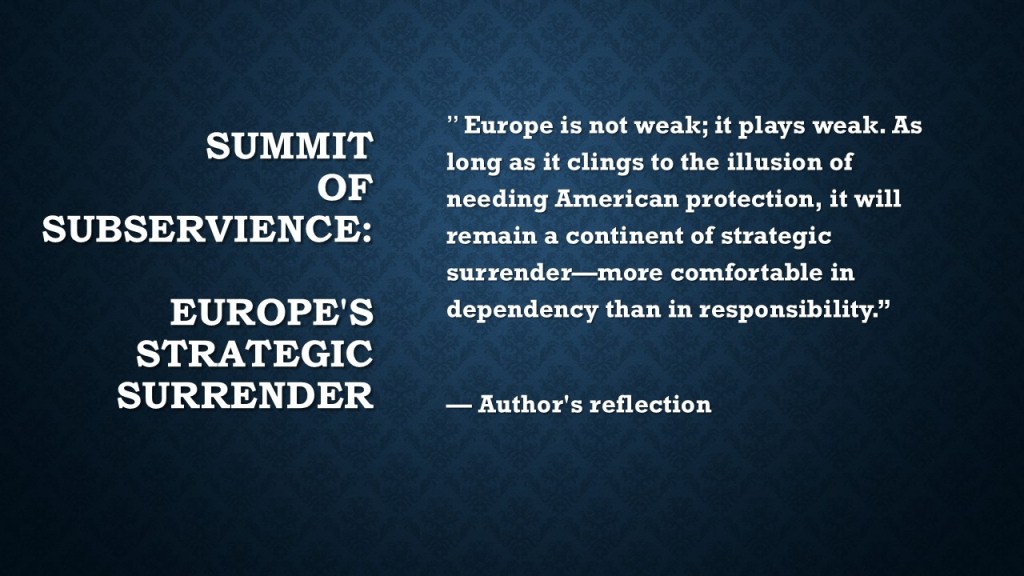
Summit of Subservience: Europe’s Strategic Surrender
“The welfare of the people in particular has always been the alibi of tyrants.”
— Albert Camus
✍️Authors Note:
As a long-time supporter of European integration and a realist observer of geopolitics, I have lived through many of Europe’s turning points. But I have grown wary of today’s inflated rhetoric, historical amnesia, and the cyclical seductions of military spending. I have watched the events surrounding the recent NATO and EU summits with both dismay and clarity and question whether the current trajectory of European defence policy—and Europe’s subservience toward the United States—truly serves our best interests. This reflection is not a rejection of European unity, but a call for coherence, historical honesty, and strategic maturity.
Smoke, Mirrors, and Subservience: A Realist’s View on the NATO-EU Spectacle
As a cynical octogenarian, I’ve seen wars start, escalate, and end—not with the fanfare of victory, but with the sobering cost of lives, economies, and illusions. I’ve watched how fear is marketed, how strategic clarity is blurred by ideology, and how politicians invoke “grave threats” to justify spending sprees and strategic overreach.
So when I hear European leaders—most recently Ursula von der Leyen—warn of “the grave nature of the threats we face, because our European security is threatened,” I pause. What does that actually mean? Are we truly facing an existential danger? Or are we allowing fear, historical trauma, and vested interests to drive us into unsustainable choices?
At a time when the EU faces enormous challenges—liberal democracy under siege, and the idea of a united Europe under tremendous pressure—the recent summitry in The Hague left me not with admiration, but with disbelief and disdain. Wrapped in ceremonial pomp and hollow declarations, the EU and NATO presented a spectacle long on choreography, short on realism, and utterly disconnected from the deeper challenges facing the continent.
For decades, I supported the dream of a federal Europe—and I still do. But this is a Europe that lost its compass when it prioritised enlargement over integration and failed to uphold the very values on which it was founded. Under the current President of the European Commission, Ursula von der Leyen, the commitment to the Union’s legal foundations and constitutional standards has taken a backseat to her political ambition for enlargement. This has given disproportionate influence to member states with autocratic tendencies—undermining coherence and obstructing policy development across the Union. The Maastricht Treaty, for all its imperfections, represented a bold vision: a political and economic union capable of acting independently on the world stage. But that vision was never realised. As Jacques Delors warned in 1992, enlargement without institutional deepening was a dangerous gamble. His warning went unheeded. The 2004 “big bang” expansion served American strategic goals more than European ones, and left the EU structurally fragmented.
That fault line became visible during the Iraq War and later through the rejection of the Paris Climate Accords and other international agreements by the United States. It widened with each crisis—from migration to Brexit—and today it has reached a breaking point. President von der Leyen’s vision of expanding to 36 or 37 members as a “catalyst for progress” raises serious doubts about the EU’s strategic direction. Enlargement begs the question: what are the limits of expansion at a time when the EU continues to add fragile, unstable states while its institutional foundation weakens? Once again, fear—this time of Russia—is being used to promote cohesion and justify enlargement. But fear is a poor architect of a lasting union.
NATO leaders’ commitment to increase defence spending to 5% of GDP—comprised of 3.5% in core defence and 1.5% in related infrastructure—raises immediate concerns. The 3.5% target is not only ambitious but also unrealistic for most member states. Spain has already sought exemption, and countries such as France, Italy, Spain, and the UK lack the fiscal capacity to meet this target without politically sensitive tax increases or spending cuts. The agreed temporary exemption from EU fiscal rules may provide short-term relief, but in the long term it will likely impact bond markets, raise borrowing costs, and deepen fiscal imbalances.
With even the 2% NATO guideline unmet by most members—only 8 out of 32 comply—the new target is structurally unsustainable. Not fiscally. Not politically. And certainly not morally, when measured against the needs of aging populations, failing infrastructure, and a climate crisis we continue to neglect. The burden will fall disproportionately on net contributors like Germany, France, and the Netherlands. Rich states pay. Poorer states benefit. And citizens are asked to accept austerity and mounting debt in exchange for militarization.
Worse still, these decisions are being made while popular support for EU enlargement remains lukewarm—hovering around 53%. Security fears are receding. Public enthusiasm is faint. Yet from the ivory towers of Brussels, the political class charges ahead, invoking existential threats that seem more real in conference rooms than in everyday European life.
Yes, Russia’s war in Ukraine is brutal, unjustified, and must be ended. But let us call it what it is: a family conflict on the Eurasian Balkans, misread and mismanaged—one that escalated after years of NATO expansion and economic sanctions. While Russia’s invasion is indefensible, its motives—seen through the lens of geopolitical realism—are unsurprising. For a state like Russia, surrounded by expanding alliances and subjected to sanctions and isolation, retaliation was bound to come. The real surprise is that it took this long.
Russia is a dangerous and unpredictable actor, steeped in a different strategic culture—but its ambitions are not suicidal. Russia’s 2024 military budget is substantial ($145.9 billion, or 6.7% of GDP), and in purchasing power terms may reach $462 billion. But this only marginally exceeds EU defence spending—without the U.S. included. What threat are we truly facing? After three years of war, Russia has failed to take Kyiv, suffered massive casualties, and strained its economy. It remains a declining regional power—not a global menace. The bear is growling at its border, not prowling through Amsterdam.
Some realism is in order. Ukraine deserves support, but all wars end in negotiation. We must now assess what is realistically achievable—at minimal cost to Ukraine and without escalating into a wider war. Russia has escalation dominance, and Ukraine’s military position is weakening. Its economy is on life support. Corruption and institutional fragility persist. Talk of EU membership without NATO protection places Ukraine in a grey zone: inside the EU tent economically, but exposed militarily. It is a recipe for disillusionment.
NATO Secretary General Mark Rutte’s closing declaration—“Ukraine’s path to NATO membership remains irreversible”—fits neatly into this pattern of rhetorical escalation. Worse is the suggestion of European “security missions” on Ukrainian soil. That would convert a regional war into a European confrontation. In my view, that would be a historic mistake.
And yet, under Rutte—a chameleon figure well-versed in flattery—NATO has embraced its role as Washington’s junior partner. Europe once again assumes its favourite posture: the lapdog. This is especially troubling as Donald Trump re-emerges, a man who openly disparages NATO and cozies up to Europe’s far right.
Rutte’s appointment is no triumph of diplomacy or autonomy. It signals Atlantic subservience. Even as Washington imposes tariffs on European allies, we reward the illusion of partnership. Strategic autonomy is not a strategy—it is a slogan.
As for European identity—I no longer believe in the fairy tale. It is built on quicksand: eroded by nationalism, inequality, and mutual distrust. These trends are accelerating. Enlargement without consolidation only deepens the cracks.
There are—and have always been—two Europes: East and West. Their memories, fears, and interests diverge. The Polish-Lithuanian Commonwealth and Soviet trauma shape the East’s worldview. But in the West, Russia is not an alien. It is part of the European house. Despite our differences, we share culture, history, and geography. No war will change that.
The real threat is not the Russian bear—it is our own institutional decay, democratic erosion, and identity crisis. That is why I found this summit so humiliating. It was theatre for American audiences—especially President Trump—who “rewards” our loyalty with tariffs and supports those autocratic leaning leaders in EU member states disregarding judicial independence, press freedom, cultural diversity, and academic autonomy, just as he attacks these values in his own country and international law.
📖Postscript: In The Hague, of all places, where law and memory are meant to be protected, the defenders of Europe watched a man mock their values—and said nothing. Strategic silence, when repeated too often, becomes self-erasure.
📖Afterword: Between Idealism and Realism
The tension running through this essay is not accidental. It is the consequence of a political generation caught between two poles: the liberal promise of cooperation and the realist necessity of power. I write not out of cynicism, but out of conviction that Europe’s future depends on reconciling these opposing forces. If we abandon liberal values for the sake of security, we will become the thing we claim to resist. But if we ignore geopolitical reality in the name of ideals, we will end up powerless and divided. The true path forward lies in honesty—about who we are, what we can achieve, and what we are willing to defend.
Netherlands, WJJH, 27.6.2025
📌 Blog Excerpt
Critique: on Europe’s defense policy, emphasizing its growing subservience to the U.S. amid inflated security rhetoric. Recent NATO-EU summits mask deeper issues like democratic erosion and strategic incoherence. Urgent questions about enlargement and fiscal sustainability arise, highlighting the need for realistic, cohesive strategies rather than fear-driven decisions.
 In what kind of world do we wish to live