What’s a topic or issue about which you’ve changed your mind?
Letters to the Prompt
✍️Authors note:
Changing one’s mind is never easy, especially about a place once admired. This musing traces my evolving view of the United States—from the wide-eyed idealism of the 1960s to the wary scepticism of today. It is both a personal account and a lament for what has been lost. But it is also a gentle reminder: minds can—and must—change when reality demands it. With a bit of humour, a touch of nostalgia, and a healthy dose of disillusionment, this is my way of saying: some friendships need boundaries.
The ox grows in size but not in wisdom.”
— An old saying, oddly fitting for modern times.
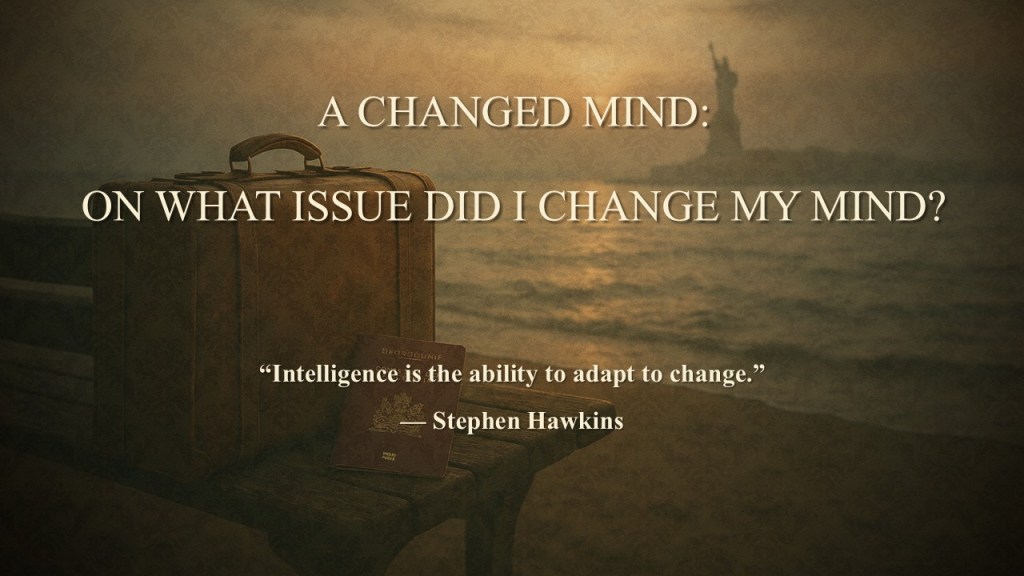
Well, dear prompt, isn’t that the whole point of growing older and—one dares hope—a little wiser? We change our minds. About many things. Because time, experience, and a few knocks on the head (or heart) have a way of tempering youthful convictions. We lose our innocence, shed illusions, and perhaps, if we’re lucky, arrive at a more balanced view of the world.
One of the things I’ve most certainly changed my mind about is how I, as a European, see the United States of America.
Now, in fairness, this isn’t an entirely original confession—my views on this topic are reasonably well known—but the question allows me to reflect on how circumstances can compel even old friends to recalibrate their affections. And yes, how could Donald J. Trump not feature in this theatre of the absurd? He’s like the proverbial ox—he grows in size, but not in wisdom.
Let’s go back in time.
In the 1950s and 60s, growing up in post-war Netherlands—a stable, cultured country rebuilding with dignity—I had what I now recognize as a rather idealized view of America. It was the land of jazz, Coca-Cola, and heroism; the generous liberator, the friend in time of need.
In my hometown, the American company Foxboro from Massachusetts opened a local subsidiary. Its management became friends with my parents, and their children became my friends. We started a baseball team, joined the Dutch competition, and were soon reinforced by American airmen from the nearby base. We played hard and won often. America had style, muscle, and generosity.
The 1960s, with all its turbulence, only reinforced this positive image—JFK, RFK, the dream of civil rights, and the romance of Camelot. I read Profiles in Courage, de Tocqueville’s Democracy in America, Ayn Rand’s Atlas Shrugged (which I found bold, if a touch self-indulgent), and Steinbeck’s Travels with Charley—a small reality check amid the optimism. America still seemed like the promised land.
When I first visited in 1962 and 1964, that image began to crack just slightly. The assassinations, civil unrest, and the Vietnam War made clear that the American dream had its shadows. But it wasn’t until the Reagan years that I truly began to change my mind.
During the 1980s and 90s, I visited the U.S. often—monthly trips for business, and a few glorious years living in New York City. I resided on Park Avenue and spent weekends on Martha’s Vineyard. Life was good. But I also began to sense the widening gap between the America I visited—wealthy, cosmopolitan, privileged—and the country beyond.
Real America—the one outside the boardrooms and cocktail parties—was struggling. Families living paycheck to paycheck, weighed down by debt, student loans, unaffordable healthcare, and little job security. This was not the land of the fair shot I once admired.
Still, admiration lingered, not least for the U.S.’s role in defeating fascism. The American cemetery in Margraten remains sacred ground—an enduring symbol of sacrifice. That debt is incalculable and eternal.
But fast forward to the 21st century and I began to see a different country altogether—less a shining city on a hill than a neglected house with crumbling foundations.
The turning point, of course, was the rise of Donald Trump. A man who, in one of his rare honest moments, proclaimed: “All my life I’ve been greedy.” No argument there. With six bankruptcies and a flair for fleecing contractors and investors, he profited from failure—and somehow spun it into political stardom. Now he’s working on his biggest bankruptcy yet: the moral and institutional bankruptcy of American democracy.
I had already grown uneasy under Bush—Guantanamo, Iraq, disdain for international institutions—but Trump took the erosion of values to a theatrical, almost operatic level. If George W. Bush represented reckless arrogance, Trump represents cynical nihilism.
Trumpism isn’t simply bad policy—it is a form of political and cultural decay. He resurrected the ghosts of bigotry, hatred, and nativism. He turned democracy into a transactional sideshow. And astonishingly, much of the country applauded.
His 2016 victory was alarming, but January 6, 2021, was the real inflection point. A mob stormed the Capitol. A sitting president incited insurrection. And yet, the base held firm. This wasn’t a one-off—it was the beginning of something darker.
In Trump’s America, dissent is vilified, power is centralized, minorities are scapegoated, and international law is treated as optional. It’s a society that Plato might have recognized—one descending from democracy into oligarchy, where wealth and spectacle replace wisdom and virtue.
And so, I changed my mind. I no longer travel to the U.S. I no longer buy American products if I can help it. I no longer see America as Europe’s indispensable partner. Europe must wake up. We must protect our standards, from food safety to digital sovereignty, and recognize that Trump’s America is not an ally—it is a cautionary tale.
My change of heart isn’t theoretical—it’s deeply personal. Years ago, a friend picked me up at Miami Airport with a self-carrying weapon tucked in his belt, heading to Fisher Island. That felt odd then. Today, it would feel alarming.
The tragedy is not just what America has become, but what it could have been. I fear for my American friends, and for the soul of a country I once admired.
But change, like aging, is inevitable. I changed my mind. And perhaps, one day, America will too.
Netherlands, WJJH, 30.6.2025
📌 Blog Excerpt
Reflecting on the changing perception of the United States, transitioning from idealism in the 1960s to skepticism today influenced by political events, particularly the rise of Donald Trump. There is the loss of admiration for a country once seen as a beacon of hope, now viewed as a cautionary tale of decay and disillusionment.
 In what kind of world do we wish to live