Moral Realism in the Age of Daddy
✍️Author’s Note
This short reflection stands apart from my broader critique of NATO and EU strategy. It was prompted by discussions I have had with people who, like many, see European flattery of Donald Trump as an unfortunate but understandable necessity. I disagree. What follows is a response—not only to them, but to the quiet normalization of a political style and strategy I believe Europe cannot afford to accept.
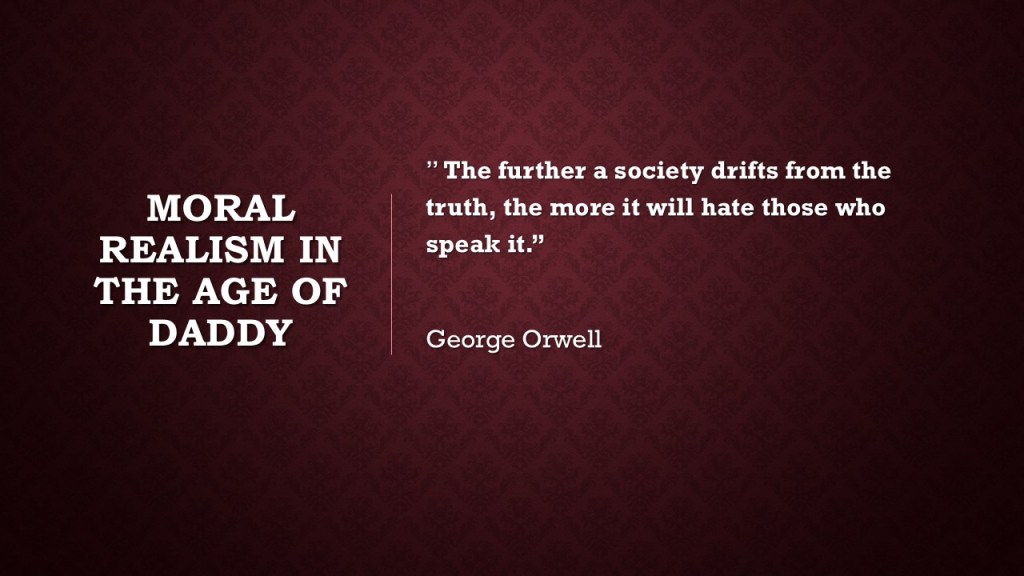
Moral Realism in the Age of Daddy: Why Appeasement Isn’t Pragmatism
There is a view, widespread and comforting, that the recent NATO summit was simply theatre for an unstable American president. That Europe’s leaders, in flattering Donald Trump, were being pragmatic. That their silence in the face of his insults to international law, to the press, to the very institutions housed in The Hague, was a calculated act of restraint. He will move on, they reason. Let him bark; the caravan moves on.
I cannot share this view. To me, it echoes the logic of 1938—when Hitler’s increasingly erratic behaviour was dismissed as political theatre, when democracies congratulated themselves for their restraint, and when a continent sleepwalked into darkness. We told ourselves fascism would pass. It did not. It burned the world.
Yes, I understand the economic and security interests at stake. I am no moralist blind to realpolitik. I am a realist. But moral realism demands we understand that how we defend our interests matters. If we defend them by sacrificing our principles, we lose more than our dignity—we lose our compass.
Mark Rutte’s flippant remark—referring to Trump as “Daddy”—was more than a joke. It was a signal. One now echoed in the U.S. as proof that Europe respects the strongman. That his intimidation is working. That humiliation is the price of protection. That the new normal has arrived.
I was born in the Netherlands. I know its Calvinist culture well. We endure. We calculate. We rarely protest if the economy is stable. But there is a point where endurance becomes complicity. When silence becomes endorsement.
In The Hague—city of the ICC and ICJ—Trump attacked the very values those institutions were built to defend. Europe said nothing. The press was mocked on European soil. International law was disregarded. Tariffs were imposed. And yet we smiled and posed for photos, assuring ourselves it was just for show.
But power is performative. Every gesture matters. Every silence echoes. If we excuse this behaviour under the guise of diplomacy, we enable it. And we abandon the democratic forces in the U.S. who are fighting to hold the line—just as we claim to support such forces in Ukraine, Russia, and China.
This is not about disliking Trump. It is about refusing the logic of appeasement. Pragmatism does not require flattery. Realism does not demand silence. And Europe must never again find itself so afraid of offending a bully that it forgets why it was united in the first place.
Because if the new normal is Daddy, then we are already in the realm of the unfree.
And I, for one, do not wish to live there.
Netherlands, WJJH, 3.7.2025
📌 Blog Excerpt
Critique on Europe’s flattery of Donald Trump, arguing it perpetuates a dangerous normalization of political intimidation reminiscent of historical appeasement. The sacrificing of democratic principles for pragmatism undermines Europe’s values. Silence in the face of Trump’s behavior fosters complicity, compromising both dignity and the foundational ideals of democratic unity.
 In what kind of world do we wish to live