Aron Sharon: Warrior, Settler, and the Limits of Peace
✍️ Author’s Note
This post is part of my ongoing reflections on history, politics, and the complex moral landscapes that define human conflict. Originally written in 2003, this revision seeks a more balanced view of Ariel Sharon’s legacy. Sharon remains a deeply divisive figure—admired by some as a fearless leader, condemned by others for his actions in Lebanon and the Palestinian territories. History is rarely black and white, and this reflection attempts to acknowledge the layers of complexity in Sharon’s life while reaffirming the universal need for dignity, justice, and a lasting peace for both Israelis and Palestinians.
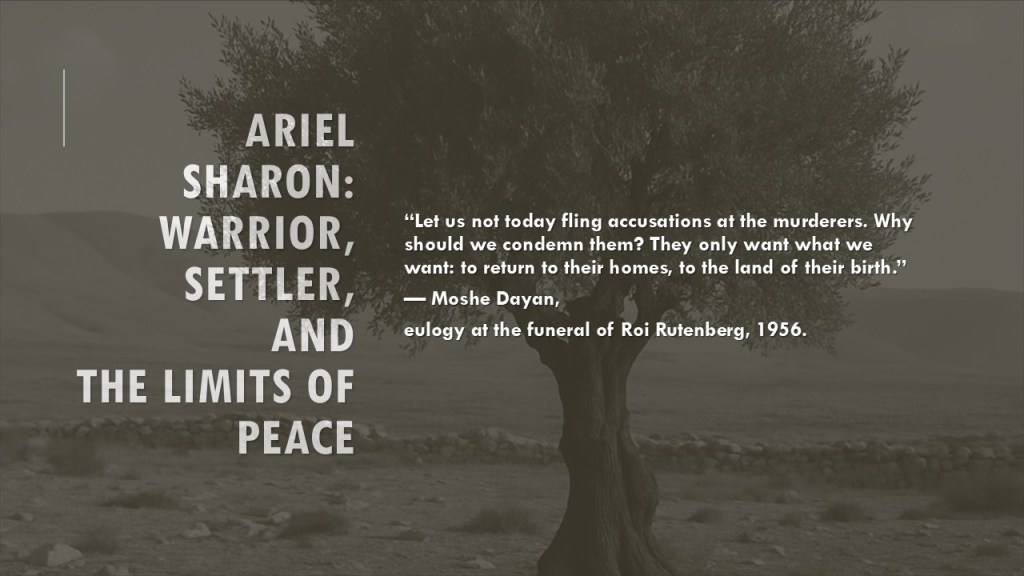
Ariel Sharon remains one of Israel’s most polarizing figures — a man celebrated for military daring, condemned for his role in atrocities, and remembered for his unexpected political decisions, including the unilateral withdrawal from Gaza. Sharon’s life, in many ways, encapsulates the complexities and contradictions of Israel’s modern history.
Sharon was born on a farm in Kfar Malal, joined the Haganah in his youth, and gained early recognition during the 1948 Arab-Israeli War for his military effectiveness. His career accelerated with the establishment of Unit 101, a commando unit noted for aggressive retaliatory raids. These raids, including the infamous 1953 Qibya massacre that claimed the lives of 69 civilians, foreshadowed Sharon’s controversial legacy.
From the 1970s through the 1990s, Sharon became a central figure in the expansion of Israeli settlements in the West Bank and Gaza, territories occupied since the 1967 Six-Day War. As a Likud party stalwart, he openly championed the settlement project, supported by Religious Zionists who believed in the vision of ‘Greater Israel’ as outlined by Rabbi Zvi Yehuda Kook. This expansion came at the expense of Palestinian rights and contravened international law, fuelling tensions that persist to this day.
Water rights, land confiscations, and the systematic expansion of settlements deepened Palestinian grievances, contributing to cycles of resistance and repression. Sharon was not alone in these policies, but he was their most visible and unapologetic proponent.
On the Palestinian side, Yasser Arafat embodied similar contradictions. The Palestinian national movement, enshrined in the PLO charter, rejected Israel’s existence for decades and pursued armed struggle. Arafat’s failure to adapt to changing realities, especially during opportunities like the Camp David Summit in 2000, led to continued suffering for the Palestinian people. His ambiguous stance toward militancy, and inability to deliver meaningful peace, resulted in disappointment and disillusionment.
History will likely judge both men harshly — mirror images in their intransigence, each contributing to the perpetuation of violence and mistrust.
Sharon’s most notorious chapter remains his role in the 1982 Lebanon War, launched ostensibly to remove the PLO from Lebanon. Israel’s involvement soon entangled it in the Lebanese Civil War, a complicated internal conflict. The war culminated in the tragic Sabra and Shatila massacre, when Christian Phalangist militias slaughtered hundreds of Palestinian civilians under the eyes of Israeli forces. The Israeli government’s Kahan Commission held Sharon personally responsible for failing to prevent the massacre, declaring him unfit to serve as Defence Minister.
And yet, Sharon’s political career did not end. His political resurrection, culminating in his election as Prime Minister in 2001, reflected both the deep divides within Israeli society and the bleak landscape of Israeli-Palestinian relations at the time.
Sharon’s controversial visit to the Temple Mount in September 2000 helped trigger the Second Intifada, while his government’s harsh military response, including targeted assassinations, led to thousands of deaths. Meanwhile, the Palestinian leadership failed to prevent terror attacks against Israeli civilians, perpetuating the mutual cycle of violence.
American policy during this period, under the Bush administration, contributed to the stagnation of peace efforts, with public declarations of Sharon as a “man of peace” standing in stark contrast to escalating violence and deepening occupation.
Yet, Sharon surprised many by initiating the unilateral withdrawal from Gaza in 2005, evacuating all Israeli settlers and soldiers from the Strip. While praised by some as a bold move towards peace, others viewed it as a cynical strategy to strengthen Israel’s hold on the West Bank. The Gaza withdrawal ultimately failed to deliver peace and contributed to further polarization within Israeli society and between Israelis and Palestinians.
Sharon’s life closed in tragedy: incapacitated by a stroke in 2006, he remained in a coma until his death in 2014.
Conclusion
History, ultimately, demands that we look beyond the deeds of individuals and understand the deeper human longing for land, identity, and peace — a longing that persists on both sides of the divide.
Ariel Sharon’s legacy remains deeply contested. He was a man of action, often guided by military logic, willing to take bold decisions but also responsible for acts that inflicted lasting trauma on the Palestinian people. His life represents both Israel’s determination to survive and the moral costs of occupation and conflict.
Israel, like any state, has a right to exist within secure and recognized borders. But the prolonged occupation, settlement expansion, and disregard for Palestinian rights have eroded Israel’s moral standing. Equally, Palestinian leadership failures have compounded the tragedy.
If peace is ever to be achieved, it will require a new generation — one able to overcome the toxic legacies of both Sharon and Arafat. Only through mutual recognition and compromise can a path forward emerge from the barren cycle of war.
Netherlands, WJJH, 20.7.2025
📌 Blog Preview
Ariel Sharon remains one of Israel’s most polarizing figures — soldier, settler, and reluctant pragmatist. This reflection revisits his complex legacy, a man of contradictions, from the battlefields of 1948 to the fraught disengagement from Gaza. Beyond the headlines and controversies, it explores the deeper tragedy of two peoples bound by history and land, still searching for peace.
 In what kind of world do we wish to live