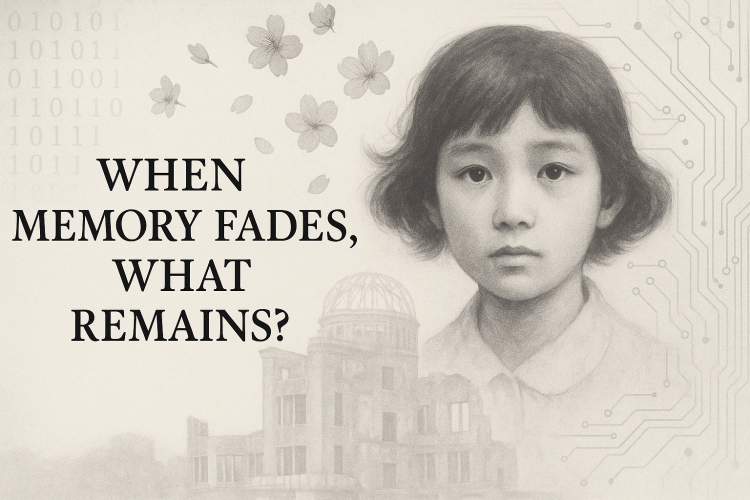
🕊️ When Memory Fades: A Reflection on Shigeko Sasamori
She wanted to hate, but she couldn’t. Now, her voice falls silent — and the task of memory is ours.”
📘 Author’s Note
This post is written in memory of Shigeko Sasamori, one of the last living survivors of Hiroshima, who passed away in December 2023. It is a reflection on the meaning of her testimony, the silence that follows, the moral challenge of remembrance, and the growing international instability we face today.
It includes a link to my earlier post:
👉https://wjjh.blog/2024/01/08/hiroshima-from-civilization-to-barbarism-only-needs-but-one-day/
The Silence After the Blast
Dear Reader,
On an ordinary morning, with coffee in hand, I came across an article by Anoma van der Veere on the NOS website. It referred to the passing of Shigeko Sasamori — a name that may not echo in the corridors of political power, but one that carries the quiet gravity of lived history.
She was thirteen when the bomb fell on Hiroshima.
She survived the blast, the fire, the aftermath — but carried the scars, both visible and invisible, for a lifetime.
And now, she too is gone.
Eighty years after Hiroshima, we are witnessing something both inevitable and profound: the gradual extinction of direct memory. With each passing year, the voices that were there — who saw it, smelled it, endured it — fade into silence. What remains is the question Angela Merkel once raised:
When the last eyewitness is gone, will we have truly learned from history?”
It is a haunting question, especially when one considers how, over time, the deeper ethical questions surrounding the use of nuclear weapons have been minimized, rationalized, or altogether ignored.
And yet, each year, on the anniversary of Hiroshima, survivors and relatives gather at the Peace Memorial Park, under the shadow of the eternal flame that will only be extinguished when the last nuclear weapon on Earth has been dismantled. Hundreds of white doves are released — a symbol of peace, of memory, and of an aspiration that remains unfulfilled.
Awards and gestures — such as the Nobel Peace Prize granted to Nihon Hidankyo, the organization of Japanese atomic bomb survivors — are meaningful, but insufficient. True remembrance requires more than ceremony. It demands reflection, honesty, and the courage to confront a world that is once again flirting with catastrophe.
1. The Weight of Witness
Shigeko Sasamori’s life stood as a quiet bridge between horror and hope. In the 1950s, she was among 25 young women — later known as the “Hiroshima Maidens” — brought to the United States to undergo reconstructive surgery. Disfigured by the bomb, these women became a symbol of postwar reconciliation and humanitarian care, helping to frame a narrative of healing between former enemies.
Shigeko later moved to New York, where she lived much of her life in quiet dignity. Her story gained renewed attention in the 2007 HBO documentary White Light/Black Rain: The Destruction of Hiroshima and Nagasaki, in which she spoke with disarming clarity about the bombing and her long journey toward emotional healing.
I wanted to hate,” she said. “But I couldn’t. Hate only brings more hate.”
Her forgiveness, her restraint, her grace — all stand in stark contrast to the political noise of today and the failure to build a world free from the threat of nuclear annihilation. Despite decades of lip service, nuclear disarmament remains elusive. The taboo on using nuclear weapons — the so-called “nuclear threshold” — has weakened, not strengthened. And no serious moral reckoning has ever taken place about the use of these weapons on Hiroshima and Nagasaki.
2. History Without Eyewitnesses
There is a difference between memory and history. Memory is lived — raw, human, imperfect. History is processed — recorded, debated, often distorted.
As survivors like Sasamori pass on, we risk losing not just their testimony, but the emotional force of their warning. What remains may be the facts — the date, the death toll, the cratered map. But facts are not memory. Memory gives meaning. Memory demands response.
Angela Merkel’s insight is worth repeating:
When the last eyewitness is gone, we will know whether we have truly learned.”
The danger now is that Hiroshima becomes a symbol drained of its meaning — a line in textbooks, a plaque in a park, a debate for the disinterested. But Hiroshima was not inevitable. And neither is its repetition.
3. The Moral Task of the Living
To remember Hiroshima is not to dwell in the past. It is to question the present and confront the future.
Today, the world is entering uncharted territory on multiple fronts. The modernization of nuclear arsenals continues across all nuclear-armed states. Emerging technologies — including artificial intelligence and quantum computing — threaten to destabilize the fragile balance of deterrence upon which the world precariously rests.
The United States has recently launched a plan titled “Winning the AI Race: America’s AI Action Plan,” which aims to cement American dominance in artificial intelligence by gutting regulations, expanding data infrastructure, and aligning technological development with what it defines as “American values.” The plan positions AI not as a collaborative tool, but as a geopolitical weapon in the race against China.
Meanwhile, China has introduced its own AI framework, focusing — at least in stated ambition — on international cooperation and regulatory alignment. The two visions could not be more different: one seeks to dominate, the other to distribute. Both, however, illustrate a global race that only accelerates — one that risks repeating the nuclear arms buildup of the Cold War, only now in digital form.
There is no permanent technological dominance. Others will catch up. And with no collective ethical framework in place, this race may produce not a winner, but a tragedy.
In such a world, the memory of Hiroshima is not only relevant — it is essential. It reminds us what happens when technology outpaces conscience, when military strategy overrides humanity, and when power silences compassion.
📌 Closing Thought
Perhaps the passing of survivors like Shigeko Sasamori is not just an ending, but a beginning — a test of our moral memory.
Without the witness, we are now the bearers of their truth.
The silence she leaves behind is not empty.
It is full of obligation.
Netherlands, William j j Houtzager, Aka WJJH, August 9, 2025
✂️ Blog Excerpt Preview
Eighty years after Hiroshima, the voices of those who witnessed it are slowly falling silent. With the passing of Shigeko Sasamori, a survivor who chose grace over hate, we are left with a question posed by Angela Merkel: When the last eyewitness is gone, will we have truly learned?
This is a reflection on silence, memory, and our moral duty in a world increasingly shaped by artificial intelligence, arms races, and ethical amnesia.
 In what kind of world do we wish to live