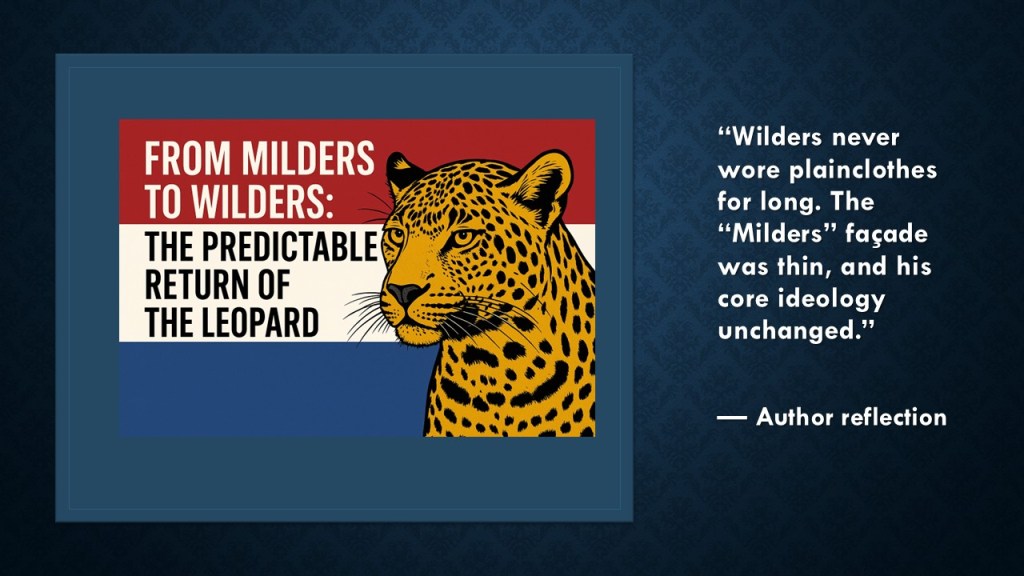
From Milders to Wilders: The Predictable Return of the Leopard
✍️ Author’s Note
This reflection was written in the aftermath of the collapse of the Schoof government — an outcome that was as predictable as it was necessary. It follows my 2023 post on the dangers of normalizing Geert Wilders’ PVV, a party displaying several hallmarks of fascism. That normalization was enabled by Dilan Yeşilgöz, leader of the liberal VVD, whose political gamble gave the PVV a credible path to governance. It was a strategic blunder of historic proportions, and its consequences have been both swift and damaging.
“Ur-Fascism is still around us, sometimes in plainclothes. It would be so much easier for us if there appeared on the world scene somebody saying, ‘I want to reopen Auschwitz, I want the Blackshirts to parade again in the Italian squares.’ Life is not that simple. Ur-Fascism can come back under the most innocent of disguises.”
🎯 Eco’s famous essay Ur-Fascism lists the recurring traits of fascism, from the cult of tradition to the appeal to a frustrated middle class and the obsession with national security. Wilders’ rhetoric and policy agenda echo several of these traits — particularly in his fixation on an exclusionary national identity, his demonization of minorities, and his anti-institutional attack
The 2023 Dutch general election results have raised concerns, as Geert Wilders far-right PVV party claimed the top spot with 37 out of 150 parliamentary seats, constituting 23.6% of the vote. This outcome is not only embarrassing but also serves as a warning, especially when politicians like Dilan Yeşilgöz of the VVD normalize and legitimize extreme right and xenophobic candidates by providing the PVV, which exhibits some of the main characteristic of fascism, a perspective of governance.
The VVD’s strategic blunder, attempting to win another term by promising a coalition with the far right, resulted in the rehabilitation of Wilders in the eyes of the voters. Former Prime Minister Rutte’s notion of “good populism” has pushed the centre further to the right, aligning with extreme positions. However, there is no such thing as “good populism” or “good nationalism”; both are deplorable and akin to a malignant cancer.
In these critical times, looking away is perilous, just as normalizing the PVV in the media is. It’s evident that Wilders’s PVV is a racist movement, and we must resist the dark forces of racism and fascism.
While Wilders has presented a more moderate version of himself, pledging to put his anti-Islam rhetoric “on hold” for cooperation with other parties, a leopard doesn’t change its spots.
The victory of the Dutch mini-Trump signifies a shift towards a “Netherlands first” and closed borders mentality, altering political discourse not only within the Netherlands and Europe but also impacting international relations.
This shift has consequences for the European Union, with the Netherlands potentially resuming a more destructive role, as seen during the Euro crisis. Wilders’ platform calls for an exit from Europe, slashing spending on climate goals, halting all foreign aid, and reinstating border control. His anti-immigration and refugee policies would face legal hurdles, given that the majority of immigration legislation falls under the jurisdiction of the European Union (EU). The future trajectory depends on coalition negotiations, and only time will reveal whether this victory turns out to be a Pyrrhic one.
Reflecting on my upbringing in the Netherlands, I recall a time when tolerance, diversity, justice, freedom, and equality were the cherished and embraced values. However, perspectives change over time, and the country itself has undergone transformations. Economically robust and civilized, the Netherlands boasts an excellent quality of life.
Historically, it has been a multicultural liberal society with a mature democracy. The population of 17.6 million includes 25% Christians, 6% Muslims, and 68% unaffiliated. The Netherlands has a rich religious history, marked by the Treaty of Westphalia in 1648, recognizing its independence, and the subsequent transformation into a leading European power during the seventeenth century.
The Dutch Republic thrived in trade, industry, arts, and sciences, boasting luminaries like Rembrandt, Vermeer, Erasmus, and Spinoza. Celebrated for religious tolerance, it became a refuge for persecuted communities, including Huguenots and Puritans. However, the nation was not without its contradictions, engaging in slavery and military repression in various parts of the world.
The core values of tolerance, diversity, justice, freedom, and equality have defined the Netherlands as a “civilized” society, characterized by welcoming refugees and freedom of movement—values in stark contrast to the extremist views of Geert Wilders.
Geert Wilders, the longest-serving MP in the Dutch parliament, aligns with other national populists on the extreme right. Drawing parallels to pre-office declarations, Wilders aims to reshape the state by changing article 1 of the constitution, according to his vision.
In the broader European political spectrum, figures like Marine Le Pen, Matteo Salvini, and Nigel Farage have a presence, but their influence remains limited. All these populists, regardless of left or right-wing orientation, rely on fervent followers with limited understanding, simplifying complex issues and sacrificing facts and truth in favor of empty slogans that offer no real solutions to today’s and tomorrow’s challenges.
Who is Geert Wilders? Geert Wilders hails from Venlo, a small city in the conservative, predominantly Catholic province of Limburg. His mother’s side has Indonesian ancestry, and after completing high school, he spent two years at an agricultural commune in Israel. Adding to this multicultural max, his wife is a Hungarian immigrant.
Wilders made his entry into politics occurred in the late 1990s when he joined the liberal VVD. The party, under the leadership of Frits Bolkestein since the 1990s, was among the first to oppose multiculturalism, immigration, and EU integration.
In 1997, Wilders served as Frits Bolkestein’s assistant, who is now considered an eminence grise. The VVD’s shift in direction, moving away from liberalism, prompted many liberals to leave for D66, the country’s liberal pro-European party.
Although initially elected to parliament for the VVD in 1998, Wilders parted ways with the party due to what he perceived as its leniency towards Islam and a misalignment with his extreme views. Subsequently, in 2004, he founded his anti-Islam/anti-immigrant/anti-EU party, later renamed Partij voor de Vrijheid (PVV). Notably, the PVV operates as a one-man show without members, democratic norms, or membership, relying solely on external donations from American, Israeli, and other extreme right conservative circles.
In 2016 Wilders was convicted of inciting hatred for a speech calling for “fewer Moroccans” in the Netherlands. His platform calls for banning mosques and the Quaron.
Described as one of Vladimir Putin’s European allies, Wilders advocates for improved relations with Russia. He opposes the EU candidacy agreement with Ukraine, and dismisses concerns about “climate change hysteria.”
Wilders’ supporters, largely comprising uneducated and low-income voters, seem captivated by the vibrant facade he paints. However, despite his long tenure in parliament, Wilders’ anti-Islam rhetoric, asserting that Islam is not a religion but an ideology, resembles a worn vinyl gramophone record from the sixties—no longer listenable, a relic consigned to the attic.
Similar to Trump supporters, Wilders’ base is urged to dispel the fairytales and scrutinize his true nature. Upon closer inspection, they would discern the caricature that Wilders has become, embodying a “brown” 1930s-style core that is inherently untrustworthy.
In certain aspects of our history, parallels can be drawn. In 1935 the NSB, an ultranationalist part led by Anton Mussert, gained 8% of the vote and then openly collaborated with the Nazis during the occupation. The PVV, a populist ultranationalist party led by Geert Wilders, shares similarities as a racist movement that reveres the will of the “people,” promoting what was once referred to as “gesundes Volksempfinden.” This involves glorifying the past and framing our society as being in crisis due to immigration and the perceived loss of our national (Christian/white) identity.
Wilders exhibits an anti-parliamentarian stance, displaying disdain for institutions and attacking the independence of the courts while deploring human rights. His opposition to the European Union aligns with a desire to “reclaim the Netherlands.” Having lived through the 1960s and aware of Christianity’s history, I appreciate the separation of church and state, embracing the societal changes that have led to a more open society and a diminished role for the church.
Despite some challenges in integration and education, our multicultural liberal society, with more advantages than disadvantages, should be acknowledged. Regarding refugees from conflict zones like Afghanistan, Iraq, Syria, or Ukraine, it’s crucial to recognize that any family in similar circumstances would seek safety for their loved ones.
In a global context, with 62.5 million forcibly displaced people, including 50% children, there is a pressing need for compassion. Angela Merkel’s courageous response during the last refugee crisis exemplified moral leadership, contrasting with the disappointments in Prime Minister Mark Rutte’s approach.
Authoritarian tendencies in Central-European countries like Slovakia, Hungary, and Poland, along with the erosion of democratic values, raise questions about EU enlargement and full membership validity. Viktor Orbán’s xenophobic expressions in Hungary and attacks on the Constitutional Court in Poland under the previous government are troubling, necessitating self-reflection and potential consideration of a two-speed EU.
Instead of erecting walls, fostering an open-minded approach is essential, especially as Europe’s aging population requires embracing well-educated refugees who can contribute positively to our society. Geert Wilders’ intolerance, aversion to Islam, and xenophobic views warrant scrutiny, as they align with extreme right-wing demagoguery threatening our liberal society.
Wilders’ discriminatory plans, particularly his “de-Islamization” measures, are not only dangerous but also violate fundamental human rights, including freedom of education, religion, speech, fair trial, and equality before the law. His views undermine institutions, freedom, and the rule of law, resonating with extremist circles, as seen in references by the Norwegian mass murderer Breivik.
Wilders’ narrow-minded perspective on Islam fails to distinguish between moderate and radical expressions within the religion. Additionally, his advocacy for leaving the EU, abandoning the euro, and returning to the Dutch Guilder is deemed utopian and economically detrimental. In our integrated global market, isolationist policies would have adverse effects on the economy, competition, and living standards, making them unrealistic and perilous propositions. Globalization and liberal societies, with their interconnectedness and ability to address issues like unemployment and poverty, remain integral and advantageous for developing countries.
Concluding, a Wilders Government would be disastrous and not in the interest of the Netherlands or Europe. Like Sigrid Kaag, I am not falling for the fairytale of “Geert Milders,” the racist politician who is said to have suddenly become reasonableness itself, by pretending to be Mother Teresa himself.
As Kaag points out, “20 years of hatred, discrimination, exclusion against population groups” and “his political earning model of allegations, accusations, and demonizing others, his opponents.” Perhaps, Mr. Wilders will become prime minister, for a limited time until sanity has returned to this country and new elections are held, but never will he represent me.
Netherlands, WJJH, November, 2025
🎯Proscript
The collapse of the Schoof government could not have come soon enough. The belief that Wilders could remain “Milders” once in power was a fantasy — the leopard, true to form, did not change its spots. Instead, his populist, xenophobic agenda quickly resurfaced, confirming what was already clear to those unwilling to indulge in political wishful thinking.
Yet the damage lingers. By giving the PVV a seat at the table, the boundaries of political discourse have shifted. Xenophobic rhetoric has been legitimized, and even centrist parties such as D66 have adopted a harder domestic tone — most visibly on migration policy.
This is the cost of normalizing the abnormal: the erosion of democratic guardrails and the redefinition of the possible. It is an embarrassment for the Netherlands, a cautionary tale for Europe, and a reminder that when democratic parties bargain with extremists, the price is always paid in credibility, stability, and liberty.
📌 Blog Excerpt
Geert Wilders’ electoral breakthrough in 2023 marked a decisive shift toward a “Netherlands First” agenda and a closed-borders mentality, with inevitable repercussions for EU relations. His discriminatory proposals threatened fundamental human rights, undermined democratic institutions, and eroded the foundations of liberal society. Two years on, those threats are no longer hypothetical — they have shaped policy, shifted the political Centre, and left a lasting mark on Dutch democracy.
 In what kind of world do we wish to live