The Netherlands: Nature and the Flows of Ebb and Tide
✍️ Author’s Note
This reflection was inspired by a personal memory of the 1953 North Sea flood — a day that left an indelible mark on my childhood and on the Netherlands itself. It is a meditation on our centuries-long struggle with the sea, from medieval floods that reshaped our map to the engineering triumphs of the Delta Works, and the looming challenge of climate change. Beneath the history and technology lies something deeper: a story of identity, resilience, and our fragile balance with nature’s power.
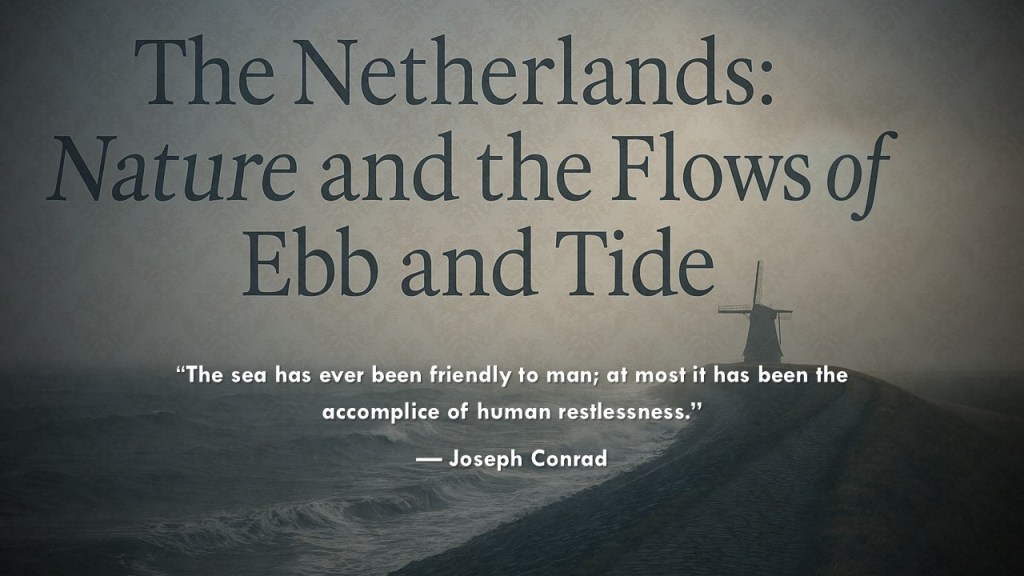
Nature is unpredictable, and the sea, perhaps most of all, is a companion whose moods can change without warning. Joseph Conrad wrote that “the sea has ever been friendly to man; at most it has been the accomplice of human restlessness.” In those words lies the paradox of our history: the water that sustains us is also the force that threatens to take everything away.
I was nine years old on the morning of February 1, 1953. The night before, a strong storm rattled the windows — nothing unusual for a Dutch winter. But by breakfast, the world had changed. News came of dikes broken, islands flooded, and lives swept away. A force 12 north-westerly windstorm, high spring tides, and low pressure had conspired with the sea to overwhelm Zeeland. More than 1,800 people were dead, 70,000 homeless. I remember standing in my father’s study, tracing the dark blue shapes of flooded land on the map, trying to imagine the scale of what had happened.
It was not the first time the sea had claimed our land, nor the last. Since the Middle Ages, storms have redrawn our coastline. The St. Lucia’s Flood of 1287 killed tens of thousands and created the Zuiderzee, forever changing the map of the Netherlands. Other floods came in 1421, 1717, 1808, 1906, each reminding us that in this country a quarter lies below sea level and another half barely above it.
And yet, we have never simply yielded. Our response has always been both stubborn and ingenious — dikes, polders, windmills, sluices — until, in the 20th century, came the Afsluitdijk and, after 1953, the Delta Works. The Eastern Scheldt Barrier is the most famous, a nine-kilometre movable wall that closes only in the face of real danger. It is a triumph of engineering and of will — a statement that we will not surrender to the sea.
But water teaches humility. The land still sinks in places like Gouda, three millimetres a year. The sea still rises — now twice as fast as in the last century. Our defences, magnificent though they are, were built for a different climate. The storms of the future will carry more rain, more force, more unpredictability.
The struggle between land and water is more than an engineering challenge; it is part of our identity. It is written in our history, in the stories passed down, in the maps I once studied with my father. It is a reminder that we live not in defiance of nature, but in a delicate, temporary balance with it.
The morning of 1953 taught me something I have never forgotten: the sea will always return. It arrives quietly in the mists of a calm tide, or roaring in the dark with the weight of a storm behind it. It shapes our land, our history, and our character. We build our dikes, drain our polders, and raise our barriers not in the belief that we will win, but in the hope that we can hold the line a little longer.
One day, perhaps centuries from now, the sea may take back what we have borrowed. But until that day, we live between ebb and tide — watchful, inventive, and stubborn — knowing that our true homeland is not the land itself, but the fragile balance we keep with the water that surrounds it.
Netherlands, William J J Houtzager, Aka WJJH, August 2025
📌 Blog Excerpt
On the morning of February 1, 1953, I came down to breakfast to find the world changed. Overnight, the sea had broken through Zeeland’s defenses, leaving thousands homeless and over 1,800 dead. Since that day, I have understood something essential: in the Netherlands, the sea is never truly defeated — it is only held at bay. Our history is written between the ebb and the tide, between the moments of calm and the nights when the water returns to remind us who really shapes the land.
 In what kind of world do we wish to live
The floods of 1287. Whoever knew their history well. By bend of bay, o history some day, will dublin wail. Grangegorman borehole chokes in radio metric calcium.
LikeLiked by 1 person
Nature requires more respect and not only in times of floods, than we seem to give it. It’s a amazing force that provides crucial lessons and we should preserve it better.
LikeLike