Morality, Pragmatism, and the Trouble with Virtue
✍️ Author’s Note
This post is part of my ongoing reflections on the dilemmas of modern society, drawn from philosophy, history, and current events. It was prompted by a letter from a friend in Geneva, Marton Radkai, at a time when letter writing has become a neglected art—an old fashioned practice in a digital, distracted world, dominated by social media, too often marked by unbalanced narratives and tribal division.
While the art of listening has become a lost skill, these monthly exchanges over the last years offer food for thought. Marton introduced me to the writings of Georg Moeller, professor of philosophy at the University of Macau, who—through his book The Moral Fool—throws a stone into the tranquil pond of ethics, morality, and legal standards. I welcome dialogue on this theme, especially from those who, like me, are both humanist and sceptical by nature.
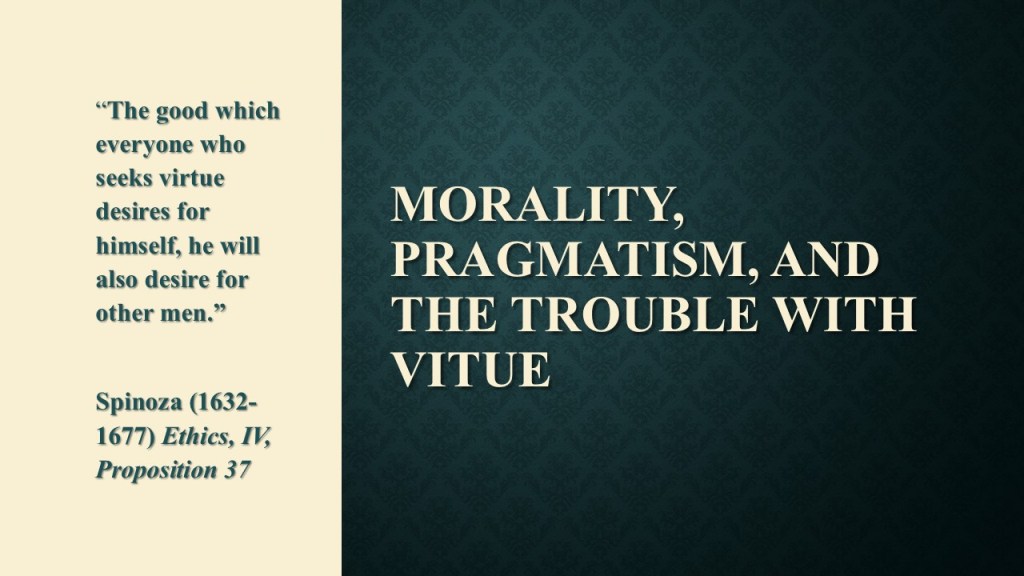
On the Limits of Ethical Absolutism and the Necessity of Self-Restraint
We live, it is often said, in a time of disorder, with a new economic paradigm looming on the horizon. Institutions once held to be stable now feel brittle. Democracies stammer, the planet burns, and the public mood has soured—echoing the wisdom of Cicero:
“We are silent when we see that all the money of all the nations has come into the hands of a few men, which we seem to tolerate and permit with more equanimity, because none of these robbers conceals what he is doing.”
Some voices in my circle, observing this decay, argue that one of the root causes of our present malaise is the insidious intrusion of morality—or more precisely, moralism—into spheres of society that ought to be governed by pragmatism and efficiency.
Others, like the Dutch thinker Rob Riemen, call for a return to virtue. But too often, such calls sound like sermons without a strategy—more about romanticizing yesterday than securing the day after tomorrow. The yearning is real, the diagnosis perhaps accurate, but the prescription remains vague. Virtue, yes—but to what end?
The Moralist’s Trap: Good vs. Bad
Into this muddled landscape enters the provocative voice of Georg Moeller. In The Moral Fool, he argues that morality itself may be the problem—that societies function best not through moral conviction but through legal clarity and rational systems. Morality, in his view, is less a compass than a cudgel.
“Morality is a tool. It is not, unlike an axe, used for splitting things into halves, but for dividing people into two categories: the good and the bad.”
This binary is not unfamiliar. We’ve seen it play out in history, in politics, and in religion. And yet, I would argue—as would Spinoza—that this is a dangerous reduction. Very few people are wholly good or wholly bad. Most of us live in the shifting spectrum of human complexity, balancing our better angels and baser instincts, like Yin and Yang striving for harmony.
The moralist, however, hovers above, sneering down at those who must navigate real-world dilemmas. In this framework, complexity is flattened into judgment. It divides more than it unites.
Two Spheres, One Problem
Moeller distinguishes between two societal spheres: the private realm of family and friends, governed by affection; and the public realm, governed by law. In the former, morality is superfluous. In the latter, it is counterproductive—law alone should suffice.
The model is neat, even seductive in its clarity. But it assumes that law can exist in moral isolation, a claim I find historically and philosophically dubious. Laws emerged from shared notions of right and wrong, from religious codes and philosophical traditions of justice. Strip away the moral soil, and law becomes sterile—worse, it becomes a mechanism of control, as it often has in authoritarian regimes.
Moeller’s view, taken to its extreme, resembles the technocratic perfection of modern-day China under Xi Jinping: efficient, orderly, but cold, surveyed, and disturbingly devoid of dissent. A society without ethics may function—but to what human end?
Spinoza’s Caution: The Morality of Domination
My thoughts return to Benedict Spinoza, whose warnings still ring true. He understood that morality, when aligned with power, could easily become a form of oppression. In his time, people were divided by dogma and sectarian strife. One group’s morality would dominate, and the other’s would be silenced.
In Geneva, the Calvinists—once persecuted—became persecutors. In France, wave after wave of civil wars broke the land. Protestant refugees fled to the Netherlands and to Geneva, only to face new forms of moral authority, now imposed by their own side.
Spinoza knew this cycle well. For him, morality had to be reclaimed from dogma and re-rooted in reason and human flourishing. In Ethics, he suggests that what we call “good” is that which increases our capacity to act and understand; “bad” is what diminishes it. His is a morality not of judgment, but of vitality—a dynamic ethic, anchored in freedom.
Kant’s Dream: Universal Law
Immanuel Kant offered a different solution. For him, morality had to be objective and universal, discoverable through reason alone. His categorical imperative—“act only on that maxim which you can will to become a universal law”—was meant as a moral compass for a pluralistic world.
But while Kant’s ethics are elegant, they leave little room for ambiguity. Where Spinoza allowed for degrees and nuance, Kant draws hard lines. Still, both thinkers believed in reason as the path to moral clarity. Neither would have been comfortable in Moeller’s moral vacuum.
The Problem of War and the End of Dialogue
What complicates this entire moral landscape—law, ethics, pragmatism—is war. War defies both efficiency and ethics. It is brutal, irrational, and uncontainable. Despite the best efforts of the Geneva Conventions and the Red Cross, war always exceeds the rules set to tame it.
And yet, war is so often morally justified, even sanctified—by those who invoke God, nation, justice, or liberation. In wartime, the moralists win, not because they are right, but because reason retreats. The moral narrative becomes intoxicating, singular, and dominant. Dialogue disappears.
As Marton rightly noted, history has often flirted with the fantasy of une bonne petite guerre—a “good little war” to resolve internal tensions, rally the nation, and quiet dissent. We know where that led. And today, the bitch of that “good little war” is in heat again, cloaked in flags, ready to march.
The Dilemma of Now: Fragile Peace, Fractured Society
Today we are caught between two cliffs. On one side stand the moral absolutists—left and right—who frame every issue as salvation or damnation. On the other stand the nihilists and hyper-pragmatists, who see all values as relative, all institutions as hollow.
Meanwhile, inequality deepens, institutions weaken, and corporations colonize the commons. Alienation spreads. When people feel they have nothing left to lose, they reach for the pitchfork—or the strongman. Either way, democracy buckles.
What Then? Toward Moral Humility
The way forward, I believe, is to step back and examine our own assumptions with humility. We must return to first-order norms—the foundational values that most people, across traditions, can agree upon: that war is a last resort; that dignity matters; that cruelty should be restrained; that flourishing—not dominance—is the aim of political life.
These are not ideological claims. They are starting points. But to recover them, we must tame our moralism, practice self-restraint, and return to something like moral humility.
As Spinoza might say: we must seek to understand, not to condemn.
📌 Blog Excerpt
Sunday Read: Exploring the tension between morality and pragmatism in modern society, questioning the role of moralism in public discourse. It discusses Georg Moeller’s view that morality can be counterproductive, suggesting that legal clarity is more effective. Advocating for moral humility and understanding, promoting foundational values that encourage societal flourishing.
William J J Houtzager, Aka WJJH, September, 2025
*Graphic by M.C. Escher “Day and Night” – 1938 – a metamorphosis – white and black birds fly over a Dutch landscape. The white birds fly to the right, through the night. From this dark sky, black birds emerge, flying to the left into the day. In a vertical movement, at the point where the birds meet, they gradually transform into the fields that make up the landscape.
 In what kind of world do we wish to live