Europe Between Sky and Horizon: A Semi-Conclusion
✍️ Author’s Note
This assay captures the paradox of Europe today: its triumphs of peace and prosperity, its disappointments in sovereignty and autonomy, and the dilemmas that enlargement and Ukraine bring to the surface. Europe has learned to survive crises, but without vision, survival risks becoming stagnation.
Prologue: Adenauer’s Horizon
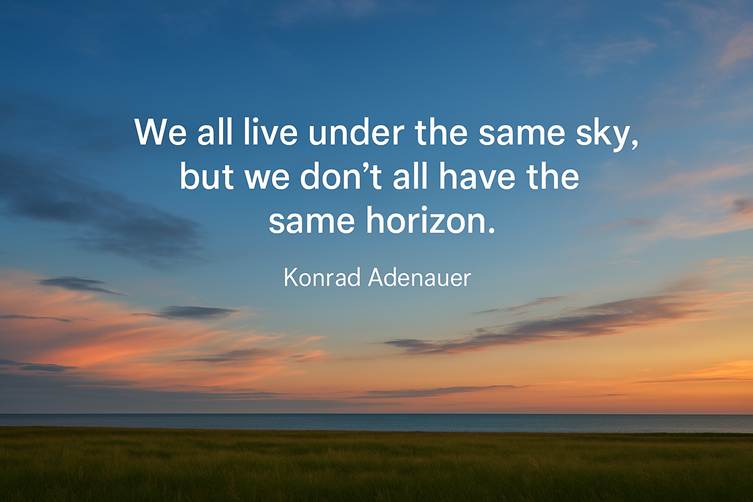
Konrad Adenauer once remarked, “We all live under the same sky, but we don’t all have the same horizon.” Few lines capture the paradox of Europe so well. Unity has always been partial, vision always fractured. Jean Monnet’s dictum that Europe would be “forged in crises, and will be the sum of the solutions adopted for those crises” has proven prophetic — though perhaps also a recipe for instability. From coal and steel to treaties and summits, Europe has stumbled forward crisis by crisis, improvising institutions and compromises along the way. Fragile as this method is, it has yielded peace and prosperity: Europe has avoided a third continental war and delivered an unprecedented rise in living standards.
And yet history reminds us how fragile this can be. The First World War began with Europe sleepwalking into catastrophe, blind to the risks of its alliances and rivalries. Today, in the shadow of Ukraine, we might be sleepwalking again — mistaking crisis management for vision.
1. Through the Eyes of the Founders
Looking through the eyes of Monnet, Schuman, De Gasperi, and Adenauer, we would see both triumph and disappointment.
- Triumph: Their core aim — peace between France and Germany — has been achieved beyond imagination. Economic integration created prosperity; the EU now represents the largest single market on earth. Even Adenauer, cautious about Germany’s role, would be astonished at Berlin’s centrality today. After the fall of the Berlin Wall, many feared a united Germany — Margaret Thatcher most of all. Yet this fear was overcome, and Germany became the anchor of Europe.
- Disappointment: But here lies the shadow. Strategic autonomy in this environment has been a mirage. Defense is outsourced to NATO, which means to the United States. Foreign policy remains fragmented, unanimity paralyzes, and Europe’s voice in the world is hesitant, easily drowned out by Washington, Beijing, or Moscow.
Would the founders recognize their creation? Yes. Would they see in it the horizon they once dreamed of? Likely not. They hoped for solidarity and independence; what they would see is complexity, hesitation, and strategic dependency.
2. Contemporary Dilemmas
Europe’s present challenges reveal the limits of Monnet’s “crisis method.”
- China: At once a “systemic rival” and a vital partner. Europe oscillates between tariffs and trade, lacking a long-term compass.
- Israel and Gaza: Europe proclaims values of law and human rights, but hesitates to act. There is no coherent EU strategy, only fragmented national voices. To many outside Europe, this looks like complicity.
- The ICC: Europe midwifed the Court into existence, but defends it timidly when Washington snarls. It preaches international law but will not enforce it when real costs are involved.
- Ukraine and Enlargement: The war in Ukraine, and the prospect of an EU of 36–37 members, must also be seen as dilemmas. Enlargement promises reach but risks paralysis. Ukraine promises solidarity but risks overextension. Neither question has an easy answer.
Europe thus appears both teacher and pupil: eager to instruct others in law and rights, but timid in applying them when it threatens convenience.
3. Dependency in Diplomatic Cloak
Would the EU’s founders take pride in today’s leaders queueing at the White House, cloaking dependency in the language of “partnership”? Doubtful. Adenauer hoped for a Europe strong enough to stand on its own. Monnet, though Atlanticist, believed in autonomous institutions. Schuman and De Gasperi believed in solidarity, not subordination.
Here Charles de Gaulle’s ghost still hovers. He saw Europe as a civilization composed of distinct peoples with unique histories and cultures. His vision was of a “third force” — a Europe independent of the American and Soviet blocs, a distinct pole of political and economic power. Fifty years later, instead of a third force, Europe appears too often as a dependent one.
History underscores this tension. In the 1920s, Europe lived under the illusion of sovereignty, tethered to the fragile system of Versailles and Anglo-American goodwill. When crisis came, the institutions collapsed. After 1945, the Marshall Plan and NATO secured peace — but at the price of autonomy. Today’s Europe lives between these legacies: less fragile than the 1920s, less sovereign than de Gaulle hoped.
4. A Realist’s Questions
So where does this leave us? Monnet’s dictum about crises has worked — Europe has been forged in crises. But has it built strength, or merely survival?
The realist must ask:
- Can Europe ever stand without the U.S.?
- Can it confront China without unity of purpose?
- Can it claim moral authority while excusing Israel or appeasing Washington?
- Can it defend the ICC and international law if it will not defend them against its allies?
- Is the strategy of an EU-36-37 truly in Europe’s interest?
- Can Europe in Ukraine be true to its motto “As long as it takes”, when its support cannot be indefinite or unlimited?
Europe’s horizon remains narrow not because the sky is limited, but because it has trained itself to see crisis as destiny. In doing so, it has limited itself to crisis as method. Vision has been replaced by improvisation, and sovereignty outsourced for convenience.
Epilogue: Between Sky and Horizon
Adenauer’s words remind us that unity of sky does not mean unity of horizon. Europe has always been plural, hesitant, incomplete. But if Monnet was right that crises forge Europe, the question today is whether crisis still builds — or whether it merely postpones collapse.
The horizon remains unclear. But perhaps that is Europe’s true condition: to walk forever between sky and horizon, never fully arriving, never fully sovereign, always semi-finished, always semi-concluded.
William J.J. Houtzager, Aka WJJH, September 2025
✍️ Blog Excerpt
We all live under the same sky, but we don’t all have the same horizon,” Adenauer once said. The European Union, forged crisis by crisis, has brought peace and prosperity, yet remains fragile in vision and sovereignty. From Germany’s unexpected centrality to the mirage of “strategic autonomy,” from the dilemmas of Ukraine and enlargement to Europe’s dependency on the United States, the same questions return: has Europe truly built strength, or merely survival?
 In what kind of world do we wish to live