Tears and Yin-Yang
✍️Author’s Note
Joy and sorrow share the same pulse. This short meditation turns to the Taoist symbol of yin and yang to remind us that opposites complete, not cancel, one another.
What brings a tear of joy to your eye?
LETTERS TO THE PROMPT
✍️ Author’s Note
This reflection began with the simple question of what brings a tear of joy to one’s eye. My answer wandered—as answers often do—between Chopin and Rumi, between old loves and new sunrises, and toward the children whose suffering demands not only tears but conscience. Tears, after all, are democratic: they appear for joy, sorrow, anger, and sometimes even onions. What matters is not their cause but that they remind us of the fragile balance between joy and pain—our own small version of yin and yang.
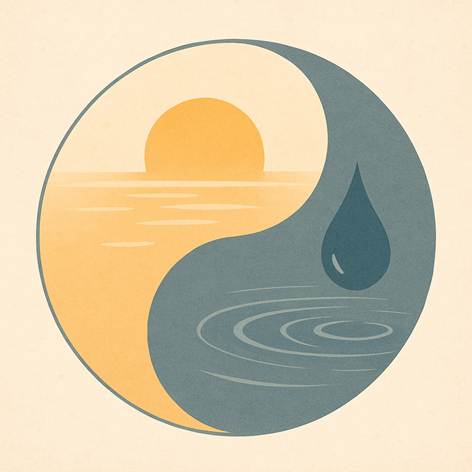
“What is joy without sorrow? What is success without failure? What is a win without a loss? What is health without illness? You have to experience each if you are to appreciate the other.”
– Mark Twain
Dear Prompt,
Wisdom dictates I correct you with Mark Twain’s reminder: “What is joy without sorrow? What is success without failure? What is a win without a loss? What is health without illness? You have to experience each if you are to appreciate the other.”
He had a point, though he forgot to mention that none of this helps much when the bill from the dentist lands on the mat.
Tennyson also comes to mind with his delicate poem “And ask ye why these sad tears stream?”—a topic worthy of another letter, if I can still summon the imagination and not just the sigh.
Now, from a medical point of view, tears are democratic: they show up for joy, sorrow, anger, or onions. “Tears of joy” may sound poetic, but physiologically, they’re no different from the ones we shed when we stub a toe. At my age, though, tears seem to come in short supply. Perhaps they’ve dried up, replaced by wry smiles, or the occasional eye-roll at the evening news.
Still, a few things can sneak up on me. The memory of my departed brother—unexpectedly, on a night with Chopin in the background. The thought of Palestinian children starving while the world, in its wisdom, looks the other way. Or children incarcerated for the crime of being “foreign.” Such cruelty deserves more than a tear; it deserves shame.
And then there are the gentler triggers: the sound of Paganini, a verse of Rumi, the memory of an old love that now makes me smile at my youthful foolishness (Billy Crystal said it well in his moving eulogy for Muhammad Ali). Or the simple act of watching nature wake up in the morning, another sunrise breaking the silence.
So, what brings tears—or smiles—to my eyes? They come from the same source, really. Joy and sorrow, beauty and cruelty, memory and forgetting. Yin and Yang. Without one, the other would be meaningless. Together, they make the human experience worth the bother.
Yours,
—W
Blog Excerpt
Tears are democratic—they show up for joy, sorrow, anger, or even onions. At my age, they’re in shorter supply, replaced more often by a smile or a sigh. Yet Chopin at night, a child’s suffering, a verse of Rumi, or the memory of a foolish love can still stir them. Joy and sorrow, yin and yang—without one, the other is meaningless, and together they make the human experience worth the bother.
 In what kind of world do we wish to live