Between Pessimism and Disillusion: A Rejoinder to Jean-Dominique Giuliani
✍️Author’s Note
This reflection responds to Jean-Dominique Giuliani’s recent essay “Fighting European Pessimism.” While I share his concern about Europe’s wavering confidence, I argue that the problem is not one of temperament but of trust. What some call pessimism is, in truth, disillusion born from decades of policy drift. By looking back to Schuman, Monnet, and Delors, I try to place today’s Europe in its historical context and ask: how can the Union recover belief not through exhortation, but through renewal?
Jean-Dominique Giuliani, Chairman of the Robert Schuman Foundation, recently published a piece titled “Fighting European Pessimism.” His appeal is clear: Europe should stop disparaging itself, see the glass as half full, and embrace confidence in its achievements. He urges us to “think deep and hard.” I have — and I reach a different conclusion.
Jean-Dominique Giuliani: Fighting-European pessimism
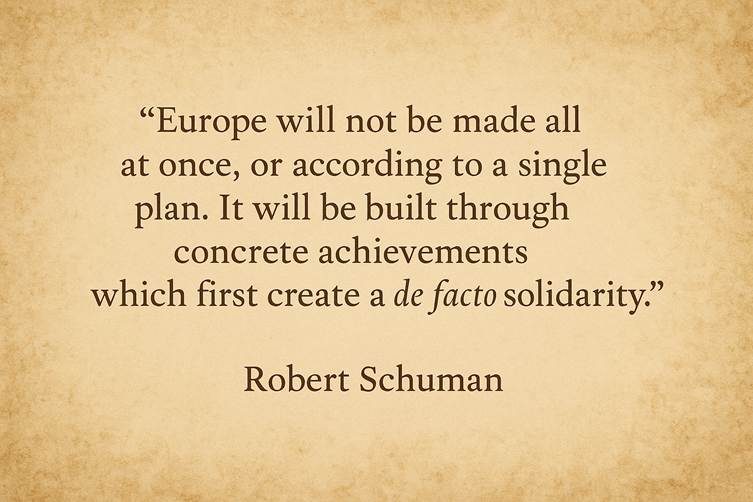
When Robert Schuman read his declaration on 9 May 1950, he did not promise perfection but direction. “Europe will not be made all at once, or according to a single plan. It will be built through concrete achievements which first create a de facto solidarity.” Jean Monnet turned that vision into institutions, each step designed to bind nations so tightly that war would become materially impossible. Later, Jacques Delors rekindled that spirit by marrying economic dynamism to democracy and social justice. He spoke of a Europe with a “soul.”
Measured against this lineage, today’s European Union feels very different.
Migration and asylum
The Union once placed human dignity at the centre of its treaties, a moral lesson learned from Europe’s darkest hours. Yet current migration policy tells another story: externalization of responsibilities, funding of holding camps beyond EU borders, and political discourse framed around deterrence rather than solidarity. Citizens see not a Union of values but a bargaining machine, cutting deals with regimes on its periphery. To call their reaction “pessimism” misses the point. It is disillusion with a Europe that forgets its own founding ethos.
Foreign and security policy
At Maastricht in 1992, leaders promised that a common foreign and security policy would enable Europe to “assert its identity on the international scene.” The Lisbon Treaty later provided institutions — a High Representative, a European External Action Service — meant to give Europe a single voice. And yet, from the wars in the Balkans to today’s war in Ukraine, Europe remains strategically dependent. The mantra of “strategic autonomy” is endlessly repeated but rarely matched by delivery. Citizens are not pessimistic when they note this gap; they are realistic.
Democracy and accountability
The Delors era inspired the idea of a political union where citizens could feel genuine ownership. The Lisbon Treaty expanded the powers of the European Parliament and promised transparency. But in practice, Europe is too often governed through opaque compromises struck in late-night summits. Policy emerges less from parliamentary deliberation than from bargaining behind closed doors. For many citizens, this does not feel like the “ever closer union” they were promised. It feels like technocracy without accountability.
Naming the mood correctly
To describe the public mood as “pessimism” is to misname it. Europe’s citizens are not defeatist by temperament. They are weary from promises unfulfilled, ideals diluted, and horizons that seem to recede with each crisis. “Ever closer union” has given way to emergency management, ad-hoc deals, and the politics of the lowest common denominator.
This matters. For if the problem is merely pessimism, the cure is exhortation — “believe harder, trust more.” But if the problem is disillusion, the remedy is different: honesty, accountability, and delivery.
A word to the Schuman Foundation
I would expect better from the Chairman of the Schuman Foundation. To carry Schuman’s name is to carry a responsibility. Schuman never confused candour with disloyalty, nor criticism with betrayal. He understood that Europe’s strength lay not only in institutions but also in the trust they could inspire.
A genuine defence of Europe must do the same. It should not dismiss scepticism as moodiness, but confront the causes of disillusion head-on. To defend Europe is to insist that its actions match its words — that its treatment of migrants, its pursuit of security, and its practice of democracy reflect the ideals it proclaims.
Between sky and horizon
In earlier reflections, I have written about Europe “between sky and horizon” — torn between lofty ideals and the realities of politics. That image returns here. Citizens were promised a horizon of solidarity, security, and democracy. What they see instead is a sky clouded by compromise and drift.
The challenge is not to summon optimism by willpower, but to re-align Europe’s practice with its promise. Only then can belief return, not out of duty, but out of recognition.
Europe does not need cheerleaders. It needs leaders who will acknowledge the distance between promise and practice — and then shorten it. Optimism, if it is to mean anything, must be grounded not in rhetoric but in renewal.
📌 Blog Description
Between Pessimism and Disillusion: A Rejoinder to Jean-Dominique Giuliani
Europe does not suffer from pessimism so much as from disillusion. In this essay, I respond to Jean-Dominique Giuliani’s call for optimism by revisiting Europe’s founding ideals — from Schuman’s solidarity to Delors’ vision of a Europe with a soul — and contrasting them with today’s policies on migration, security, and democracy. The question is not whether citizens should believe more, but whether Europe can once again live up to its own promise.
William J J Houtzager, Aka WJJH, October 2025
 In what kind of world do we wish to live