Lessons from Moldova: Europe’s Mirror
✍️Author’s Note
This reflection responds to Jean-Dominique Giuliani’s essay “Some Lessons from Moldova.” While I share his recognition of Moldova’s courage, I argue that the true lesson lies not only at Europe’s borders but within the Union itself. Moldova’s enthusiasm for Europe contrasts sharply with the disillusion of many EU citizens, a gap that has been overlooked for too long and exploited by nationalist movements. By holding up Moldova as a mirror, we can see both Europe’s enduring attraction and its internal erosion.
Jean-Dominique Giuliani: “Some Lessons from Moldova.”
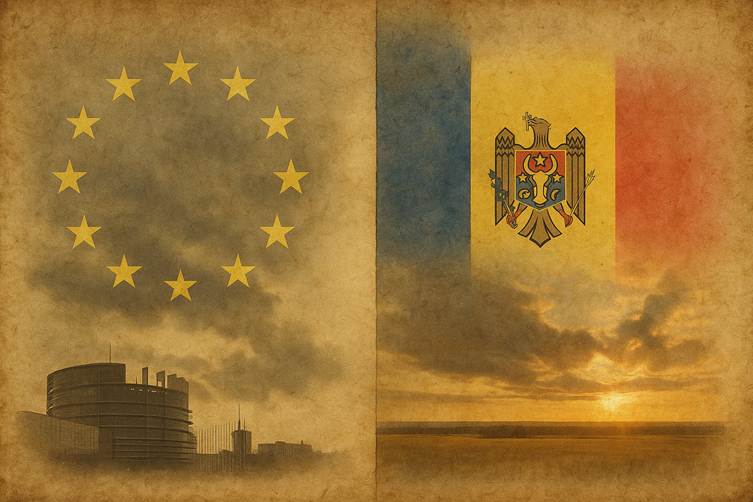
Jean-Dominique Giuliani hails Moldova’s recent elections as proof of Europe’s enduring appeal. He notes that despite Russian interference, Moldovans chose again to anchor themselves in the European project. He draws three lessons: for Moscow — hands off; for Europe — proof of its attractiveness; for America — a reminder of leadership.
But there is a deeper lesson, one Giuliani does not name.
Yes, Moldova’s choice is striking. Yes, the EU still represents a beacon of freedom and democracy on its borders. But the paradox is this: while Moldovans vote for Europe with enthusiasm, many within the Union quietly wonder what became of the Europe they were promised.
The paradox of attraction and erosion
For those outside the Union, Europe represents dignity, law, stability, prosperity. For many inside, the dream has thinned into bureaucracy, half-measures, and drift. The disillusion that feeds today’s extreme right does not spring from fantasy; it grows from a decade of policies that eroded confidence and widened the gap between promise and practice.
To celebrate Moldova’s choice without acknowledging this paradox risks turning the Schuman Foundation into an echo chamber: rejoicing in Europe’s external magnetism while ignoring its internal corrosion.
Ignored discontent
For the last 8–10 years, mainstream elites have largely dismissed the groundswell of discontent inside the Union. They treated criticism of Europe’s failings as pessimism, or worse, as disloyalty. Meanwhile, populists and the extreme right spoke directly to citizens’ frustrations — not always honestly, often with toxic nationalism, but in a way that felt real.
This neglect gave them their opening. When the establishment insists Europe is “attractive” while people feel abandoned, cynicism grows. Europe’s detractors exploit the gap, claiming to defend nations against a Union that no longer inspires.
The real lesson of Moldova
The real lesson is not that Europe is still admired. It is that admiration cannot be taken for granted. Moldovans remind us what it looks like to choose Europe consciously, against alternatives that are darker. Europeans inside the Union must relearn that choice — not out of habit, but out of conviction.
For that, optimism will not suffice. Nor will slogans. What is needed is candor: an admission that Europe has drifted, that disillusion is real, and that only by reconnecting institutions with citizens can belief be renewed.
Between mirror and horizon
In Moldova we see a mirror: the Europe that inspires from outside, and the Europe that struggles to inspire from within. If Europe is to bridge that gap, it must listen to its citizens as much as it welcomes new ones. Otherwise, the dream will remain more vivid in Chisinau than in Brussels or Strasbourg.
📌Blog Description:
Lessons from Moldova: Europe’s Mirror
Moldovans continue to vote for Europe, even under pressure from Russia — proof of the EU’s enduring appeal. But while Europe inspires abroad, it struggles to inspire at home. In this rejoinder to Jean-Dominique Giuliani, I suggest that Moldova offers Europe a mirror: admiration on the outside, disillusion within. If the Union ignores this paradox, it risks leaving the story of Europe more vivid in Chisinau than in Brussels.
 In what kind of world do we wish to live