Butterflies, Phantoms, and the Memory of Delight
✍️ Author’s Note
Morning reflections often lead me down unexpected paths—toward memory, poetry, and the voices that once shaped my inner life. Wordsworth has long been a companion in those moments, reminding me how beauty, emotion, and memory intertwine. This post grew out of such a morning, with coffee, music, and the company of butterflies and phantoms of delight.
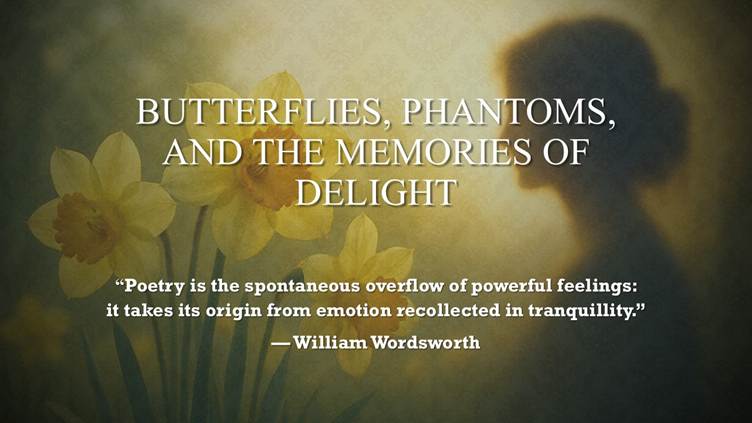
Have we not all been there—when our mind drifts back in time, when old emotions stir, and we find ourselves murmuring, “She Was a Phantom of Delight,” smiling at the complexity of human nature?
I sometimes wonder what became of that sophisticated and charming “Phantom of Delight” I once knew—the one who dazzled me in youth with her grace, charm, and beauty, and who revealed a spiritual depth I was barely prepared to comprehend. It was intense, lovely, and fascinating, yet fleeting—because that is what often happens in the ardour of youth. I know now how differently life might have unfolded, less adventurous perhaps but more steady, had we walked together along life’s road. Alas…
Now, older and perhaps a little wiser, I sigh with the recognition that certain experiences shaped me, some altering my path, others best left forgotten. Still, I return at times to those inner landscapes, in the happy company of butterflies and phantoms of delight, companions who walked beside me in the many phases of life. Together we passed through introductions and enchantments, daily motions and emotions, joys and sorrows, and the difficult balance between earthly passions and spiritual qualities. Inevitably, there came moments when priorities fell out of step, when harmony gave way to dissonance.
When I look back and grant myself the luxury of memory, I still feel those amorous sentiments—and sometimes regret that they were not always better expressed. I wonder at my understanding, my maturity, my priorities. With time, I have come to realize more fully how inner beauty outshines physical charm. Occasionally, I seem to hear again the lyrical voice and sense the softness of presence, as if Wordsworth’s verses themselves were breathing, reminding me that some regrets are inescapable companions of memory.
And so, in this reflective mood, I turn to Wordsworth’s She Was a Phantom of Delight.
William Wordsworth (1770–1850), one of the leading figures of the Romantic movement, transformed poetry by giving it new subjects and a new voice. Where Neoclassicism had sought order and formality, Romanticism found renewal in nature, in the power of memory, and in the emotional life of ordinary people. With Samuel Taylor Coleridge, Wordsworth published Lyrical Ballads in 1798, a collection that redefined poetry as deeply personal and rooted in lived experience.
The upheavals of his time—the French Revolution above all—shaped him profoundly. His early republican sympathies turned to disillusion as the Revolution descended into terror, prompting him to shift his poetic focus from nature alone to the moral struggles of humanity. In poems such as Tintern Abbey and Ode: Intimations of Immortality, he explored how nature speaks to the human spirit and how memory deepens the meaning of past experience. His best-loved lyric, I Wandered Lonely as a Cloud, immortalized the daffodils of the Lake District as emblems of joy and renewal. His greatest and most ambitious work, however, is The Prelude—a semi-autobiographical meditation he revised throughout his life, published only after his death in 1850.
Yet for me, it is She Was a Phantom of Delight, written in 1803 and published in 1807, that remains closest to the heart. Inspired by his wife, Mary Hutchinson, Wordsworth once said of it: “It was written from my heart.” More than two centuries later, it still reads that way—a tender evocation of love, beauty, and the mystery of the human spirit.
William J J Houtzager, Aka WJJH, September, 2025
🌿 Blog Excerpt
In moments of quiet reflection, memory opens its door to butterflies and phantoms of delight—companions of youth who still walk with us in thought. Wordsworth’s poetry, especially She Was a Phantom of Delight, captures that delicate interplay of beauty, emotion, and time. More than two centuries on, his words still speak directly from the heart.
 In what kind of world do we wish to live