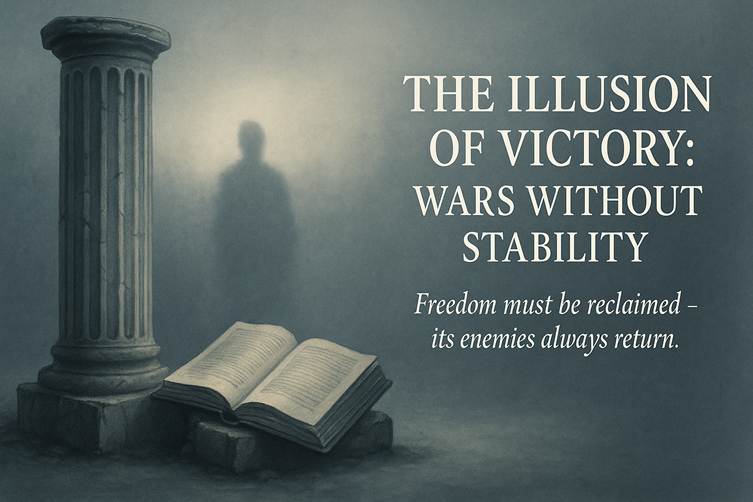
The Illusion of Victory: Wars Without Stability
✍️ Author’s Note
Victory has become a word without meaning in the modern battlefield.
This piece examines how wars may be won militarily yet lost in peace, leaving nations hollowed by instability and pride.
This wars of my lifetime — from Korea and Algeria to Afghanistan, Iraq, Ukraine, and Palestine — and asks why so few have produced lasting freedom or stability. Guided by Hannah Arendt’s On the Freedom to Be Free, Henry David Thoreau’s Life Without Principle, and even Machiavelli’s warning from The Prince, I consider the difference between liberation and freedom, and why revolutions so often collapse into chaos.
Among the books left by my late brother, I found an essay titled Revolution and Freedom, shelved next to Rob Riemen’s The Eternal Return of Fascism. The pairing seemed almost prophetic: freedom must be constantly renewed, renewed, and shared if it is to endure, while its enemies endlessly return. This essay is written in that spirit — part reflection, part warning, and part tribute.
“The most radical revolutionary will become a conservative the day after the revolution.”
— Hannah Arendt
Introduction: The Illusion of Victory
Looking back over my lifetime, the Second World War stands apart as the last great conflict with a conclusive outcome. Its brutality reshaped the world, but it ended with a decisive victory and a framework for peace, however imperfect, that held for decades. Every war since has been of a different kind — not total wars of survival, but what I would call minor wars, civil conflicts into which greater powers intervened: Korea, Algeria, Vietnam, Afghanistan, Iraq, Ukraine, even Palestine.
None of these wars has made the world more stable. Even when one side “won,” what followed was not integrity but corruption, not renewal but deterioration. Beneath the rubble of military campaigns, social and political decay continued, often leaving nations weaker than before.
The failure lies not only in strategy but in understanding. External powers intervened with force, but seldom grasped the inner dynamics of revolutions, local grievances, and the fragile hopes of those caught in the struggle. Too often, the underprivileged and the poor bore the heaviest costs, their lives consumed in conflicts fought in the name of freedom but delivering little of it.
Here Hannah Arendt’s words resonate: freedom is not privilege and liberation is not the same as freedom. In her essay On the Freedom to Be Free, she reminds us that genuine freedom requires more than the end of domination — it demands the creation of institutions, justice, and civic responsibility strong enough to endure. Without this, wars may end, but the promise of freedom fades quickly, leaving behind only the illusion of victory.
2. Arendt and the Freedom to Be Free
Hannah Arendt, reflecting on the revolutions of her time, drew a sharp distinction between liberation and freedom. Liberation means the end of domination — the collapse of an occupying power, a tyrant, or a colonial master. Freedom, however, is something more fragile and demanding: it is the ability of a people to govern themselves, to create enduring institutions, and to live in a civic space where justice and responsibility are shared. Freedom is not privilege, and liberation is not the same as freedom.
In her essay On the Freedom to Be Free, Arendt warned that revolutions often succeed at liberation but fail at freedom. The act of overthrowing an old order is dramatic, immediate, and clear. But the building of freedom is slow, uncertain, and easily undermined by corruption, factionalism, or renewed authoritarianism. Without the structures that secure civic participation, liberation quickly degenerates into chaos.
The history of the last 500 years provides ample proof. The decline of Western imperial hegemony after 1945 unleashed a flood of national movements, each shaped by the creation of the modern nation-state. Many of the wars since then — in Asia, Africa, the Middle East, and Eastern Europe — were less about ideology than about the collapse of empires and the ambitions of new states. Great powers intervened not out of altruism but to preserve or extend their spheres of influence.
And revolutions themselves rarely produced what they promised. The French Revolution descended into catastrophe and terror. The Russian Revolution gave birth to the totalitarian state. The Chinese Revolution became one of the most consequential events of the 20th century, fundamentally altering China’s destiny and reshaping global politics. By contrast, the American Revolution, though flawed, succeeded in building institutions that endured — largely because its leaders combined practical skill with theoretical wisdom. As Machiavelli wrote in The Prince: “There is nothing more difficult to take in hand, more perilous to conduct, or more uncertain in its success, than to take the lead in the introduction of a new order of things.”
Henry David Thoreau, in Life Without Principle, offered an earlier guide to freedom: to live in integrity with one’s conscience rather than the dictates of society. “All good things are wild and free,” he reminded us — a vision of freedom that complements Arendt’s political frame with an inner one.
Arendt’s point remains simple but profound: the freedom to be free is not granted by victory in war or revolution. It must be cultivated, nurtured, and shared. When neglected, it withers quickly, and the newly liberated find themselves trapped in a cycle of disillusionment and decline.
3. Wars as Civil Conflicts, Powers as Interveners
The wars of the last seventy-five years have rarely been straightforward contests between states. More often, they were civil conflicts — wars of identity, ideology, or independence — into which greater powers projected their rivalries. These interventions transformed local struggles into proxy wars, layered with external ambitions but disconnected from the realities on the ground.
Korea (1950–1953)
A war that began as a civil conflict quickly became a frontline of the Cold War. The United States and its allies intervened to defend the South; China poured forces into the North. The result was a brutal stalemate, millions dead, and a divided peninsula that remains a frozen conflict to this day. Liberation was achieved on neither side — only partition.
Algeria (1954–1962)
The Algerian War of Independence was a revolution against French colonialism, yet the victory of the National Liberation Front led not to freedom in Arendt’s sense, but to one-party rule and authoritarianism. Liberation was real, freedom far less so. The poor and rural classes who had borne the brunt of the struggle saw little improvement in their lives.
Vietnam (1955–1975)
Perhaps the clearest case of misjudgement. The United States believed its military and technological superiority could secure victory. Instead, North Vietnam’s endurance and political resolve outlasted America’s domestic patience. The war left Vietnam devastated and deeply scarred, even as reunification came under a system far from the democratic freedoms once promised.
Afghanistan (1979–1989; 2001–2021)
First the Soviets, then the Americans — two superpowers tried and failed to remake Afghanistan. Both interventions underestimated the country’s tribal and cultural complexities. Both left behind not stability but collapse. Liberation from one occupier was swiftly followed by civil war or renewed domination. Here Arendt’s distinction could not be clearer: liberation without freedom.
Iraq (2003–2011, and after)
The fall of Saddam Hussein was heralded as the dawn of democracy. In practice, regime change opened the gates to sectarian violence, corruption, and chaos. Liberation destroyed the old order, but freedom never took root. Instead, Iraq became a case study in how the rhetoric of freedom can mask the reality of instability.
Ukraine (2014– )
Ukraine’s struggle is both a fight for survival and a proxy war between Russia and the West as well as a civil war to remain independent from mother Russia. Heroic in resistance, yet dependent on external lifelines, Ukraine’s future may be decided not in Kyiv but in Washington and Moscow. Liberation from Russian domination is the aim, but freedom in Arendt’s sense — self-determination without great-power interference — remains elusive.
Palestine (1948– )
A conflict as old as the post-war order itself, created as a result of the Balfour declaration and intervention of the great powers. For Palestinians, decades of resistance and uprisings have brought neither liberation nor freedom. For Israelis, military victories have not brought security, only perpetual struggle. Here the gap between rhetoric and reality is laid bare: liberation is claimed by both sides, but freedom for either remains unrealized.
The Pattern
Again and again, the pattern is the same: external powers intervene, wars are fought in the name of liberation, but freedom proves elusive. Institutions collapse, corruption festers, and the underprivileged pay the price. The cycle of intervention, war, and disillusionment continues — proof of Arendt’s warning that without the freedom to be free, liberation is little more than a temporary reprieve.
4. The Failure to Learn from History
One would think that after so many wars, the lesson would be clear: military victory is no guarantee of stability. Yet time and again, great powers fall into the same trap — mistaking battlefield success for the foundation of peace.
History whispers its warnings, but leaders rarely listen. Thucydides recorded in the Peloponnesian War that “the strong do what they can and the weak suffer what they must.” But history also shows that even the strong often discover their victories hollow. They win the war, but lose the peace.
The Allies after the Second World War were the great exception, precisely because they understood that winning the war was only half the task. The Marshall Plan, European integration, and NATO were deliberate steps to secure a peace that might endure. Indeed, the European Union — from the Treaty of Rome through the Maastricht Treaty of 1992 — remains the most successful peace project in modern history. For half a century, it brought stability to a continent scarred by endless conflict.
Yet even Europe failed to turn economic union into true political union. The constitutional experiment of 2004 faltered; foreign and security policy remained fragmented; enlargement was pursued more as an economic project than as a political one. The EU succeeded in reducing war but failed to create a genuinely new political space. Western Europe remained as it was; Eastern Europe was asked to adapt to the power of the purse. Ukraine today illustrates the gap: Europe can promise money, but not decisive security.
The United States, too, has repeatedly confused victory with stability. Vietnam left deep scars on its social fabric, fueling polarization and distrust that still shape its politics today. Afghanistan and Iraq revealed again that military superiority cannot buy national security, let alone civic renewal. As George Kennan warned, America’s greatest danger lay not in defeat abroad but in disillusionment at home.
Ukraine risks becoming the next chapter in this book of forgetfulness. The West speaks of principle, but it has not answered the harder question: what happens the day after? Even if Russia is contained or pushed back, what structure, what vision, what institutions will secure a peace that endures? Here the failure to learn from history repeats itself — not in ignorance, but in wilful neglect.
5. Freedom, Stability, and the Role of the Underprivileged
In every conflict, it is the poor and the powerless who bear the greatest burden. The rhetoric of liberation is written in lofty declarations, but on the ground it is the underprivileged who are displaced, dispossessed, and destroyed.
Korea’s partition left millions of families divided for generations. In Algeria, peasants who had fought for independence found themselves excluded from the spoils of liberation. In Vietnam, villages were burned and bombed in a struggle justified in the name of ideology. Afghanistan’s wars drove millions into refugee camps, their lives reduced to subsistence on the margins of neighbouring countries. In Iraq, the fall of dictatorship brought not freedom but sectarian violence and corruption, hitting hardest those who had least. Ukraine today suffers the same fate: ordinary civilians endure bombardment, exile, and economic collapse while the great powers argue over borders and principles.
Hannah Arendt saw this clearly. Freedom, she argued, cannot exist where people lack the means to participate in civic life. A society fractured by inequality, stripped of trust, or consumed by fear cannot sustain the freedom to be free. Liberation achieved by arms is fleeting if it is not followed by justice, inclusion, and a framework that allows the least privileged to share in shaping their common future.
Here lies the deepest failure of the post-war interventions of the last century. They have too often reduced freedom to the act of removing an oppressor, without addressing the structures of poverty, exclusion, and corruption that suffocate real self-government. The result is predictable: liberation is proclaimed, but freedom never arrives.
6. Toward a Sobering Lesson
The sobering lesson of the last seventy-five years is that victory in war rarely delivers freedom, and almost never guarantees stability. The illusion lies in believing that military force can settle questions that belong to the fragile realm of politics, justice, and civic life.
Hannah Arendt’s warning remains urgent: liberation is not the same as freedom. Armies can topple regimes, redraw maps, or enforce temporary order. But they cannot create the trust, justice, and institutions that make freedom endure. These can only be built from within, through the long and patient work of civic responsibility.
Great powers forget this at their peril. They intervene as if stability were something that could be imposed from above, with enough firepower or money. Yet what history shows — from Algeria to Afghanistan, from Iraq to Ukraine — is that imposed stability is only a pause before the next crisis. It leaves behind corruption instead of integrity, disillusionment instead of trust, and despair instead of renewal.
The deeper tragedy is that the people most often left behind are those least able to shape their own destiny: the poor, the marginalized, the powerless. They are caught in the cycle of promises betrayed, wars fought in their name but not for their benefit.
If there is any guidance to be drawn, it is this: the true measure of freedom is not the fall of an oppressor but the rise of institutions that allow ordinary people to govern themselves with dignity. Without this, even the most resounding victory is little more than a prologue to chaos.
7. Conclusion: Remembering the Fragility of Freedom
The wars of my lifetime have confirmed one truth: victory is an illusion when it is mistaken for freedom. Korea, Algeria, Vietnam, Afghanistan, Iraq, Ukraine, Palestine — each in its own way has shown that even the strongest armies cannot secure what only civic trust, justice, and shared responsibility can provide.
The Second World War remains the great exception, not because it was more just, but because its aftermath was marked by a deliberate effort to build peace: the Marshall Plan, European integration, and institutions that allowed freedom to take root. In the smaller wars that followed, that lesson was neglected. Liberation was achieved, but freedom proved elusive.
Hannah Arendt’s insight is as clear today as when she first wrote it: the freedom to be free is not won on the battlefield. It is earned in the difficult work of building institutions that endure, in the courage to share power, and in the will to include the least among us. Thoreau’s words add a personal reminder: freedom is also lived in integrity, in the simple truth that all good things are wild and free.
Among my brother’s books I found a slim essay titled Revolution and Freedom. It was a reminder that these questions linger not only in the world but in our lives, waiting to be asked again. Freedom, fragile though it is, must be reclaimed and renewed in each generation — or it slips away.
History offers this lesson, if we care to read it: wars end not with victory parades but with the quiet and patient work of creating conditions in which freedom can survive. And power vacuums, left behind by war or revolution, are attractive for those who intervene — often leading to the limitation of the very freedoms they claim to establish. Without vigilance, the end of one war becomes only the beginning of the next.
William J J Houtzager, Aka, WJJH, September, 2025
📌Blog Excerpt
The wars of the last seventy-five years — from Vietnam to Afghanistan, Iraq, Ukraine, and beyond — show that liberation is not the same as freedom. Hannah Arendt reminded us that true freedom requires enduring institutions and civic trust, while Henry David Thoreau spoke of living “without principle” and in the knowledge that “all good things are wild and free.” Among my brother’s books I found Revolution and Freedom, shelved beside The Eternal Return of Fascism. Between them lies the central lesson of history: freedom is fragile, and without vigilance, victory becomes illusion.
 In what kind of world do we wish to live