Living in Vladimir Putin’s Head
✍️Author’s Note
This essay began as an attempt to step inside Vladimir Putin’s mind, not to excuse but to understand the ghosts that haunt his choices. It grew into a meditation on Russia’s long cycles of autocracy, nostalgia, and power, where time seems to stand still and history repeats in rhyme.
The “rooms” are both metaphor and structure — from the Historian’s chamber lined with chronicles, to the Council of Shadows where oligarchs play the role of modern boyars, to the Mirror Room where only distrust, resentment, and fear remain. Figures like Alexei Kudrin and Elvira Nabiullina remind us of the paradox of Russian technocracy: brilliant minds serving a broken system.
The Afterword widens the lens. Ruthlessness is not Russia’s alone; it is the logic of power itself. From Cold War war-gamers to Madeleine Albright’s words on sanctions, to Churchill’s haunting “Are we beasts?”, history teaches us that leaders everywhere are tempted to turn people into numbers. This essay asks us to look harder, not only at Russia’s ghosts but at our own.
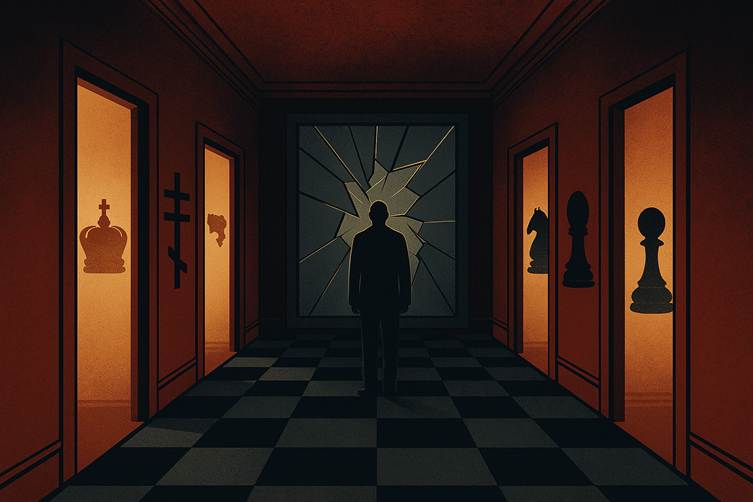
“Russia is never as strong as she looks, nor as weak as she fears.”
— Old Russian proverb
Introduction
To understand Vladimir Putin is to step into a house of many rooms. Each chamber is haunted by history, furnished with philosophy, and guarded by ghosts. He is not merely a politician but a listener to centuries — to rulers, generals, and thinkers whose voices still echo in the Kremlin’s halls.
Inside this house, memory and strategy are inseparable. Myths of Kievan Rus, the lessons of empire, the calculations of realists, the warnings of decline — all inhabit him. To walk these rooms is not to excuse, but to glimpse the forces shaping Russia’s course, and the dangers of misjudging them.
The Historian’s Room
Russia’s problem is not that it is too big, but that it cannot stop expanding.”
— George Kennan
Here the walls are lined with maps and chronicles. The voices of Russia’s origins still speak:
- Prince Vladimir of Kiev, who baptized Kievan Rus in 988, whispering of a spiritual destiny distinct from the Latin West.
- The Mongol khans, reminding Russia of the price of weakness and the hard autocracy forged under the Tatar Yoke.
- Peter and Catherine the Great, urging reform, expansion, and recognition as a European power.
History here is both burden and guide. It tells Putin that Russia survives only through vigilance, expansion, and centralized rule. But it also warns of collapse — in 1613, 1917, and 1991 — when weakness, division, or reform opened the gates.
This is the room where Putin’s siege mentality is rooted. Russia is always encircled, always misunderstood, and always destined, in his eyes, to rise again.
The Realist’s Room
The strong do what they can and the weak suffer what they must.”
— Thucydides
Bare walls, harsh light. Here Putin sits with the voices of strategy:
- Thucydides, who taught that fear, honour, and interest drive conflict.
- Machiavelli, who counselled it is safer to be feared than loved.
- Hobbes, who saw a world of anarchy where only power secures survival.
From this room, Ukraine is not simply a neighbour but a buffer state, essential to Russia’s security. NATO’s expansion eastward is read not as defensive, but as encirclement. Western sanctions are not economic tools but acts of war — attempts at regime change.
By this logic, the 2022 invasion was not irrational but necessary. Yet the gamble has exposed weakness: a military stretched, an economy cornered, and a West more united than expected.
The Nostalgist’s Room
A people that forgets its past has no future.”
— Ivan Ilyin
Incense fills this chamber. Prince Vladimir offers spiritual mission, Peter and Catherine promise greatness, and in the shadows stands Ivan Ilyin, preaching Russia’s destiny as authoritarian, Orthodox, and eternal.
Here nostalgia is not mere memory but weapon. Crimea’s annexation was framed as a “homecoming,” proof that history could be rewritten. Yet longing for past glory blinds Russia to its present limits.
The Technocrat’s Abandoned Room
Modernization is impossible without institutions.”
— Alexei Kudrin
This room is quieter, lined not with portraits of emperors but with charts, balance sheets, and the dry prose of economic reports. It once held Alexei Kudrin, who urged modernization, diversification, and integration with the West — advice ignored, though remembered like an echo of a road not taken.
But where Kudrin departed, another remained. Here stands Elvira Nabiullina, Governor of the Central Bank, one of the few figures Putin trusts enough to speak candidly. Brilliant, pragmatic, and for years respected abroad, she has kept Russia’s economy functioning under extraordinary pressure. Her stewardship steadied the rubble after the Crimea sanctions, and again after the full-scale invasion of Ukraine. Inflation, debt, capital flight — all managed with a steady hand.
To some in the West, she is condemned as a collaborator, even compared to Speer or Eichmann. Yet such comparisons miss the point. She is no ideologue, no architect of repression. She is a technocrat — loyal, competent, indispensable. Her tragedy is that her skill prolongs a system she cannot change, her reputation abroad sacrificed to her survival at home.
In this room, one sees the paradox of Russia’s technocracy: its brightest minds chained to a decaying order, keeping it alive even as it resists the reforms they once dreamed of. Kudrin chose to leave. Nabiullina chose to stay. Both paths end in compromise.
The Council of Shadows Room
We Russians live not by laws but by arrangements.”
— Ivan Turgenev
Here the air is stale, thick with the dust of Muscovy. The chamber feels timeless, as though the boyars never left. Their whispers are carried forward by modern oligarchs, whose wealth and intrigues shape the corridors of power as surely as their medieval forebears once did.
In this room, Putin is not the all-powerful autocrat of Western imagination but the arbiter of rival clans. He balances oligarchs against the security services, clans against clans, knowing that his survival depends on keeping them all in check. Like the Tsars before him, he rules not by absolute command but by the ancient right of ownership: everything in Russia belongs to the ruler until the ruler falls.
The oligarchs enjoy power above the law, their agents woven into the bureaucracy, the courts, the media. They fight among themselves, testing boundaries, yet never openly defying the Czar. For they know the lesson of Khodorkovsky and Yukos — that fortunes can vanish overnight when the Czar reclaims what is “his.”
Here time stands still: the boyars have become oligarchs, the oprichniki have become the FSB, and the common people remain voiceless, ruled rather than represented. Putin presides as the umpire, strong enough to keep the balance, indispensable to the system, yet not invincible. Should he falter, the ownership of Russia would pass — not to the people, but to the next ruler, and the game would begin again.
The Strategist’s Labyrinth
The Eurasian mission of Russia is not choice but destiny.”
— Alexander Dugin
Corridors twist without end. Here Alexander Dugin whispers of Eurasian destiny, of resisting the West by forging a new civilizational bloc.
But the labyrinth entraps its master. Ukraine, entered as a quick gamble, has become a war of attrition. Instead of restoring empire, it has drained Russia’s strength and deepened its isolation. Each path narrows. The labyrinth offers no exit, only circles.
The Mirror Room
Power is a burden that no ruler can ever lay down without cost.”
— Russian saying
In the final chamber, only mirrors remain.
Here Putin confronts not history, not strategy, but himself. At one shoulder stands Nicholas II, the tsar who abdicated and lost his empire. At the other, Mikhail Gorbachev, the reformer whose concessions unraveled the Soviet Union. To Putin, both are warnings: never surrender power, never show weakness.
But the mirrors reveal more than history. They reflect the face of a ruthless chameleon — a man who can smile warmly to his daughters yet remain unmoved by the wreckage of Grozny, the wars in Georgia and Ukraine, or the silencing of opponents and journalists. The reflections show shadows of Anna Politkovskaya, Boris Nemtsov, Alexander Litvinenko, and countless others whose lives ended suddenly — accidents, poisonings, bullets in the dark. Each is less an anomaly than a grim pattern: in Russia, decency is seen as weakness, and power demands cruelty.
His companions here are not destiny but distrust, resentment, and fear. Distrust of those closest to him, resentment of the West and its contempt, fear of betrayal and collapse. The mirrors show him as he is and as he will be remembered: saviour and saboteur, master and prisoner, admired for strength yet condemned for ruthlessness.
The bitter reflection is this: his likely legacy is not greatness restored, but decline accelerated — a Russia poorer, more isolated, and more fearful than the one he inherited.
🌿Afterword: The Danger of Certainty
“History does not repeat itself, but it does rhyme.”
— Mark Twain (attributed)
To walk these rooms is not to sympathize but to understand. Putin acts not in isolation, but in the company of ghosts who whisper of siege, destiny, and power. His choices are shaped by centuries of memory and myth.
But ruthlessness is not Russia’s alone. All leaders, whether democratic or authoritarian, are tempted to calculate in numbers rather than lives. During the Cold War, strategists calmly gamed scenarios where millions might perish, like today the same simulations are made for a US-China conflict. In 1996, when asked about sanctions on Iraq and their toll on half a million children, a U.S. secretary of state replied: “We think the price was worth it.”
And yet, there are moments when leaders confront the abyss of their own decisions. Winston Churchill, after watching film of the bombed German cities, turned to his aides and asked: “Are we beasts?” George W. Bush, years after Iraq, began painting the faces of veterans and wounded soldiers — a halting attempt to meet, one by one, the people behind the numbers. These glimpses of conscience are rare, but they matter.
Vladimir Putin shows no such reckoning. For him, regret is weakness, and weakness is death. His mirror reflects only power, never penitence. Trump too, in his own way, has lived by denial, unable to acknowledge harm except as someone else’s fault. Some leaders search for redemption; others can only cling to defiance.
And still, Russia is not monolithic. Even within Putin’s circle, figures like Elvira Nabiullina remind us that talent and pragmatism endure, even when bound to a failing order. She is no architect of conquest, yet her skill in keeping Russia’s economy afloat under sanctions makes her complicit in a system she cannot change. The West condemns her as a collaborator, but her story is more complex: a brilliant technocrat whose competence prolongs a regime that otherwise might collapse. She stands as a reminder that in Russia, as elsewhere, the line between survival and compromise is blurred.
The danger lies not only in Moscow but also in ourselves. The West too easily imagines history as a morality play, with clear right and wrong, victory assured by conviction. But certainty is its own danger. Great powers fall when they mistake belief for strategy, when they assume destiny will bend to their will.
With a nuclear power, misjudgement magnifies risk. History teaches that it rarely ends where we expect.
“Russia cannot be understood with the mind alone… one can only believe in her.”
— Fyodor Tyutchev
William J J Houtzager, Aka WJJH, October 2025
📌Blog Description
What does Vladimir Putin see when he looks in the mirror? This essay explores Putin’s world as a house of rooms — haunted by history, shaped by ideology, and constrained by rival clans. From Kievan Rus to Ivan Ilyin, from Alexei Kudrin to Elvira Nabiullina, from Crimea to Ukraine, the ghosts of Russia’s past define its present. But ruthlessness is not Russia’s alone. The Afterword reminds us that every system, democratic or authoritarian, risks turning lives into numbers — and that certainty itself may be the greatest danger.
 In what kind of world do we wish to live