Principles for Living: Virtue, Dignity, and the Cycles of Nature
What principles define how you live?
✍️ Author’s Note
This reflection began with a deceptively simple question: What principles decide how you live? For me, it became an inquiry into virtue, memory, and the cycles of nature. From George Herbert’s poetry to Erasmus’ humanism, from the liberal tradition of Europe to the unchanging truths of the seasons, I found that the guiding principles are not abstract ideals but humbler truths: dignity, tolerance, responsibility, and harmony with nature.
“Man is not disturbed by events, but by the view he takes of them.”
— Epictetus
Letters to the Prompt
“What principles decide how you live?”
The prompt bothers this octogenarian with a question that seems both simple and audacious. It asks for an inquiry into virtue — and indirectly whether one has lived a virtuous life. It is a curious matter, for the prompt is always silent after receiving the answer, yet it urges me to look back across eight decades and pose the same question to myself.
No doubt there have been moments of virtue and principle — and just as surely moments of their opposite. Between the positives and negatives, I like to believe that my soul has remained intact. As the poet George Herbert reminds us, beauty fades — the day, the rose, the spring — yet “a sweet and virtuous soul, like season’d timber, never gives.”
Still, Heraclitus whispers from antiquity: nothing endures but change. Transformation and impermanence are at the heart of all things, in nature, in our relationships, and in ourselves. Perhaps virtue lies not in denying this, but in accepting it with dignity.
I count myself fortunate to have lived beneath the blanket of liberal democracy, where freedom and tolerance gave space for a life guided by principles. Yet I am also conscious that this is a privilege not shared by all. In the West, the principles by which we live flow from a long river of civilization: the philosophical roots of Plato and Kant, the turbulence of our blood-stained history, and the humanist voices — Erasmus among them — who reminded us of both our folly and our reason, our cruelty and our grace.
My own guiding principles have grown from this soil: dignity and tolerance as foundations, realism as a corrective to youthful idealism, and a belief that freedom and responsibility are the highest human aspirations. They are not the product of grand visions of perfection, but of humbler convictions: the need to avoid returning to the darkest pages of history; the duty to face present challenges honestly; the responsibility to plant seeds for generations whose shade we ourselves will not enjoy. We are links in a long chain, and what we pass on — values, stories, institutions, even forests — strengthens or weakens that chain.
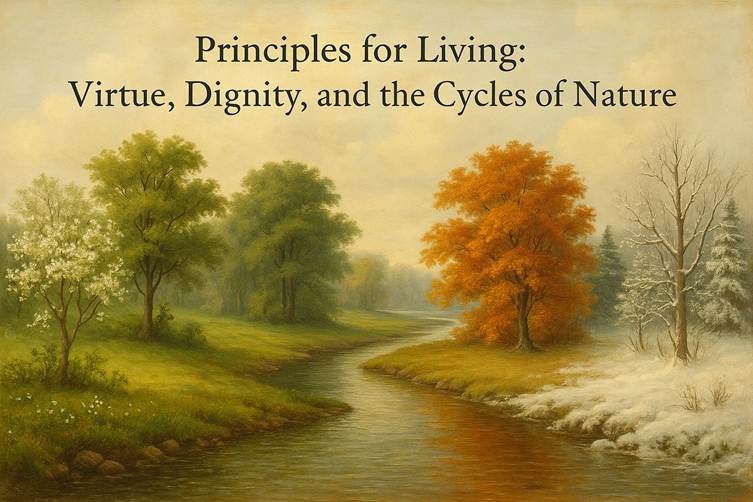
And yet, beyond philosophy and history, there is nature. If we are wise, we listen to her laws and cycles. In nature, nothing lives in isolation. Every expansion is followed by contraction, every spring by winter. To live well is to adapt, to harmonize, to remember that survival itself depends not on dominance, but on cooperation.
So if you ask what principle decides how I live, I would say this: to seek harmony where there is chaos, dignity where there is cruelty, and continuity where there is change.
William J J Houtzager, Aka WJJH, October, 2025
📌Blog Excerpt
What principles truly guide the way we live? For me, the answer lies not in endless growth or ambition, but in the humbler soil of dignity, tolerance, and responsibility. Our Western tradition has been shaped by philosophers from Plato to Kant, and humanists like Erasmus, who reminded us that every person holds both folly and reason. Yet beyond history and philosophy, there is nature — whose cycles of birth and decay teach us that nothing exists in isolation. To live well is to adapt, to seek harmony where there is chaos, and to remember that survival depends less on domination than on cooperation.
 In what kind of world do we wish to live