The Silence At Margraten
✍️Author’s Note
This reflection continues the story of Margraten – A Legacy of Sacrifice. It was written after learning that two panels honouring the Black Americans who helped liberate the Netherlands were quietly removed.
For those of my generation, this is hard to comprehend. We were raised in the shadow of war, when freedom was rebuilt from rubble — not slogans. The politics of erasure dishonours the dead and distorts the truth they died to defend.
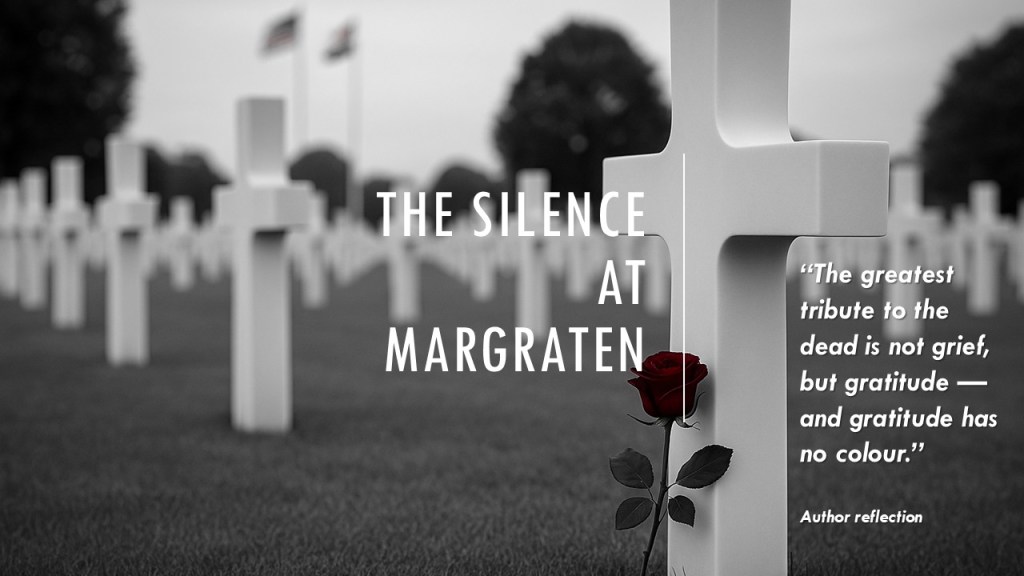
The news that two panels at the American cemetery in Margraten — honouring the Black Americans who helped liberate the Netherlands — have been quietly removed is deeply disturbing. Margraten is sacred ground. It tells a story of courage, sacrifice, and shared humanity. To remove part of that story is to betray it.
When my parents returned to their home, confiscated by the Nazis during the occupation, they did not ask whether it was white people or people of color who made their return possible. They simply knew that freedom had a human face — and that it came at a terrible price.
The men buried at Margraten came from every corner of America: white, Black, Catholic, Jewish, Protestant. Some knew liberty only in theory; others had to fight for it abroad while being denied it at home. Yet they came, and they died for a Europe most had never seen. Their story must not be edited to suit the political moods of any age.
The removal of those panels — reportedly without explanation, perhaps even under ideological pressure — is more than a bureaucratic act. It is an act of erasure. To silence the Black liberators is to silence a part of truth. And truth is what gives remembrance its meaning.
Margraten is not an American outpost of politics; it is a place of gratitude, reflection, and reconciliation. It belongs to history, not to today’s culture wars. The dead do not ask for privilege or correction. They ask only that their story be told honestly.
If there are those who find the acknowledgment of diversity uncomfortable, they misunderstand both history and decency. The men who rest in Margraten did not fight for selective memory. They fought for the freedom that allows us to remember all who served. The panels should be restored. Transparency is owed to the living, and respect is owed to the dead. Anything less dishonors both.
Afterword: The Politics of Erasure
There are moments when history seems to hold its breath — when what vanishes tells us more than what remains. The removal of these panels at Margraten is one such moment. It is not about marble or metal, but about the story we choose to tell.
Donald Trump and those who think like him live in a different era — an era where truth is negotiable, where inclusion is seen as weakness, and where memory must serve ideology. To me, even as a realist, this feels alien. I was born in a time when freedom had to be rebuilt from rubble, not manufactured from slogans.
Margraten stands as witness to that truth. The young men who rest there — white and Black, American and European — did not die for selective remembrance. They died for the idea that humanity, once defended, cannot be divided.
To erase them, even in silence, is to betray not only history, but ourselves.
William J J Houtzager, Aka WJJH, November 2025
📌Blog Excerpt
At Margraten, silence has fallen where truth once spoke. Two panels honouring Black American liberators have been removed without explanation. My parents, when they returned to their war-torn home, never asked whether those who made it possible were white or Black — only that freedom had a human face. To erase their story is to betray not only history, but ourselves.
 In what kind of world do we wish to live