The Internet and Humanity: Between Promise and Peril
✍️Author’s Note
This reflection was written upon an invitation from the Humanistisch Verbond (Humanistic Society) to consider and discuss how the Internet is shaping humanity. Yet in our time, the Internet can no longer be seen in isolation. Artificial intelligence, the smartphone, and the global digital ecosystem are now intertwined — forming a single force that shapes the pace, texture, and depth of modern life.
As someone who has witnessed this transformation from its earliest days, I see both its promise and its dangers. These technologies have expanded human capacity but are increasingly replacing human judgment. They empower individuals, yet also erode autonomy.
This essay offers a first, modest exploration — a humanist attempt to bring clarity to a world where progress and peril now travel together. A deeper analysis will follow later.
We live in remarkable times. Few inventions have transformed human life as profoundly as the Internet. It has reshaped nearly every aspect of our societies, turned the world into a connected village, and changed not only how we communicate, but how we learn, work, and perceive one another.
During the same period, the rise of artificial intelligence and the smartphone — embodied most visibly in the iPhone — has woven digital technology into every moment of daily life. What began as a tool has become an environment. The Internet, AI, and mobile computing now form a single web that defines how we work, think, and even experience reality.
I belong to a generation that has seen this transformation unfold — from the era of the typewriter to the age of intelligent machines. To reflect on the Internet today is also to reflect on how these interconnected technologies have altered not just the pace of life, but the texture of human existence itself.
Origins and Early Visions
The origins of the Internet lie in the 1960s, in the shadow of the Cold War, when the U.S. government sought a decentralized network capable of surviving a nuclear attack. But the human face of the modern Internet emerged later, when Sir Tim Berners-Lee, working at CERN in 1989, sought to create a system through which scientists could share information freely across platforms.
Artificial intelligence, meanwhile, has its roots in the 1950s, when computer scientists dreamed of machines that could solve complex scientific problems. For decades progress was slow, but from 2010 onward — driven by data, cloud computing, and vast commercial investments — AI began to enhance and increasingly surpass human judgment in specific domains.
Then came the smartphone. The iPhone did not merely add convenience; it changed human behaviour. It placed the Internet — and now AI — directly into our pockets. Some would say it also created a generation half-bent over glowing screens, walking in a hybrid state between the physical world and the digital one.
The Promises: Connection, Knowledge, and Opportunity
The Internet democratized knowledge. It placed the world’s libraries within reach of anyone with a connection. It allowed people to learn, teach, and collaborate across borders, social classes, and generations. Entire industries transformed: healthcare, agriculture, education, logistics. Remote work, once an exception, became a norm during the pandemic.
In its early promise, digital technology appeared to realize a deeply humanistic ideal: the free circulation of knowledge, the empowerment of individuals, and the enhancement of human capability.
The Perils: Surveillance, Acceleration, and Loss of Autonomy
Yet every revolution casts a shadow.
Today’s technologies — interconnected, instantaneous, and increasingly autonomous — operate at a speed and complexity that often exceed human understanding.
The consequences of AI have been broadly underestimated. Unlike earlier inventions that merely extended human strength or reach, today’s systems increasingly replace or surpass human judgment. This shift has profound implications:
- loss of autonomy,
- levelling of society into users rather than citizens,
- constant dependency,
- and a world where decisions are shaped by opaque algorithms operating far beyond our oversight.
The smartphone has accelerated this. It made the Internet permanent — not something we “visit,” but something we inhabit. It has given us global access while narrowing our attention. It connects us, yet often isolates; it informs, yet can dull reflection; it empowers, yet can reduce complex thought to compulsive swiping.
Cybersecurity threats, surveillance, algorithmic manipulation, and the flood of misinformation have eroded trust in public discourse. The digital divide persists, leaving behind those without access, skills, or the ability to keep pace with constant change. Many newspapers vanished, and with them the culture of patient reading. Letters turned into posts; conversations into reaction chains.
We gained speed, but often lost depth.
A Humanist Question
For the humanist, the central concern is not whether we should reject technology, but how to preserve humanity within it.
We must ask:
• Can independent thought survive in an age of instant reaction?
• What becomes of judgment when machines make decisions for us?
• How do we protect dignity when attention itself becomes a commodity?
• And how do we remain human when everything — work, communication, identity, even memory — is mediated by machines?
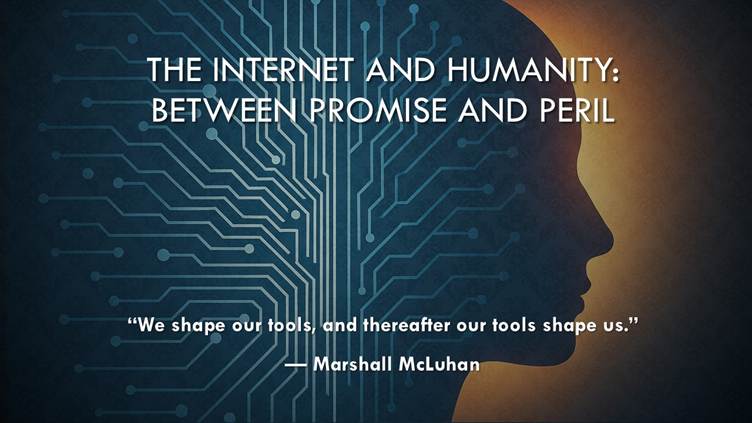
As Marshall McLuhan warned, we shape our tools, and thereafter our tools shape us. Today’s tools shape us faster than ever before, often without our consent or awareness.
Conclusion: Between Promise and Peril
The Internet is neither saviour nor villain; it is a mirror.
AI, the iPhone, and the vast digital ecosystem we now inhabit reflect our curiosity, creativity, fear, and folly.
But something more has changed: technology no longer merely serves human capacity — it increasingly defines it. The challenge of our time is to ensure that intelligence, whether human or artificial, remains guided by conscience.
Technology has always been a powerful servant. It is our responsibility to ensure it does not become our master.
As Christian Lous Lange wrote:
“Technology is a useful servant but a dangerous master.”
The question, as always, remains human: not what the Internet or AI will become, but what we will become through them.
William J J Houtzager, Aka WJJH, November 2025
📌Blog Excerpt
The Internet, AI, and the smartphone have reshaped modern life — expanding human potential while eroding autonomy and depth. This reflection examines how these interconnected technologies democratize knowledge yet also accelerate surveillance, dependency, and misinformation. A humanist perspective on the promise and peril of the digital age.
 In what kind of world do we wish to live