Europe’s Drifting Tanker: Between Aspiration and Inertia
✍️Author’s Note
This essay continues my exploration of Europe’s condition after The Leaking Roof of Europe. It reflects on the slow transformation from Juncker’s confident 2014 vision to today’s quieter drift — from the Europe of ideals to the Europe of inertia. The metaphor of the tanker remains: vast, dignified, yet slow to turn.
Europe’s course is still uncertain, divided between sovereignty and unity, dependency and ambition. But beneath the fatigue there lingers the same aspiration that once inspired the Union’s founders: the belief that cooperation is a choice to be renewed, not a memory to be admired.
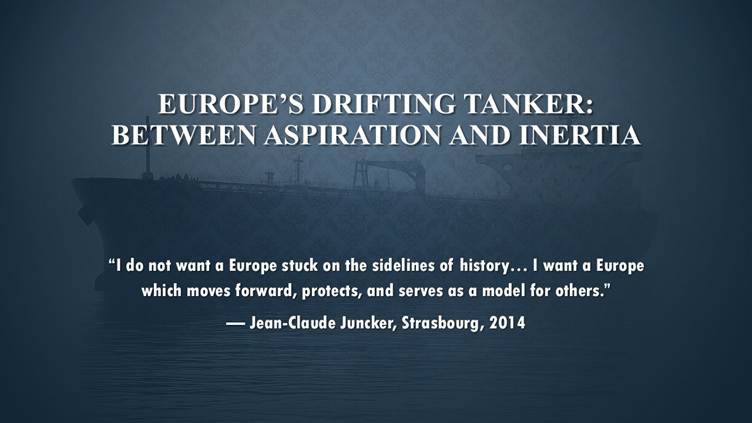
In July 2014, standing before the European Parliament in Strasbourg, Jean-Claude Juncker offered what now reads as the last confident declaration of a self-assured Europe. “I do not want a Europe stuck on the sidelines of history,” he said. “I want a Europe which moves forward, protects, and serves as a model for others.” Ten years later, that vision has run aground. The world Juncker hoped to shape has changed course, and Europe—like a great tanker at sea—has been slow to adjust its bearings. Beneath the calm surface, the currents of history have shifted direction.
During Juncker’s presidency, the outlines of change were already visible: the shock of Crimea, the erosion of transatlantic unity under George W. Bush and later Donald Trump, and the economic and moral fatigue that followed the eurozone crisis. Europe, proud of its regulatory precision, mistook stability for strategy. When the waves rose, the Union responded with procedure, not propulsion. In Juncker’s measured pragmatism lay both wisdom and warning: he knew Europe needed consolidation, not expansion—but even he underestimated how swiftly the global balance would move.
The decade that followed transformed Europe’s surroundings and unsettled its foundations. Brexit deprived the Union of one of its geopolitical anchors. The Covid pandemic exposed its dependency on external supply chains. The war in Ukraine revealed both solidarity and weakness: unity of principle but absence of power. Meanwhile, Washington and Beijing pursued clear strategic goals, while Brussels fine-tuned directives. Europe, once the moral compass of the postwar world, now resembles a vast vessel with uncertain command—its engines humming, its course ambiguous, its crew divided between caution and conviction.
The tanker moves, but not toward a destination. Its captains speak of strategic autonomy and global relevance, yet decisions are increasingly reactive—made not from vision but from necessity. What began as an integration project has hardened into crisis management, and what was once a political community of hope has become an economic mechanism for survival. The energy of the Delors era—the faith in shared destiny—has faded into a quiet, bureaucratic endurance.
The End of European Exceptionalism
For decades, Europe’s self-image rested on a quiet conviction: that its model of peace, democracy, and social welfare represented not merely a regional achievement but a universal standard. From the ashes of two world wars, Europe had fashioned something that seemed to transcend power politics — a moral alternative to empire, and proof that integration could tame history’s darker instincts. This sense of exceptional virtue defined the postwar identity of the Union and gave birth to what scholars later called the “normative power of Europe.”
But history has a way of eroding illusions. The claim of moral uniqueness began to falter when Europe’s values met the tests of reality. The refugee crisis exposed the limits of solidarity; the financial crisis revealed the fragility of the eurozone’s promises; and the war in Ukraine showed that “soft power” cannot deter hard aggression. The world beyond Europe, once expected to admire and emulate, began instead to diverge — economically, politically, and ideologically. From Beijing to Ankara, Delhi to Washington, few looked to Brussels for guidance.
Europe remains admired for its culture, its civilization, and its humane ideals — yet it is no longer perceived as decisive. The moral capital it built in the postwar decades has been largely spent. To the Global South, the EU often appears paternalistic; to the United States, it is a junior partner; to Russia and China, a convenient economic sphere with little strategic unity. The age of European exceptionalism has quietly ended — not with confrontation, but with irrelevance.
The paradox is cruel. The Union that once sought to rise above power politics has found itself diminished precisely because it avoided them. Its devotion to process and consensus became a virtue too finely polished — admirable, but inert. Europe confused being respected with being influential, and mistook the endurance of its institutions for proof of vitality. As the global order fractured into competing spheres, Brussels continued to legislate as if the world were still bound by the assumptions of 1992.
If Europe’s project was born from the moral determination to prevent war, its current predicament stems from the inability to imagine renewal. The conviction that integration itself was progress has hardened into complacency. What began as moral leadership has turned into a management of decline — a quiet, elegant, well-administered descent.
The Age of Fragmentation
If the end of European exceptionalism marked the fading of the Union’s moral authority abroad, the age of fragmentation has eroded its cohesion within. Beneath the polished surface of Brussels’ institutions, the continental consensus that once drove integration has splintered into competing national and political realities. Europe has not become weaker for lack of treaties, but for lack of trust.
The centrifugal forces are everywhere visible. North and South remain divided over fiscal policy and debt; East and West over migration and sovereignty. Even within individual member states, the European question has ceased to inspire conviction and has become a line of partisan demarcation. Where Delors spoke of solidarity and “a community of destiny,” today’s leaders speak of flexibility and opt-outs. The vocabulary of ambition has given way to the grammar of exception.
Populism has further widened the fissures. In countries once considered pillars of Europeanism—France, the Netherlands, Italy, and even Germany—skepticism toward Brussels now shapes the political mainstream. The European ideal, born from a shared memory of catastrophe, has struggled to survive in a generation for whom peace is assumed, not achieved. The result is a Union sustained by inertia rather than inspiration.
The digital revolution, too, has deepened disunity. In an age of instant outrage and fragmented attention, the slow, deliberative rhythm of European politics feels archaic. Social media amplifies resentment, national populists exploit fears, and European institutions—designed for consensus and reason—appear increasingly distant, abstract, and powerless. The political center that once anchored Europe’s stability has thinned, leaving a landscape of polarized electorates and transactional leaders.
The loss of common purpose is also cultural. The idea of Europe as a civilization—a meeting ground of law, humanism, and dignity—has faded from the collective imagination. The shared story that once bound the continent together has been replaced by a bureaucratic narrative of regulations, budgets, and targets. Europe has mastered the art of governance but forgotten the craft of persuasion.
In this atmosphere, the tanker drifts not because it has lost its engines, but because its captains cannot agree on a course. Each state guards its own compass; each captain steers by a different star. The result is motion without direction—a Union that moves, but not toward destiny.
The Flight Forward
Europe’s history since Maastricht reveals a curious instinct: when faced with internal weakness, it moves outward. Instead of repairing the structure, it adds new rooms; instead of slowing to recalibrate, it accelerates. It is a form of motion that masks fatigue — what one might call the flight forward.
This impulse has often served as a substitute for reform. Enlargement became the answer to indecision, and new directives the response to political deadlock. Expansion gave the illusion of strength, even as the Union’s inner fabric frayed. The eastward enlargement, while historic in scope and moral intent, diluted rather than deepened cohesion. As Jean-Claude Juncker once acknowledged, consolidation was essential before the next expansion — but history, as so often, moved faster than prudence.
Jacques Delors had already sensed the problem: every broadening of the Union should be balanced by a strengthening of its foundations. Yet the political will for genuine constitutional reform faded as enlargement advanced. The founding paradox — balancing unity with sovereignty — became harder to sustain. What had been a necessary compromise in the 1950s turned, by the 2000s, into a structural fault: the primacy of national sovereignty over collective purpose. The Union was built on the promise that states could share power without surrendering it; today that promise has hardened into constraint.
The divisions between North and South, East and West, old and new members are not merely geographic but philosophical. Each region carries a different memory of dependence, a different definition of freedom. The dream of convergence has been replaced by a struggle for advantage. The machinery of Brussels still turns, but its parts no longer move in unison.
Complicating this imbalance is the presence of a co-captain on the bridge. Since 1945, Europe’s course has been influenced — sometimes directed — from across the Atlantic. The United States, while guaranteeing Europe’s security, has also shaped its horizons. The great “eastward turn” of the 2000s served Washington’s strategic depth as much as Europe’s unity, ensuring that the Union’s frontier remained aligned with NATO’s. Zbigniew Brzezinski foresaw this clearly when he wrote that a truly united and powerful Europe could one day rival the United States — and that, perhaps, was precisely what should be prevented.
For a time, Angela Merkel managed to balance these forces. She slowed the tanker when needed, vetoing Ukraine’s NATO membership in 2008, tempering ambition with realism. Under her cautious navigation, Europe retained a measure of sovereignty in its dependence. But with her departure, the helm passed to leaders less inclined toward restraint. Ursula von der Leyen — a well-intentioned European and former defence minister whose tenure left the German military weakened — has governed in the same manner she once commanded: by acceleration rather than reflection. Her strategy reflects both the flight forward and Europe’s deeper instinct for the buffer zone — an expansion of borders to protect the core, a projection of stability outward to avoid confronting fragility within.
And so the tanker moves, not because it knows where to go, but because it cannot stop. The sea is calm, but the course uncertain; the co-captain’s hand remains on the rudder, and the captains in Brussels argue over charts that no longer match the waters they sail.
Between Aspiration and Inertia
The European Union remains a triumph of political imagination, yet it now lives in tension with its own ideals. It was built to transcend the logic of power, but it cannot escape it. It seeks to lead by moral example, yet is compelled to act through the language of economics and sanctions. Between aspiration and inertia lies the paradox of modern Europe: a union capable of immense technical achievement but paralyzed by the fear of choosing.
The European Commission speaks of strategic autonomy and global relevance, but these have become rhetorical instruments rather than political realities. Europe regulates where others act, legislates where others lead, and moralizes where others strategize. Its strength remains normative and procedural — a power of example, not of execution. Yet in a world once again defined by confrontation and realpolitik, moral authority without agency risks becoming an echo of itself.
The Union’s institutions are still formidable, but their purpose has grown uncertain. Enlargement is pursued as proof of vitality, even when integration stagnates. Economic coordination substitutes for political vision. Climate policy, once a banner of leadership, is softened under industrial pressure. Europe’s compass still points toward its founding values, but the instruments no longer respond to the magnetic pull of conviction.
There is no denying the achievements: peace among former rivals, the world’s largest single market, a remarkable body of law and rights. But these successes now form a kind of tranquil prison — the Union is trapped by its own accomplishments, confined by the very stability it once sought. When Delors spoke of “the soul of Europe,” he implied motion toward meaning; today, meaning is maintained through motion.
And yet, to drift is not the same as to sink. Beneath the surface fatigue lies the same longing that inspired Monnet and Schuman — the hope that cooperation can outlast conflict, that unity can arise from diversity. Europe’s greatest weakness remains the shadow of its greatest virtue: its preference for deliberation over decision, dialogue over dominance. What it lacks in speed, it still holds in endurance.
To move beyond inertia, Europe must rediscover courage — not in the military sense, but moral and imaginative courage: the will to believe that its story is not yet finished. The tanker may be slow to turn, but it still floats upon deep waters. Whether it finds its way again will depend not on new treaties or institutions, but on recovering the clarity of purpose that once made it the world’s conscience.
Epilogue: The Quiet Sea
When Jean-Claude Juncker spoke in Strasbourg in 2014, he appealed to the spirit of Delors, Mitterrand, and Kohl — the men who believed that Europe could exist not merely as a market or an alliance, but as a moral enterprise. “I do not want a Europe stuck on the sidelines of history,” he said. A decade later, the tanker he once tried to steer still moves, but on a quieter sea.
Its engines hum with habit, its crew busies itself with charts and rules, and its captains hold meetings about direction. Yet no one quite remembers the destination. The horizon remains the same, but the sense of purpose that once illuminated it has dimmed. Europe drifts — dignified, intact, but uncertain.
Still, even a drifting vessel can find its way again. Storms have a way of clarifying direction. Perhaps it is not too late for Europe to remember what Juncker, Delors, and Kohl once understood: that the strength of this Union lies not in its size or wealth, but in its conviction that peace and cooperation are choices to be renewed, not merely inherited.
The tanker may yet turn, slowly and deliberately, toward that forgotten light on the horizon — not a new beginning, but a return to itself.
William J J Houtzager, Aka WJJH. November 2025
📌Blog Excerpt
A decade after Jean-Claude Juncker’s call for “a Europe at the heart of action,” the European Union drifts between ambition and fatigue. From expansion to fragmentation, it has mistaken motion for progress, enlargement for integration, and management for vision. The tanker still moves, but without destination — propelled by habit, external influence, and the illusion of unity. This reflection traces Europe’s long drift between aspiration and inertia, asking whether the Union can rediscover not its size, but its soul.
 In what kind of world do we wish to live