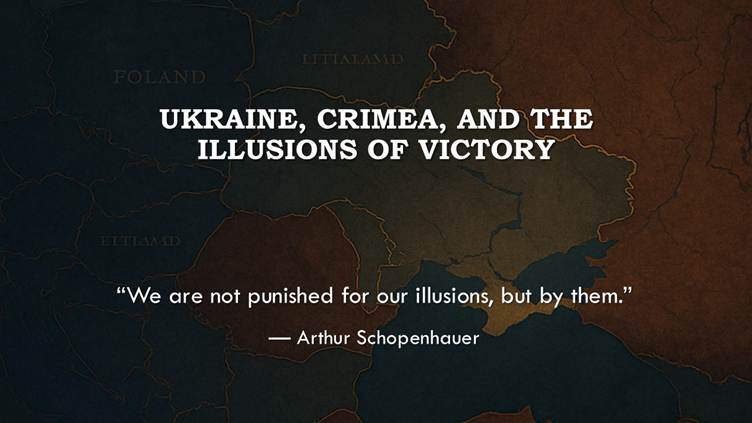
Ukraine, Crimea, and the Illusions of Victory
Hubris, Memory, and the Unwelcome Return of History
✍️ Author’s Note
This reflection continues arguments I first made in 2014 and again in 2016 and 2025, when I wrote that Crimea would not return to Ukraine and that the West was slipping into illusions it could not sustain. A decade later, as the war enters its fifth year, the gap between rhetoric and reality has become impossible to ignore.
The dividing line in Europe — between the memories of the Polish–Lithuanian Commonwealth and the postwar West — explains much of today’s impasse.
What follows is not a verdict, but an attempt to see clearly in a time crowded with illusions.
Prologue
History has a way of returning when we least expect it. The war in Ukraine is no exception.
Behind the slogans and declarations lies a harder truth: Europe is divided not by politics, but by memory. Crimea, the Donbas, and the old frontier of the Polish–Lithuanian Commonwealth have resurfaced as reminders of a past we once believed buried.
What follows is an attempt to view this war not through wishful thinking, but through the sober clarity that reality demands.
I. When Reality Catches Up
There are moments when reality overtakes narrative — and crushes it.
Ukraine is entering that moment.
For years, Western leaders spoke in absolutes:
- “As long as it takes.”
- “Victory is the only acceptable outcome.”
- “Every inch of territory will be reclaimed.”
These absolutes reflected a misconception: that a state on Europe’s periphery is somehow existential for Europe’s future.
Yet none of these promises were grounded in strategic reality, military capacity, or political will. They were rooted instead in a belief that the world must conform to our moral vocabulary — that if we insisted loudly enough, history would obey.
It never does.
What began as a war of aggression is becoming a tragedy of illusions. And what follows illusions is always nemesis — the classical consequence of overreach and the refusal to see limits.
II. Crimea: The Geopolitical Constant We Pretended Was Temporary
For anyone remotely familiar with Russian history, Crimea as part of Ukraine was a mistake of history — and was never coming back. Not in 2014. Not in 2022. Not now.
Crimea is:
- Russia’s mythological southern gateway
- the jewel of Catherine the Great’s imperial expansion
- the anchor of the Black Sea Fleet
- the age-old flashpoint of the 1853–56 Crimean War
Different century, same anxieties, same geography, same autocracy, same illusions.
The West responded to the annexation with outrage, sanctions, and wishful thinking. But outrage is not strategy, sanctions rarely alter great-power behaviour, and wishful thinking is not analysis.
III. Donbas: A Region of Languages, Loyalties, and Family Ties
The Donbas is not a Western-style frontier. It is a cultural continuum where identities blend rather than divide, where Ukrainian and Russian families are entwined, and where political boundaries do not match lived realities.
Ukraine’s de-communisation — later evolving into de-Russification — was politically understandable yet socially destabilizing, especially in regions where linguistic and cultural ties run across the border.
When this war ends, wounds will not simply heal. They will linger across both countries for generations.
IV. Europe’s Dividing Line: Two Memories, Two Histories
Europe does not look at Ukraine with one mind.
Its attitudes follow a centuries-old fault line: the frontier of the Polish–Lithuanian Commonwealth.
East of that line
Poland, Lithuania, Belarus, western Ukraine, Latvia — regions shaped by:
- repeated Russian imperial expansion
- partitions and occupations
- forced Russification
- shifting borders and broken sovereignties
For these states, Russia is not a theoretical threat.
It is the agent of centuries of trauma.
West of that line
Germany, the Low Countries, France — societies shaped by the Reformation, Enlightenment, colonialism, and post-1945 reconstruction.
Russia for them is not a former occupier but a strategic competitor or energy supplier.
This explains why Eastern Europe sees Ukraine as existential, while Western Europe sees it as tragic but not civilizational.
Both views are legitimate — but they cannot produce a coherent long-term strategy.
V. The Limits of EU Idealism: Enlargement as Therapy, Not Strategy
The idea of Ukraine joining the EU was shaped by U.S. geopolitical ambitions in the Eurasian Balkans, European symbolism, fear, and moralistic rhetoric — not administrative realism.
The belief that Ukraine could be transformed into a rule-of-law democracy through EU membership was always optimistic.
Anyone who has witnessed:
- entrenched oligarchic power
- systemic corruption
- political dysfunction
- weak judiciary
- pervasive patronage networks
…knew Ukraine was far from ready for integration.
Friends from Kosovo and Montenegro often say corruption in Ukraine surpasses that of Russia — a view supported by Transparency International and countless personal experiences. They understand this intimately; they have lived through Western over-optimism in the Balkans.
Enlargement does not cure structural weakness.
It merely imports it — and destabilizes.
VI. “As Long as It Takes”: A Slogan Searching for a Strategy
Europe’s mantra rested on four illusions:
- Russia is a minor regional power.
- Sanctions would decisively pressure Moscow.
- Russia would collapse economically or politically.
- Ukraine could defeat a larger nuclear state with Western support.
None of these proved true.
Russia holds escalation dominance and has shifted to a wartime economy.
Ukraine is bleeding manpower it cannot afford to lose.
Europe cannot produce weapons in sufficient volume.
The United States is politically divided and strategically inconsistent.
Kyiv’s demand for total restoration of territory — including Crimea — is morally understandable but militarily impossible.
Achieving it requires NATO troops — which Europe will not send, and America cannot risk.
The reality is unavoidable:
Ukraine cannot achieve its maximalist goals without triggering a European war.
Russia cannot give up Crimea without escalating to prevent it.
Leaders know this.
They simply cannot say it.
VII. The Human Ledger: Why the War Must End
As the war enters its fifth year, the human cost becomes the strongest argument for settlement:
- Ukraine’s demographic decline is catastrophic
- Russia can mobilize deeper and longer
- Europe is fatigued and divided
- nuclear powers cannot be pushed into humiliation without danger
Every month prolongs the tragedy without changing the outcome.
Endless war is not justice.
It is destruction.
VIII. Nemesis: The Return of Limits
Hubris is not pride — it is blindness to limits.
The tragedy of this war lies not only in Russia’s aggression, but in the West’s insistence on narratives unmoored from reality.
We demanded history behave morally.
History behaved historically.
The consequences now unfolding are not punishment but the return of constraints:
- geography
- demographics
- military capacity
- political will
- historical memory
These forces always prevail.
IX. A Final Reflection
For Eastern Europe, Ukraine is the final buffer protecting their sovereignty from a familiar adversary.
For Western Europe, Ukraine is a moral cause tied to the post-1945 order.
For Russia, Ukraine — especially Crimea — is central to identity and empire.
And for Ukraine, the war will shape its social and political fabric for generations.
But symbols do not win wars.
Material power, history, and limits do.
The time has come to acknowledge reality:
This conflict must end — not because justice has prevailed, but because prolonging it risks a catastrophe far greater than the tragedy already endured.
Wisdom lies not in clinging to impossibilities, but in preventing the irreparable.
Afterthought: On Moral Posturing and the Luxury of Illusions
History rarely gives clean choices — only limits, hard boundaries, and inconvenient truths. The tragedy of Ukraine lies not only in Russia’s aggression, but in the comforting illusions woven around it. The task ahead is not to chase impossible victories, but to prevent history from demanding an even greater price.
Everyone insists on morality in war — so long as someone else pays the price.
It is a modern habit: to wrap strategic blindness in ethical language and call it virtue.
Since 2014, I have been told that realism is immoral, that compromise is appeasement, that recognizing limits is betrayal. But the critics imagine history as a Hollywood script: evil defeated, justice triumphant, the world yielding to moral expectation.
History has never obeyed moral expectation.
It obeys power, geography, demography, and exhaustion.
Every war ends in a settlement — usually long after far too much has been lost.
Moralism makes for stirring speeches.
It does not resurrect the dead.
To prolong a war because one refuses to accept limits is not ethical; it is hubris disguised as virtue. To condemn those who seek a settlement is not courage; it is the luxury of speaking in absolutes from a safe distance.
The usual objections — Munich, Hitler, “he will be back” — are not arguments, but reflexes.
Mantras recited to avoid the discomfort of reality.
Those who claim that compromise invites future war forget that endless war guarantees it.
They also forget that nuclear powers do not behave like 1930s dictatorships and that modern states collapse inward long before they march outward.
Russia is dangerous — but not omnipotent, and not immortal.
If this realism sounds harsh, it is because the alternative is delusion — and delusion is far more lethal.
There is nothing moral about sending young men to die for goals that cannot be achieved.
Nothing noble about insisting on maximalist outcomes that will never materialize.
Nothing ethical about confusing wishful thinking with strategy.
Realism is not the enemy of morality.
It is the condition for morality in a world where human lives, not abstractions, bear the cost of decisions.
Call it harsh if you like.
I accept the charge.
Harsh clarity is better than comforting illusion.
History does not care for moral theatrics.
It cares for what is possible —
and punishes those who refuse to see it.
William J J Houtzager, Aka WJJH, November 2025
📌Blog Excerpt
A clear-eyed reflection on the war in Ukraine, the immovable reality of Crimea, Europe’s divided memory, and the illusions driving Western policy. A sober argument for ending the conflict before catastrophe deepens.
 In what kind of world do we wish to live