The Fables of Power – Old grudges, new costumes, timeless quarrels
📖 The Black Knight in the Labyrinth ⚔️
✍️ Introduction
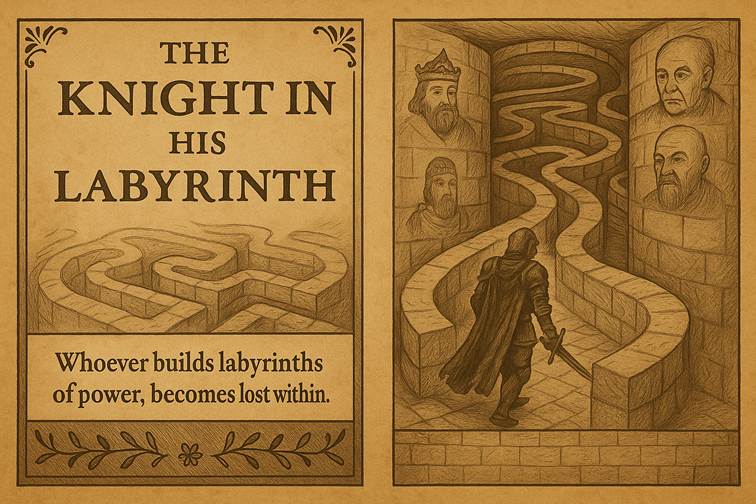
In the marble halls of the Kremlin Castle, the Black Knight of Muscovy wandered alone. The corridors twisted like a labyrinth, and at every turn he met not courtiers, but shadows: czars, generals, spies, and ghosts who whispered not only of triumphs and betrayals, but also of death.
🎭 “Whom the gods would destroy, they first make mad.”
—Euripides
🪄 The Tale
The Black Knight walked with his companions: distrust, resentment, and fear.
He remembered Peter the Great with gratitude, the czar who had carved an empire by iron will. He bowed to the ghost of Fyodor Yuryevich, the first master of secret police, whose chains ensured silence in place of opposition.
But with disgust he thought of Nicholas II and Mikhail Gorbachev, whom he cursed as weaklings — men who had let crowns fall to the floor and mumbled their surrender. “I will never abdicate,” the Knight vowed to the darkness.
He remembered Prince Menshikov, the shark in noble robes, who survived only by devouring more. And he recognized himself in that truth: to stop consuming was to invite destruction. He recalled how he had risen, too — by granting the Yeltsin clan safety from prosecution and seizure. Power, traded like coin, always carried a price.
Now, as his reign neared twilight, the Black Knight grew more isolated. He dismissed thousands of guards, suspecting betrayal, even as his secret service swelled threefold. The labyrinth walls pressed tighter, until only loyal shadows remained. His circle narrowed; his sight dimmed.
He thought of Alexei Kudrin, who once urged him to modernize, to build roads, diversify trade, to lift Russia from dependence on oil. The Knight had ignored him, and now the parchment of reform was dust.
Instead, he donned again the cloak of the Chekist, the spy. Military adventures, pestilence, sanctions, and isolation left his land poorer, weaker, more brittle. The realm he had lifted from ruin slid back into poverty, corruption, and fear.
Yet the Knight was unafraid. He believed that when the time came, a successor would be chosen as always since Peter the Great: from the inner circle, cast in the same steel, the same suspicion, the same creed of power.
And so he wandered his labyrinth, thinking not of prosperity or freedom, but only of survival. For in his mind, to stop moving was to fall — and to fall was to die.
⚖️ Moral of the Tale
A ruler who builds a labyrinth of power will one day find himself its prisoner..
🎭 Closing Line
The stage of the world is never empty. The next fable is already being written…
🧹 Next Fable Preview
🌊 The Mandarin of Cathay
Patient as still water, the Mandarin sails the seas, waiting for the east wind to prevail while collecting more than he gives
📌 Blog Excerpt
In the endless corridors of his Kremlin labyrinth, the Black Knight of Muscovy walks with shadows of czars and generals. He recalls triumphs, curses weakness, and clings to power. But every step deeper into his maze leads him further into isolation, leaving behind only poverty, fear, and a legacy as cold as stone.
WJJH, September, 2025
 In what kind of world do we wish to live