The Twin Roofs: Washington and Brussels
✍️Author’s Note
This reflection continues my recent explorations into the shifting foundations of the Western world. The metaphor of the “Twin Roofs” — Brussels and Washington — emerged from a morning of reading, coffee, and the uncomfortable recognition that history often repeats its oldest warnings. What follows is not a lament, but a realist attempt to understand the fractures, illusions, and structural weaknesses shaping our time. The view may be sharp, but the intention is simple: clarity before comfort.
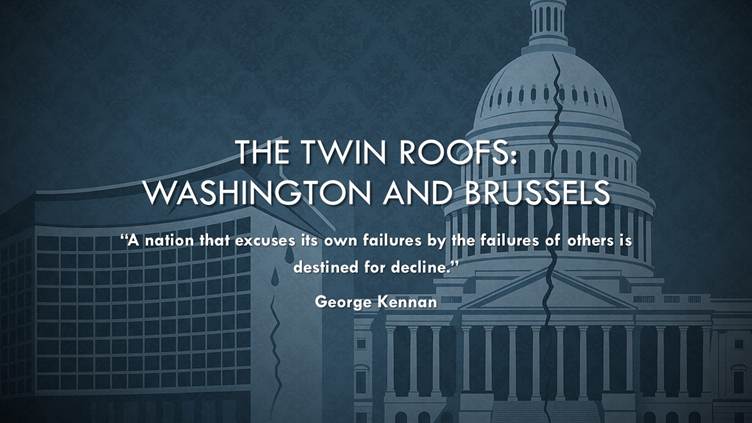
There are mornings when one looks at the world with a touch of cynicism — perhaps induced by too much coffee, or by the persistence of human folly. Today is such a morning. I find myself reflecting on a paradox: the more states expand to feel safe, the less coherent their core becomes. And as I once noted, “fear and a lack of respect for what lives beyond our limited horizon” has come to define the world in which we live. Wisdom so often gives way to fear.
After writing about the drifting European tanker, another image appears: the two roofs under which the Western world shelters — Brussels and Washington. One wonders about their decay. When the storm gathers — and it will — leaks become floods. The roofs must either be repaired or rebuilt. This does not mean abandoning the underlying structures, but rediscovering the spirit that created them: courage, imagination, and moral clarity.
I. Two Roofs, Two Types of Trouble
The European Union and the United States share a belief in freedom, dignity, and justice. Yet their leaking roofs resemble each other only superficially.
Brussels leaks because the structure is unfinished — a political house built by half-measures, moral compromises, and institutions trapped between national sovereignty and supranational necessity.
Washington leaks because the foundations are cracking — deep fractures running through society, politics, and the constitutional order.
One suffers from drifting stagnation.
The other from structural fracture.
Two roofs, two crises — and one West increasingly exposed to the storms of the 21st century.
II. Brussels: A Damp House That Refuses Renovation
The European project began as an act of imagination. Born from the ruins of war, it aimed not merely to secure peace, but to make peace permanent. That moral vision gave the Union its early vitality. But where once stood visionaries — Roosevelt, Adenauer, Monnet, Kennedy — today stand managers of crisis. Western politics has lost the capacity to look beyond the next election, summit, or news cycle.
Over time, vision hardened into procedure. Bureaucracy replaced imagination; process replaced conviction. Enlargement continues because it must; integration stalls because it can; reform remains a word everyone praises but no one defines.
Europe has become a massive tanker drifting in fog, unable to change direction, slowly gathering rust. Its roof leaks, its rooms are damp, and familiar ghosts — nationalism, resentment, the mirage of restored sovereignty — wander once more through the corridors.
For years Brussels has preached values while compromising with those who violate them. The Juncker era illustrated this clearly; the present one continues the pattern. To stay in power, coalitions are formed with actors who erode the very foundations they are charged to defend.
Europe’s tragedy is not weakness but hesitation. The EU knows what it must do — consolidate, reform its governance, invest in defence, build resilience — yet it moves with the speed of a frightened cat rather than a continental power.
And yet, it must be said: Europe’s problems are serious, but manageable — if its political class finds the courage it lacks.
III. Washington: A House on the Hill with Cracking Foundations
Across the Atlantic, the roof leaks for different reasons, and American politics increasingly resembles the theatre of the absurd. The United States appears to be mirroring the long decline of the Roman Republic — from Marius to Caesar — where decay was a process, not a singular event.
The erosion of the Constitution, civil rights, voting rights, and the widening economic divide has pushed the country towards oligarchy. Ownership concentrates, influence follows, and money has become the bloodstream of Washington politics. The social safety net frays, trust in institutions evaporates, and the house on the hill is splitting at its base.
The fractures run both vertically and horizontally:
- between rich and poor
- between educated and uneducated
- between racial communities
- between urban and rural
- between the Constitution’s 18th-century logic and the realities of a digital age
Trump is not the cause but the symptom.
Pat Buchanan’s 1991 resurrection of “America First” laid the groundwork for Trumpism, channelling economic despair, cultural anxiety, and anti-globalist sentiment. If Trump had not emerged, someone else would have. Buchanan, Gingrich, the Tea Party — the lineage of American nativism is long and predictable. Trump merely gave it a voice so loud, so abrasive, and so theatrical that many mistook him for the root rather than the fruit.
He is the fever, not the infection.
After Clinton, the house was still sound.
After Bush the Younger, moral capital was squandered.
Brzezinski was right to warn of Manichaean paranoia — the belief that America embodied the forces of good fighting evil, thus justifying questionable acts.
Such hubris is expensive.
It cost the United States its legitimacy, its credibility, and the respect its power once commanded.
The compass has been spinning ever since.
IV. The Buffer Instinct and the Flight Forward
History teaches that international relations are fluid and anarchic. Nations act according to their interests — infinite, shifting, and rarely sentimental. Great powers protect themselves with buffers:
- Russia with its satellites
- China with its spheres
- America with its hemisphere
- Europe with its rings of stabilization
This instinct is not ideological; it is structural. When nations feel insecure, they expand outward to protect inward weaknesses.
What we call “strategy” is often merely a sophisticated name for fear.
The flight forward — the belief that one can secure oneself by projecting outward — is as old as recorded history.
V. Europe’s Co-dependence: Rolling the Dice on Washington
For decades the environment was stable. Washington provided the strategy; Brussels provided the legitimacy. America led, Europe followed — sometimes reluctantly, often gratefully. Europe lived cheaply under the American umbrella. But the world that sustained this arrangement has changed.
Today’s geopolitical landscape — multipolar, fractured, less forgiving — demands adaptability. Yet both roofs leak because both were built for another climate. The United States can no longer sustain global primacy without partners; the European Union cannot act as a true partner without American approval.
Dependence became inertia.
Inertia became quiet resignation.
Europe clung to the illusion that the U.S. would continually correct itself.
After Bush, Europe waited.
After Trump, Europe prayed.
After Biden, Europe dreamed.
Europe gambled on a stability it neither controlled nor truly understood.
Merkel saw more clearly than most. Old alliances, she warned, could no longer be relied upon. Yet Brussels and many member states behaved like ostriches, burying their heads in the sand while pretending that Biden’s victory restored the world of yesterday.
Then came 2024 — and the dice rolled against Europe yet again.
No Fortune 500 company would survive being run this way.
Europe has survived through inertia and luck — and luck, as the Romans knew, is never permanent.
VI. Closing: The Rule of Self-Interest
I may be wrong. I hope I am wrong. I expect no applause for these observations, nor do I need any. I am old enough simply to say what I see.
Nations follow one rule:
the rule of self-interest.
The West forgot this.
China did not.
Russia never did.
America is rediscovering it brutally.
Europe pretends it is above such things — and pays the price.
Cicero saw the pattern long ago:
“All the money of all nations is in the hands of a few men, and none of these robbers conceals what he is doing.”
And Brzezinski’s warning still hangs over Washington:
“When power is masked as moral superiority, catastrophe follows.”
If the twin roofs of Brussels and Washington are to endure, they must be repaired not with nostalgia, but with realism — and with the courage to rebuild their houses before the foundations fail.
William J J Houtzager, Aka WJJH, November 2025
📌Blog Excerpt
The Western world lives under two leaking roofs: Brussels and Washington. Each creaks, but for different reasons. Brussels suffers from stagnation and hesitation; Washington from internal fracture and moral exhaustion. Europe kept rolling the dice on American stability — and lost. The United States mistook power for moral certainty — and paid the price. If the West is to endure, both roofs must be repaired not with nostalgia, but with realism.
The West shelters under two leaking roofs: Brussels, weakened by hesitation, and Washington, cracked by internal division. Europe gambled on American stability; America gambled on its own moral exceptionalism. Both lost. Only realism — not nostalgia — can strengthen the foundations before the next storm arrives.
 In what kind of world do we wish to live