Brexit: A Fata Morgana Revisited
✍️ Author’s Note
`“What was the purpose of this all?”
A question that haunts the corridors of Westminster—and European minds alike—nearly a decade after the UK’s grand leap into the unknown.
When I first wrote Brexit: A Case of Temporary Insanity, I held a fragile hope that our British friends would awaken from their self-inflicted delusion. That the spell of slogans, myths, and Murdoch headlines would wear off, and wisdom would return. But hope, as Camus might say, is sometimes just another form of resignation.
It is now time to assess the wreckage.
The Myth of British Exceptionalism
The forces that led to Brexit were not simply about fish quotas or bendy bananas. They were driven by the persistent myth of British exceptionalism—a notion that Britain is too grand, too sovereign, too “special” to be shackled by the rule-bound pragmatism of Brussels. Like Russia’s uneasy tango with Europe, Britain has always been part of our European home—but emotionally aloof, like a guest who never quite unpacks.
Until the Reformation, Britain was more integrated with Europe than it is today. But history has a way of repeating itself—first as tragedy, then as farce. Brexit was both.
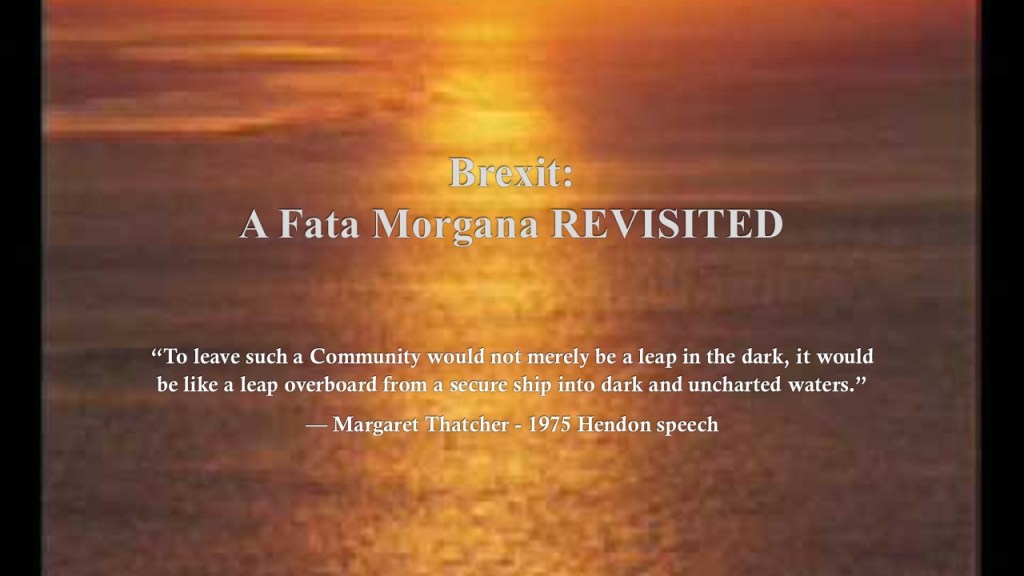
A Leap Overboard
Margaret Thatcher, in her 1975 Hendon speech, put it plainly:
“To leave such a Community would not merely be a leap in the dark, it would be like a leap overboard from a secure ship into dark and uncharted waters.”
And so it was. A referendum sold on lies, wrapped in nostalgic imperial banners, and driven by the fantasy that sovereignty equals supremacy. That by cutting the cord, Britannia would once again rule the waves. Instead, it drifted rudderless.
Reasonable voices like Dominic Grieve and Lord Heseltine warned against this delusion. But reason, sadly, was not on the ballot.
Forty Years of Marriage—Half in, Half Out
The 40+ year marriage between Britain and the EU was never particularly romantic. Successive British governments—from Thatcher to Cameron—excelled at opting out, stalling integration, and waving a reluctant Union Jack from the sidelines. And the EU, ever tolerant and spineless, allowed it. Opt-outs, rebates, and exemptions were granted in the name of “unity,” all the while sowing the seeds of division.
The Real Architects of Brexit
Let us not forget the ideological poison of nationalism—an ever-reliable fuel for the machinery of self-destruction. Well-funded forces that gave us Trump and Brexit were never interested in reform; they aimed to dismantle liberal institutions entirely. The Murdoch press and the Eurosceptic right were not merely critical of the EU—they were its gravediggers.
The irony, of course, is that both the Conservative Party in Britain and the Republican Party in America have now fallen victim to their own monsters.
Post-Imperial Hangover
Brexit was a mirage. A Fata Morgana shimmering on the horizon of lost grandeur. But reality, like gravity, eventually asserts itself.
The British economy today is over 5% smaller than it would have been. Foreign investment has cooled. Trade has slowed. Energy bills are rising. And the “sunlit uplands” promised by Brexiters? Still shrouded in fog.
The UK has, in effect, reset the clock to the 1970s—a time of economic dysfunction, energy crises, and IMF bailouts. A full circle. Or perhaps a downward spiral.
The Slow Path to Reconciliation
And yet, even amid the debris, something stirs. The recent EU-UK summit marked a modest turning point. Both sides signalled a desire to reset the relationship—not out of love, but necessity. A Security and Defence Partnership, energy cooperation, and even agreement on fisheries show the beginnings of a thaw.
In our globalised world of geopolitical blocs and rising authoritarianism, it is cold outside. And even the most stubborn island nation cannot weather the storm alone.
Conclusion: What Was the Purpose of This All?
To ask the question is to reveal the absurdity of it all. Brexit did not restore British greatness; it revealed its fragility. It did not empower the people; it empowered populists. It did not increase sovereignty; it diluted relevance.
Perhaps the only thing Brexit succeeded in doing was to teach a lesson. One paid for, as always, by those least able to afford it.
And so, we are left with a paradox. Britain remains close, yet distant. A part of Europe’s geography, but not of its project. Important, but peripheral. Bound to us by history—and separated by fantasy.
It may take another generation to undo the damage. But for now, the rest of us must move on, wiser, warier—and hopefully still united.
Netherlands, William J J Houtzager, Aka WJJH, December 2025
📌Blog Preview
This reflection revisits the self-inflicted delusion, based on slogans, myths, and the and Murdoch headlines. Ten years after Brexit, the promised sunlit uplands are still under construction, and Britain’s global ambition has turned into an expensive solo act. The question remains unanswered, what was the purpose of it all.
 In what kind of world do we wish to live