Rising From the Table of Life
Reflections on Love, Loss, and Mortality
✍️ Author’s Note
This reflection on my younger brother Felix is written in the spirit of remembrance and philosophical inquiry. It explores how grief sharpens our awareness of impermanence, and how memory—like nature—holds us in quiet continuity. I share these thoughts not only in sorrow, but in gratitude: for a life shared, and for the lessons we continue to learn, even in the winter of our years.
The Winter of Our Years
I write this reflection with the awareness that decay and impermanence are inescapable elements of our existence—truths we often ignore as we move through life as though we were eternal. Yet as I look back on the seasons of my own life, I find myself firmly in the final one—the winter of my years—where the unpredictability and inevitability of life’s end can no longer be denied.
At this stage, it becomes easier to think, write, and speak about fragility, to quietly accept the ancient truth: what is born must die. This was brought home to me decades ago by Sri Nisargadatta Maharaj in I Am That. His simple phrasing contains the profound reality not only of individual lives but of entire civilizations. The forces of creation and destruction are always at work, pulsing like a vast diastole and systole—life’s universal rhythm.
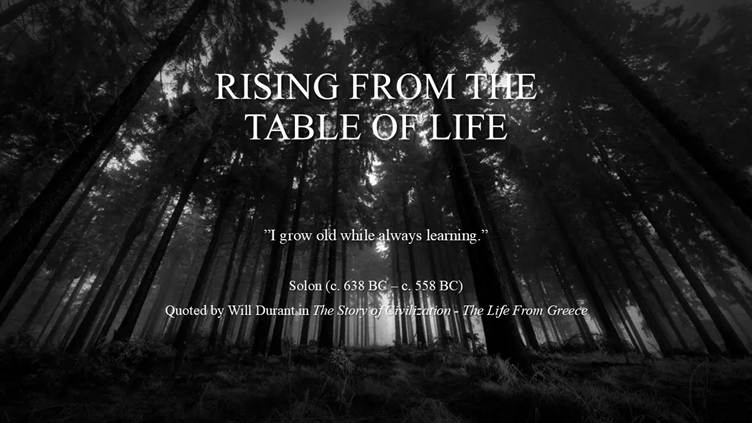
Solon, the Athenian statesman and one of the Seven Wise Men of Greece, said: “I grow old while always learning.” What, then, should we learn when we enter life’s final chapter—when the days grow longer, the nights shorter, and each sunrise might be our last?
What did I learn when my brother passed away? His departure, far too early, felt as though a healthy branch had been torn from the tree of life. What do any of us learn when those dearest to us complete their journey? Perhaps this: that with time comes understanding, and with understanding, acceptance. Grief overwhelms us at first—it is part of our shared humanity—but gradually, we learn to step back, reflect, seek balance—and to look upon memory not with sorrow, but with gratitude.
I imagine him now, watching me tend my balcony garden, that familiar sardonic smile on his face. Gardening was never quite my domain—that passion belonged to my mother, my father, my brother, and the gardener who prepared our garden each spring and autumn. I admired their work more than I participated in it, and our parents allowed us the freedom to follow our interests.
Yet despite our philosophies and preparations, we are never truly ready for the final parting. Impermanence remains a mystery; though we ponder it, most of us are occupied with living. But there comes a moment when we ask what the final farewell might feel like.
One day, sooner or later—suddenly or gradually—my own time will come. When that moment arrives, I hope to leave the table of life with grace. Like a grateful guest rising from a long and abundant meal shared with thoughtful companions—after the dessert has been served and the wine and port (or, better yet, a fine Hennessy X.O.) enjoyed—I will bow out. And I will return to nature with the awareness that, in the words of Ludwig Friedländer, as quoted by Will Durant:
“Life is only lent to man; he cannot keep it forever.
By his death, he pays his debt to Nature.”
When a Light Goes Out
The passing of my brother happened unexpectedly—one day before his 72nd birthday. At 71, Felix was vibrant and curious, playing chess and Go, studying Chinese language, culture, and history, reading voraciously, and writing with quiet discipline. His life was defined by movement, discovery, an intimate relationship with nature, and a thoughtful embrace of life’s many hues. On his daily walks, he found peace in nature, which he saw as both teacher and witness. “Nature has us all on trial,” he would often say.
Nothing suggested that Christmas Day of 2024 would be our last together. It was a day of quiet joy—long conversations, laughter, wine, and a final bottle of Gevrey-Chambertin 2018 with dinner. As usual, we ended with a glass of Hennessy X.O., our ritual of continuity.
We spoke of the world’s troubles—polarisation, populism, the strange human need to see one’s ideas reflected in others. He was concerned, as I was, by American fantasies like Manifest Destiny and the creeping return of McCarthyism. Europe, too, was vulnerable to those same winds. History, we agreed, has its rhythms—and fascism always returns in disguise.
That evening is now a tender reminder to cherish the present. It called forth memories of our childhood in Soest, the quiet lanes, the warmth of our parents, the long family dinners and glowing Christmases, and our Sunday walks through the Pijnenburg estate—an oasis of green beloved by us both.
A small contribution was recently made in his name: young oak and lime trees planted in the forests of Lage Vuursche. A final gift to the nature he loved, forming a living legacy.
We often visited the Spiehuis, a restaurant at the edge of the woods that closed its doors this year. I remember how our father carried Felix on his shoulders on the walk home. Later, the Spiehuis became the setting for my first romantic evening with a dear lady who remains woven into my memory, as I once wrote in Daffodils and Butterflies. These recollections, untouched by today’s turbulence, returned to me with vivid warmth.
We had spoken often of life’s end, always with realism. We assumed I would leave first. He was reading Will Durant’s Fallen Leaves—fittingly, a book of reflections on love, life, and mortality.
Then came December 27. After a long morning walk, he was hospitalised at the Meander Hospital in Amersfoort, close to where we had grown up. The care was kind and professional, yet moments like these strip life to its essentials. Realism set in: we are not in control. All we can do is respond with dignity.
Yet nothing prepares us for the emotional storm—fear, despair, fleeting hope. In those moments, I thought of Dylan Thomas:
“Do not go gentle into that good night…
Rage, rage against the dying of the light.”
Hope flickered, then faded.
I accepted that he would not wake again, would not see another sunrise.
In his final hours, I sat beside him as he passed quietly into the eternal night—in what Cicero called securitas and facilitas, peace and ease. Doubts lingered—did I say enough? Did I do enough?—but regrets, even unfounded, are part of love.
I was reminded of Shams Tabrizi’s words:
“Try to find if you’ve lost, apologize if you’ve hurt, forgive if you have been hurt.”
In the end, we said our farewells at our family grave in Hilversum, on a quiet winter day as the sun slipped beneath the horizon. I closed with Shakespeare’s lines:
“There will be no more glorious mornings to see,
To flatter the mountain tops with sovereign eye…”
The Quiet Continuation — Memory, Meaning, and Mortality
Now, when I think of my brother, I descend into the rich landscape of memory—a place of questions without answers. I reflect on our shared humanity, our joys and losses, and I feel deeply grateful. His presence remains with me.
He lived with courage, kindness, and quiet grace, finding rhythm and renewal in nature—especially the Pijnenburg woods, where sunrise held special meaning. Though we differed in temperament—I was drawn to risks, he to stability—we were bound by affection and loyalty. When I returned from abroad in a troubled state, he was waiting at the airport, as always.
We were raised that way—on a quiet lane in Soest, embraced by nature and loving parents who taught us the importance of caring for one another. In today’s individualistic world, that sense of kinship is no longer universal.
With age, we watch more people rise from the table of life. Each departure leaves an emptiness. What do we learn from their passing?
When my father died in 1996, I accepted the reality of death—and my own mortality. New Year’s lost its celebration then. When my mother died in 1998, another chapter closed. What remains is memory: their love, their generosity, their wisdom.
Since then, the seasons have turned many times. Tragedy shifts perspective—what once seemed vital loses urgency; what was taken for granted becomes sacred. The sunlight of spring and warmth of summer have brought healing. In this clearer light, a dear friend of my brother reminded me of Henry Scott Holland’s All Is Well. As she suggested, I listened to Brahms’s Ein Deutsches Requiem, Haitink conducting, a glass of wine in hand. It was transcendent and grounding. Whatever we believe of life and death, memory remains—and so does he.
In the aftermath, we sort the details: iPhone, notebooks, accounts, tax returns. A gentle voyeurism, stepping into the intimate corners of a life now just out of reach. Closing an account feels final. Because it is.
And yet, I’ve found peace. At the table of life, I notice empty chairs—each year, fewer of us remain. This is the nature of being an octogenarian.
I reflect on what I will leave behind. I have begun a quiet “spring cleaning”: deciding what matters and what can be let go. Letters, Hermès ties, my grandfather’s butterflies, my mother’s violin, books, paintings—what will speak for us, and what will fade?
Returning to Plato’s Phaedo, I find comfort in Socrates: death is a release. Cicero, Montaigne, Spinoza all say: “To study philosophy is to learn how to die.” Cicero adds: “with security and ease.”
Epicurus said:
“Death… is nothing to us;
for when we exist, death is not present,
and when death is present, we do not exist.”
Spinoza assures that the soul dies with the body; we return to nature. I find peace in that.
And so my time will come. I do not hasten it, but I know it will arrive when the light begins to fade. I hope to leave the table as a grateful guest. When dessert has been served and the wine—yes, the Hennessy X.O.—has been enjoyed, I will rise from a long and satisfying dinner, among companions who made the journey worthwhile.
With a nod, I will enter that final sleep—a sleep that ends all dreams. I will return to the nature I have always loved, not with fear, but with calm understanding: I lived the life I could. It was imperfect, but it was mine. And that is enough.
Epilogue: A Quiet Grace
Grief does not end; it changes shape. In time, sorrow softens into remembrance, and memory becomes a quiet companion. What once brought tears now brings a smile, a pause, a whisper of gratitude. My brother lives on—not in some distant realm, but in the turning of the seasons, in the morning light, in the moments that shaped us both.
In the end, we do not leave behind perfection. We leave presence—gestures of care, the warmth of a voice once heard, a chair once filled, a walk once shared. These are the traces that endure. And we continue, until we too rise from the table of life—
With peace.
With thanks.
With grace.
William J J Houtzager, Aka WJJH, January 7th, 2026
📌Blog Excerpt
A meditation on love, loss, and the quiet rhythm of mortality. In this deeply personal reflection, I look back on my brother’s final days, the enduring strength of memory, and the lessons found in philosophy, nature, and the late seasons of life. A tribute not of sorrow, but of gratitude—and of rising, with grace, from the table of life.
 In what kind of world do we wish to live