The Netherlands on February 1, 1953
✍️ Author’s Note
This reflection was inspired by a personal memory of the 1953 North Sea flood — a day that left an indelible mark on my childhood and on the Netherlands itself. It is a meditation on our centuries-long struggle with the sea, from medieval floods that reshaped our map to the engineering triumphs of the Delta Works, and the looming challenge of climate change. Beneath the history and technology lies something deeper: a story of identity, resilience, and our fragile balance with nature’s power.
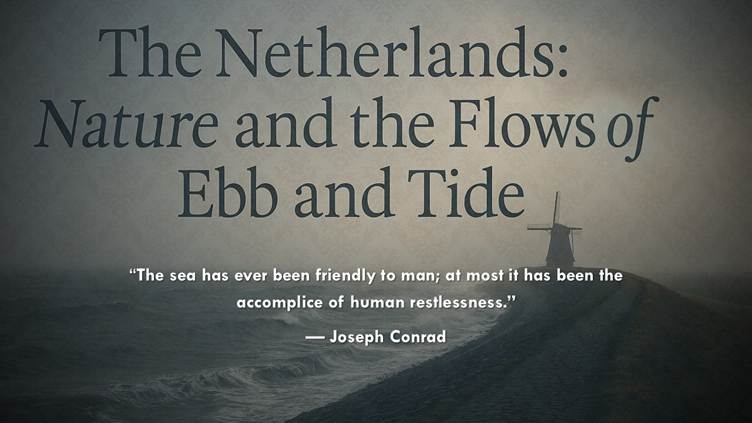
Nature is unpredictable. Joseph Conrad once observed, “The sea has ever been friendly to man; at most it has been the accomplice of human restlessness.” This captures the paradox of our relationship with the vast, unforgiving waters that surround us: the sea is both a companion in our pursuit of knowledge and adventure, and an ever-present danger demanding caution and respect.
Living in the Lowlands of the Netherlands — one of the most densely populated regions in the world, where roughly 60% of the population is vulnerable to flooding — this undertone of danger is never far away. The threat is magnified by climate change, yet our actions too often fall short of our words. By the 1950s, scientists already knew that the climate had been warming for more than a century, melting glaciers and altering sea levels. But such concerns had yet to enter the public debate.
Our history has been one long struggle against the elements. About a quarter of the country lies below sea level, another half sits less than a meter above it, and two-thirds of our land is at risk of flooding. Farmers built the first dikes, windmills pumped water from the land as early as the 14th century, and in the 17th century, entire polders were drained. Parts of Amsterdam are below sea level — Schiphol Airport, once the bottom of Haarlem Lake, lies more than four meters beneath it.
A Morning in 1953
I was nine years old on the Sunday morning of February 1, 1953. The night before, a strong storm had blown in from the northwest — nothing unusual for the season. But by morning, the news was clear: disaster had struck.
A force 12 north-westerly windstorm had combined with high spring tides and a deep low-pressure system. In Zeeland, the sea overwhelmed the dikes, flooding vast areas, destroying homes, and taking lives. More than 1,800 people died, 70,000 were displaced, and 2,070 km² of land was submerged. Helicopters rescued people from rooftops.
It was not the first time, and history tells us it will not be the last. Since the year 1200, over a hundred storm-surge disasters have struck the Dutch coast, averaging fifteen to twenty per century. Zeeland, in particular, has suffered repeatedly: the loss of parts of Goeree in the 17th century, the 1715 storm surge, the 1808 flooding of 130 polders, and another in 1906.
A storm tide is among the most dangerous events in the North Sea. When cyclone winds and tides combine, the results can be catastrophic. That night in 1953, sea levels rose up to five meters above normal. I remember studying maps in my father’s office, tracing the spread of the water, and talking with him about what this meant for our country’s future.
A Long Memory of Water
The Netherlands has faced such disasters for centuries. The St. Lucia’s Flood of 1287 killed between 50,000 and 80,000 people in the Netherlands and northern Germany, reshaping the coastline entirely. It created the Zuiderzee, a saltwater inlet reaching 100 km inland, which altered trade routes and elevated Amsterdam to prominence.
Our battle with water has also led to great engineering achievements. The Zuiderzee was finally tamed in 1932, when the Afsluitdijk closed it off, creating the IJsselmeer. This allowed large tracts of land to be reclaimed, forming today’s province of Flevoland.
From Disaster to Defence
The 1953 flood was a turning point. Within weeks, the Delta Committee was formed to devise a new national defence. The result was the Delta Works — thirteen interconnected projects of dams, sluices, locks, dikes, levees, and storm-surge barriers. The most famous, the Eastern Scheldt Barrier, is a 9-kilometre movable dam that closes only during extreme conditions, preserving the tidal ecosystem while protecting human life. When Queen Beatrix opened it in 1986, she declared: “The Delta Works are completed. Zeeland is safe.”
But safety is never absolute. Rising seas and sinking land are slow-moving threats. In some areas, such as Gouda, the ground sinks three millimetres a year. Sea levels, which rose 12–20 cm between 1902 and 2010, are now rising twice as fast — 4–5 mm annually — and accelerating.
The Maeslantkering near Rotterdam, completed in 1997, was built to defend South Holland against such risks. Yet the Royal Netherlands Meteorological Institute (KNMI) warns that by 2100, sea levels could rise between 54 and 121 cm in the worst case — far beyond what our current defences were designed for.
The Uncomfortable Truth
The Dutch government says our defences are sufficient until 2050, but this is short-term thinking. The Urgenda Foundation’s landmark lawsuit against the state, upheld by the Supreme Court in 2019, established that failing to cut emissions violates citizens’ human rights. It inspired similar cases worldwide, highlighting the link between environmental policy and justice.
For every degree Celsius of global warming, the atmosphere holds 7% more water vapor, intensifying storms and rainfall. Warmer air carries tropical moisture farther north, bringing heavier rains to regions like ours. Fossil fuel pollution is amplifying these risks, creating conditions that no system — however advanced — can fully control.
The Netherlands has exported its water-management expertise to China, Africa, and Australia. Yet we may be fighting a losing battle at home. Over centuries we have learned to live with the ebb and flow, but climate change may tip the balance in favour of the sea. The lesson of 1953 still stands: the water will always return. Our task is to stay ahead of it — not just for the next storm, but for the centuries to come.
Netherlands, William J J Houtzager, Aka WJJH, January 2026
📌 Blog Excerpt
On the morning of February 1, 1953, I came down to breakfast to find the world changed. Overnight, the sea had broken through Zeeland’s defences, leaving thousands homeless and over 1,800 dead. Since that day, I have understood something essential: in the Netherlands, the sea is never truly defeated — it is only held at bay. Our history is written between the ebb and the tide, between the moments of calm and the nights when the water returns to remind us who really shapes the land.
 In what kind of world do we wish to live