Madmen and Fools: Flaubert, Gogol, Nietzsche, and the Noise of Our Time
There are moments when literature becomes a mirror, held up not to the past but to ourselves. This reflection is one of those moments — a conversation across centuries about madness, folly, and the fragile art of staying sane in a world that no longer tolerates silence.
✍️ Author’s Note
This essay began with a simple morning gesture: taking Flaubert’s Memoirs of a Madman from my bookshelf. What followed was not a quiet rereading, but an unexpected conversation across time. Flaubert was joined — as these things happen — by Gogol, Nietzsche, and Erasmus, each with their own reflections on madness, folly, and the inner life.
What struck me most was how modern their concerns feel. Today we inhabit an age of acceleration and noise, where interior life has become endangered, ambiguity is suspect, and solitude nearly impossible. The madmen of literature and the fools of philosophy became mirrors through which to observe our own digital world — one shaped by endless reaction, performative identity, and a troubling lack of silence.
This essay is not a lament, but an attempt at understanding. It is an invitation to reflect on how we might reclaim what Flaubert and Nietzsche understood so deeply: the value of standing apart, of thinking without haste, of resisting the easy certainties of the crowd.
A reminder that clarity rarely emerges from belonging — and that sanity often begins in silence.
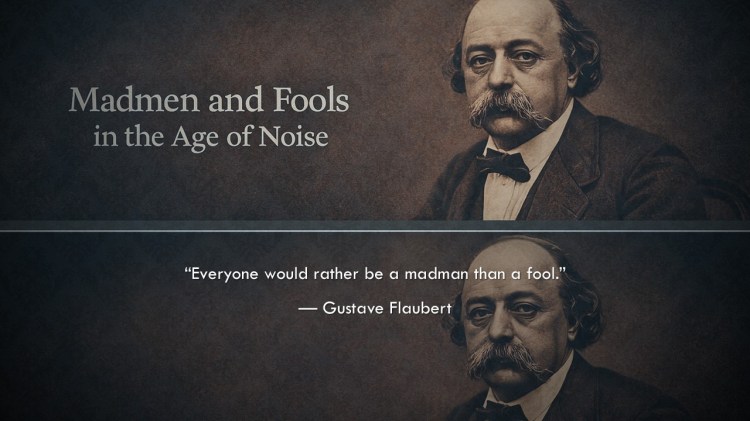
There are books that linger on a shelf and books that linger in one’s mind.
On a quiet morning not long ago, I pulled from my bookcase a small, yellowed volume: Memoirs of a Madman, written by Gustave Flaubert in his late teens. Long before Madame Bovary made him infamous, long before he became the precision-obsessed anatomist of human folly, Flaubert had already glimpsed the contours of madness, longing, and the fragile interior life.
Next to it stands Gogol’s Diary of a Madman, a work I first encountered as a play in my early twenties — an encounter that deepened my fascination with the Russian library my father kept so carefully. Where Flaubert offers introspective lyricism, Gogol offers satirical dislocation: a minor clerk crushed by hierarchy, slipping into delusion to escape an unbearable insignificance.
Different cultures, different prose, different temperaments — but both writers understood a simple truth:
Every age produces its own madness, and every society cultivates its own fools.
Today, in an era of digital cacophony, their insights feel eerily prophetic.
I. The Haunted Observers
The “madman” of Flaubert’s youthful imagination is not insane but exiled — a sensitive soul hovering between yearning and futility, watching life through a window that never opens. Gogol’s clerk, Poprishchin, grasps for dignity in a world that grants none, until reality fractures beneath the weight of his desire.
Neither figure is a monster.
Both are symptoms of their time.
Rereading these early works, one sees the essential Flaubert forming: the writer who fused moral ambiguity, moral critique, and lyrical prose into a single, unsettling vision.
- Moral ambiguity: people are enigmas, not lessons.
- Moral critique: he despised the herd, the cliché, the unexamined opinion.
- Lyrical prose: his sentences carve despair into beauty.
Flaubert understood that truth lives not in certainty but in the shifting tensions between hope, vanity, fear, and desire. It is precisely this sensitivity that makes him so contemporary.
II. Madmen, Fools, and the Age That Breeds Them
Sartre, in The Family Idiot, described young Flaubert as a child caught between the surgical precision of his father and the depressive withdrawal of his mother. “Idiocy,” Sartre suggested, was a form of resistance: a quiet refusal to play a role in a world that misunderstood him.
Perhaps. But one need not accept Sartre’s diagnosis to see its deeper truth:
some temperaments are shaped by dissonance, and dissonance, when unrelieved, becomes insight.
The child who does not fit the world becomes the adult who sees through it.
Flaubert and Gogol lived in an age of dramatic transformation — industrialization, bourgeois expansion, bureaucratic suffocation. Their madmen were early warnings of a civilization accelerating faster than the human spirit could adapt.
Ours is not so different.
The forces have changed, not the fractures.
We now live under:
- the tyranny of visibility,
- the dictatorship of acceleration,
- the economy of attention,
- the cult of immediacy.
Where Flaubert’s madman turned inward, today’s madman turns outward — compelled to react, perform, and be seen.
The madness of our time is not melancholy but velocity.
Not loneliness, but overexposure.
Not interiority, but performance.
We have built a world in which both madmen and fools thrive — and often they are the same person.
III. Flaubert and the Madness of Our Time
Flaubert’s great enemy was la bêtise — not stupidity as such, but the stubborn refusal to think, the surrender to borrowed opinions, the eagerness to replace complexity with slogan.
He would recognize our age instantly.
The Triumph of Noise Over Thought
We live in a civilization where communication has replaced understanding, expression has displaced reflection, and opinion has eclipsed truth. Noise travels faster than thought; the algorithm rewards the shrill, the simplistic, and the indignant.
Flaubert’s “mania for opinion” has been mechanized.
La bêtise now travels at fibre-optic speed.
Outrage as Identity
For many today, identity emerges not from inner life but from outer combat. The self becomes a choreography of grievances, assembled for display. Outrage provides belonging; anger provides meaning.
Gogol’s clerk sought escape in delusion.
Our avatars seek escape in conflict.
The Collapse of Ambiguity
Flaubert’s realism forced readers to inhabit ambiguity.
Our age demands immediate verdicts.
Ambiguity is betrayal.
Complexity, elitism.
Reflection, hesitation.
The fool thrives because he answers quickly.
The madman thrives because he shouts loudly.
The reflective mind suffocates.
The Erosion of the Interior Life
For Flaubert, interiority was everything.
For us, it is nearly extinct.
Notifications colonize attention.
Distraction devours meaning.
Performance replaces introspection.
Our madness is quiet, pervasive, exhausting — a condition of perpetual stimulation and profound hollowness.
IV. What Would Flaubert Say?
If Voltaire would laugh at us, Flaubert would wince.
But Nietzsche — Nietzsche would nod.
Nietzsche warned of the herd, of the flattening of the spirit, of the danger of becoming “the last men,” blinking contentedly while their souls atrophy. Flaubert warned of the same phenomenon in a different register: the victory of conformity over consciousness.
For Nietzsche, the great enemy was ressentiment.
For Flaubert, it was bêtise.
Different words, same diagnosis.
On the Internet
Flaubert would see social media as the mass-production of fools.
Nietzsche would see the triumph of herd instinct.
On Politics
Flaubert would disdain all factions.
Nietzsche would diagnose them as competing moralities of weakness.
On Culture
Flaubert would mourn the death of style.
Nietzsche would mourn the death of depth.
On Artificial Intelligence
Flaubert would fear the end of slow thought.
Nietzsche would fear the end of the self.
Both would say that the danger is not the machine but the shallow soul using it.
Nietzsche asked:
“How much truth can a spirit bear?”
Flaubert answered:
“Not very much, unless it has learned to be alone.”
V. Solitude and Sanity: The Art of Being Alone Without Becoming Lost
In the end, Flaubert offers not only critique but a way of being.
Solitude was not escapism; it was honesty. Silence was not emptiness; it was oxygen.
Today, silence is treated as a void to be filled.
We are urged to share before we understand, belong before we reflect, respond before we think.
In such a world, the capacity to be alone becomes an act of quiet defiance.
To be alone well — to be alone without collapsing into isolation or delusion — requires courage and discipline:
- the refusal to be swept into agitation,
- the patience to let thought ripen,
- the willingness to confront one’s own illusions,
- the humility to accept ambiguity.
Solitude is the workshop of clarity.
It is where sensitivity becomes insight rather than burden.
It is where the self becomes more than a reaction.
In a world addicted to noise, solitude is resistance.
Epilogue — The Eternal Return of Folly
Flaubert, Gogol, Nietzsche, and Erasmus — four temperaments separated by centuries, yet united by the understanding that folly is a constant of the human condition. It merely changes masks.
Erasmus saw folly in the courts and churches of Europe.
Gogol saw it in the bureaucracies of the Tsar.
Nietzsche saw it in herd morals and shrinking spirits.
Flaubert saw it in bourgeois complacency and intellectual laziness.
And we?
We live in a world where folly now wears digital masks — where perception overwhelms truth and where society increasingly behaves like a zero-sum game.
Nietzsche wrote:
“There are no facts, only interpretation.”
Flaubert added:
“There is no truth. There is only perception.”
Neither dismissed truth.
Both understood its fragility.
Which is why Flaubert’s furious line still pierces the air like a warning flare:
“So when will this society, bastardised by every debauchery of mind, body and soul, finally come to an end?”
He wrote it in disgust at his own century, yet it speaks effortlessly to ours.
But folly has never ended — and perhaps it never will.
The question is not whether madness persists, but how we meet it.
Those who can be alone without being lost
— who can think without shouting, doubt without collapsing, and see without submitting —
remain the fragile guardians of sanity.
Flaubert chose solitude.
Nietzsche chose solitude.
Gogol fled from it.
Erasmus laughed at it.
We, living in an age that fears silence, must rediscover it —
not as escape, but as the last sanctuary where clarity survives.
William J J Houtzager, Aka WJJH, March, 2026
📌Blog Excerpt
Drawing on Flaubert’s early Memoirs of a Madman, Gogol’s satirical clerk, Nietzsche’s critique of the herd, and Erasmus’ Praise of Folly, this essay explores how every age produces its own forms of madness — and why ours is defined by speed, noise, and the collapse of interior life. From social media’s manufactured outrage to the triumph of perception over truth, we confront a world where folly thrives behind digital masks. Yet the antidote remains what Flaubert and Nietzsche understood: solitude, depth, ambiguity, and the courage to think without belonging. A meditation on madness, sanity, and the fragile art of being alone.
 In what kind of world do we wish to live